
Quick answer: A battery storage commissioning checklist should track qualified test ownership, approved results, open defects, utility permissions and handover records. Administrative follow-up can collect the status of each item, but cannot certify a battery system as safe or authorise energisation.
A battery storage project may look physically complete while its commissioning file is still missing critical evidence. The cabinet is installed, the wiring team has departed, and the delivery photographs are filed—but the project manager still needs qualified test results, open-item resolution, utility coordination, training records and a documented handover. That is the gap a battery storage commissioning checklist should close.
Commissioning is not an administrative declaration that equipment is ready. It is a controlled technical process carried out under the applicable design, manufacturer instructions, codes, standards and site requirements. The U.S. Department of Energy’s BESS procurement checklist highlights why technical specifications and interconnection planning belong in the project record. A scheduled status call may help identify who owes a document; it does not replace the expert test or approval.
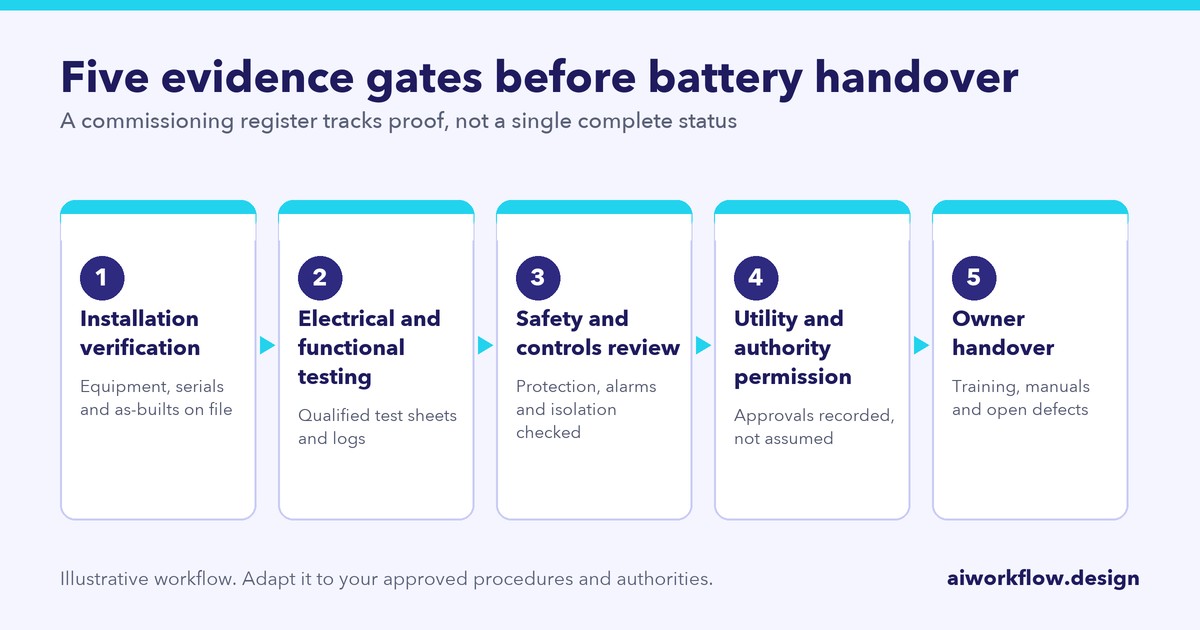
Start with five evidence gates, not a single “complete” status
A useful commissioning register distinguishes installation verification, electrical and functional testing, safety and controls review, interconnection and operating permission, and owner handover. Each gate needs an accountable reviewer and a link to its authoritative evidence. For example, “inverter settings report received” is an administrative fact; “settings approved for operation” is a qualified technical decision. Those belong in separate columns.
The precise tests depend on the site, equipment and jurisdiction. They may include protection settings, communication checks, battery-management-system reporting, alarms, emergency stop functions, commissioning logs and manufacturer-specific procedures. The project manager should not invent a universal test list. Instead, attach the engineer-approved commissioning plan and track whether its specified records have been submitted and accepted.
Build the documentation checklist around the responsible parties
Create one record per required deliverable with its document name, site, owner, due date, submitted date, reviewed-by, review result, and evidence location. Typical categories include as-built drawings; equipment serial numbers and warranties; approved operating procedures; commissioned settings; test sheets; fault and alarm logs; training attendance; maintenance instructions; and a current list of outstanding defects. The authorised reviewer should identify which documents are actually required for that project.
Avoid writing sensitive technical findings into a general-purpose call transcript. A caller can ask, “Has the commissioning report been submitted, and who is reviewing it?” It should not ask an electrician to recite live protection settings or passwords. Store the actual technical file in the approved document repository, where the right people can verify versions and permissions.
Use a status call to chase owners, not to clear hazards
A good administrative check-in is short: “Are the agreed test records uploaded? Which document is still outstanding? Who is responsible for the next action? What date can they confirm? Is there a safety, access or authority issue requiring immediate human contact?” A no-answer should remain unconfirmed, not silently become a green status.
If the technician reports a failed test, unexpected heat, an alarm, a damaged enclosure or uncertainty about isolation, the workflow should stop asking routine completion questions and route the concern to the designated safety or commissioning lead. OSHA’s solar lockout/tagout guidance underscores that hazardous energy controls require authorised people and formal procedures. A phone summary cannot show that those controls were implemented.
Separate energisation permission from progress reporting
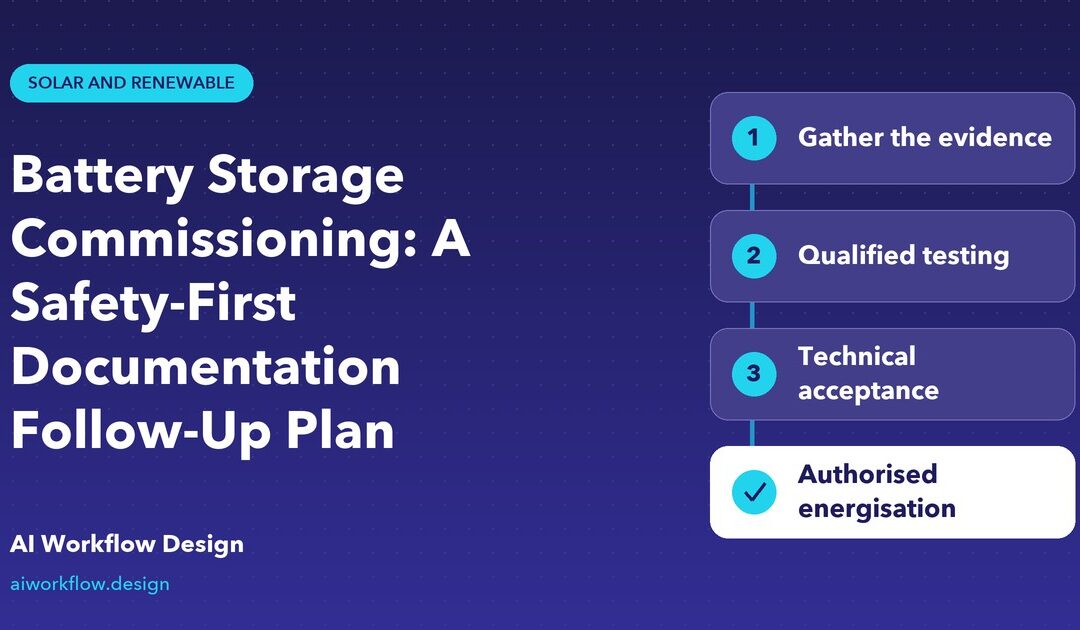
Create at least three distinct states: administrative evidence received, technical acceptance documented, and energisation or operation authorised. These prevent the all-too-common mistake of treating “the contractor says it passed” as a release to operate. Whether utility permission, inspector sign-off or specific engineering authorisation is needed depends on the connection and jurisdiction; the responsible party must verify those requirements.
The DOE’s photovoltaic commissioning guidance emphasises plans, system documentation and testing. For storage coupled with solar, project teams should also confirm that storage-specific commissioning and controls have their own review path, rather than assuming PV acceptance covers the battery system.
Example monday.com board for commissioning follow-up
An illustrative board can use task groups such as “engineering and permits,” “installation evidence,” “qualified testing,” “defect resolution,” and “owner handover.” Suggested columns are site ID; deliverable; discipline; accountable person; evidence link; requested date; reported status; reviewer decision; blocking dependency; and escalation owner. These are recommended board fields, not a claim that Autoza automatically creates them.
Make the mapped updates narrow. For instance, an authorised schedule could record “report uploaded,” “awaiting reviewer,” or “needs project manager call.” It should never convert a verbal “yes” into “commissioning accepted,” “safe to energise,” or “permit issued.” Keep the document of record with the qualified approver and use the project board for visibility.
Plan the handover before the final week
Handover may require operations training, user manuals, emergency contact information, maintenance schedules, performance documentation and a clear description of unresolved items. Confirm who will operate the asset, who can call for technical support and who holds warranty and service responsibilities. A document delivered without an assigned owner can remain effectively lost.
Use milestone-based check-ins: after installation, ahead of formal testing, after test review and before the handover meeting. Where an approval is pending, the right next action is a review or escalation, not repeated automated calls. The solar project handover article provides a complementary approach to final deliverables.
Review the follow-up results against the evidence, not just the response rate
The commissioning coordinator should monitor how many required records arrive before the review meeting, how often versions need correction, which approvals remain genuinely outstanding and whether open issues reach the right professional. A high call-answer rate is not useful if the evidence links still point to draft files or failed tests are mislabeled as complete. Give reviewers the ability to dispute a reported status and show the documented reason. This creates a feedback loop in which reminders lead to better files and fewer unverified assumptions.
Where AI follow-up belongs—and where it ends
Teams already using monday.com can explore Autoza AI for scheduled project check-ins and board updates. The product can support an administrative reporting cadence, subject to the customer’s configured permissions and calling rules. Use only authorised recipients, clear AI-caller identification, approved calling hours and compliant consent practices.
The outcome to aim for is a complete, reviewable evidence trail—not a robot certifying a battery. Start with one active project, identify five documents that regularly hold up handover, and test whether scheduled owner updates surface missing records earlier. Technical commissioning, safety controls and operation authorisation remain with the designated professionals.
Frequently asked questions
Who is authorised to commission a battery system?
The qualified professionals and authorities designated by the applicable installation, electrical, safety and regulatory requirements. A project coordinator or AI caller can monitor documentation status but cannot substitute for their testing, sign-off or authority to energise.
What documentation should be filed?
Follow the approved project-specific commissioning plan. Common categories include drawings, equipment records, qualified test results, protection/control settings records, defect logs, approvals, user training evidence, operation manuals and warranty information.
Does phone confirmation mean a battery system can be energised?
No. A verbal update is not a technical release. The required inspections, test acceptance, isolation controls, utility permissions and authorised operation approvals must be independently verified and documented.
Can monday.com track commissioning blockers?
Yes, a team can design a board for evidence ownership, due dates, submitted documents, review status and escalations. Restricted technical decisions should remain in the formal approval system, even when their high-level status appears in the project board.
When should the project manager escalate a commissioning issue?
Escalate immediately for reported hazards, failed tests, unexplained alarms or unclear isolation; escalate routinely for missing evidence, overdue reviewer decisions or unresolved utility dependencies using the project’s agreed escalation plan.
See the monday.com project follow-up workflow
For scheduled status calls and controlled updates to an existing project board, explore Autoza AI for monday.com. Request a workflow review to confirm call scope, field mappings, consent requirements, limitations and human escalation rules before deployment.
Related reading
- Multi-Site Solar Installs: A Contractor Capacity and Milestone Check-In Plan
- Solar Project Handover: Who Confirms Final Tasks and Documentation?
- Panel and Inverter Deliveries: Follow-Up Calls Before Installation Day
- Solar Plus Battery Design Changes: A Follow-Up Workflow for Scope Revisions
- Failed Solar Inspection: Tracking Corrections and Reinspection Tasks
- Explore workflows by industry
- Autoza AI for monday.com