
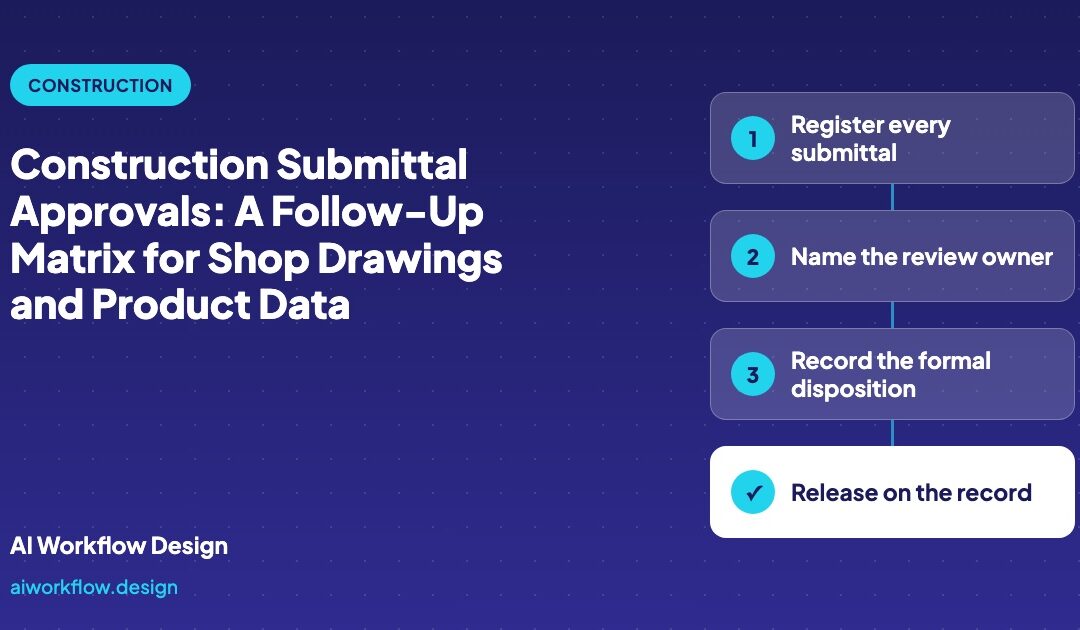
Quick answer: Construction submittal approval tracking works best when every shop drawing, product-data package and sample has a unique register entry, a named review owner, a current revision, a required response date and a clearly documented decision. Scheduled status calls can chase missing inputs and capture blockers, but a phone update must never be confused with a design professional’s formal review response.
Why a submittal can hold up work even when the team is busy
A construction submittal is information passed between project participants so proposed materials, equipment or fabrication details can be reviewed against the contract documents. Shop drawings show how something will be fabricated or installed; product data describes selected components; samples communicate characteristics that specifications may require someone to examine. The AIA Contract Documents guide to submittals explains why requirements and review responsibilities depend on the contract. That makes a generic “awaiting approval” task too vague for a useful project board.
A delay may be caused by an incomplete manufacturer cut sheet, a subcontractor’s old drawing revision, an unanswered design question, or a reviewer who has not received the correct package. These have different owners and remedies. Calling everyone every day does not improve the situation; identifying the next actionable handoff does.
For businesses managing project follow-up in monday.com, the useful distinction is status collection versus formal approval. An AI caller may ask the package coordinator whether a revision has been submitted or whether a response arrived. Only the authorised reviewer and the contract’s established procedure can determine a submittal’s formal disposition.
Build one submittal register rather than several competing lists
Start with one register aligned to the contract specification sections and procurement programme. Give each submittal a stable identifier. Keep fabrication release, procurement deadlines and installation dependencies visible next to review dates. A shared board can serve as the follow-up view, while the controlled document platform retains the actual submitted files and signed reviews.
| Register field | What to capture | Why it matters |
|---|---|---|
| Submittal ID and specification section | Unique identifier, trade and package | Avoids confusion between similar items |
| Description and type | Shop drawing, product data or sample | Sets the expected evidence |
| Current revision | Revision code and submitted date | Prevents decisions based on superseded files |
| Responsible submitter and reviewer | Named roles and contact route | Establishes who must act next |
| Formal disposition | Exact reviewer response from the approved system | Separates recorded authority from verbal summaries |
| Needed-by date and downstream task | Fabrication, purchase or installation dependency | Shows the consequence of delay |
| Next action, owner and due date | Specific request, not generic “follow up” | Makes progress measurable |
A useful status vocabulary includes Drafting, Internal Check, Submitted for Review, Response Received, Revise and Resubmit, and Closed per Approved Record. Do not replace a project’s contractual approval terminology with a simplified AI-generated label. If the review is conditional, preserve the reviewer’s exact decision and comments in the controlled source.
The follow-up matrix: who to call and what to ask
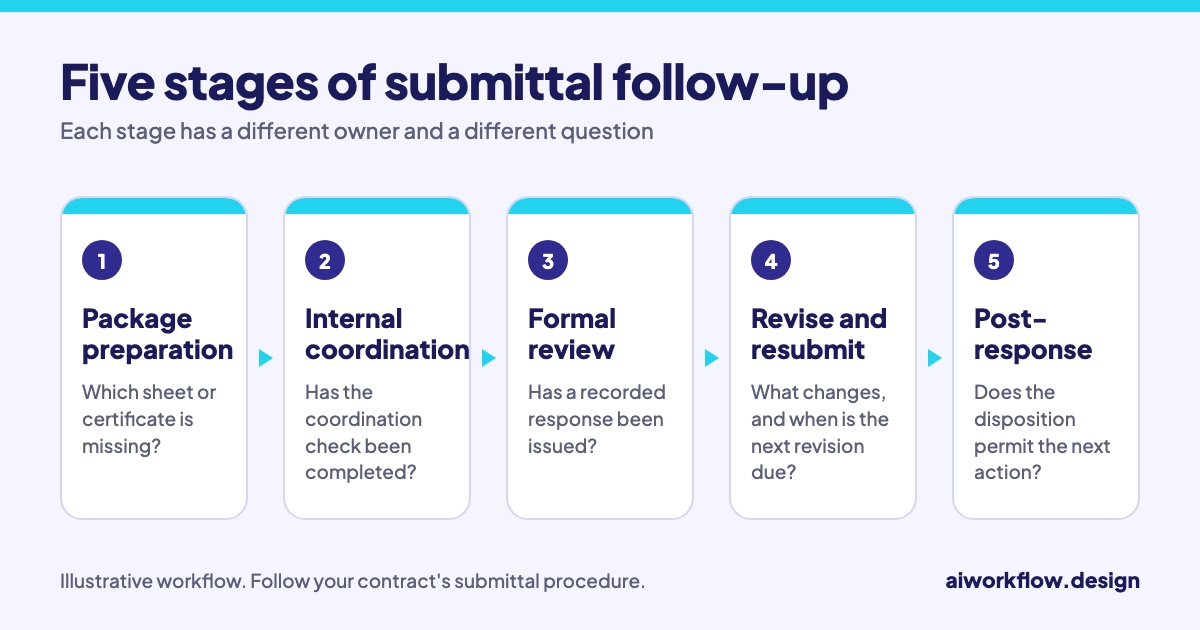
Use the stage of the submittal to determine the next call. A drafting delay belongs with the subcontractor or supplier. An incomplete package belongs with the submittal coordinator. A review that is genuinely overdue may need a documented escalation to the contract administrator—not an indiscriminate reminder to the design team.
| Stage | Follow-up recipient | Precise question | Escalation signal |
|---|---|---|---|
| Package preparation | Subcontractor document owner | Which required sheet or test certificate is missing? | Package cannot meet submission date |
| Internal coordination | Trade lead / coordinator | Has the latest coordination check been completed? | Conflicting dimensions or systems |
| Formal review | Design or contract administrator through agreed channel | Has a recorded response been issued? | Review date threatens dependent work |
| Revise and resubmit | Assigned designer or fabricator | What change is required and when is the next revision due? | Repeated unsuccessful cycles |
| Post-response | Procurement or site lead | Does the recorded disposition permit the intended next action? | Team plans work despite unresolved comments |
For automated calls, keep questions brief: “Which submittal ID are you updating?”, “What revision are you working from?”, “What is the blocker?”, “Who owns the next action?” and “When can the controlled record be updated?” Store the answer as a progress note, not as an approval. Sensitive commercial details or drawings do not belong in an open call transcript.
Build a cadence around the fabrication deadline
A practical construction submittal plan works backwards from the date material or fabricated equipment is needed on site. The review window, resubmission contingency, production time and transport all affect the target submission date. The coordinator should flag long-lead items first, even if their immediate “due this week” task appears less urgent than a short-lead package.
For routine packages, a check-in at the agreed handoff dates may suffice. As a fabrication dependency approaches, increase follow-up only for the responsible owner and only within permitted calling windows. Where a reviewer is not supposed to receive automated calls, route the status request through the approved correspondence process. A reminder does not reset contractual response clocks.
Track two dates: the formal response date from the source record and the next follow-up date for the assigned action. Combining them into a single date can make it look as though a call changed a contract obligation when it did not.
Set up project follow-up in monday.com without over-automating
A suggested board can hold one item per submittal, with subitems for drafting, coordination, submission, formal review and implementation. Configure view permissions so recipients see only what they should. Keep the official drawing repository linked, not copied casually into every call log.
If the organisation uses Autoza AI’s monday.com check-in workflow, a proposed application is to schedule short calls with the owners of outstanding preparation or coordination tasks, collect status and write back permitted progress fields. AI Workflow Design describes scheduled status calls and board updates; the specific submittal columns, reviewer permissions and escalation steps must be configured and confirmed for the project. See the broader product options for how check-ins fit alongside other workflows.
The follow-up script should include a stop rule: if someone says “approved,” the system asks for the formal disposition reference and routes the case to the document controller. It must not mark a package approved purely because the caller heard that word.
What a good submittal review looks like at the weekly meeting
A short weekly review should show which packages threaten a purchasing or installation milestone, what the current formal status is, and which person owns a specific outstanding action. Include the last dated evidence, rather than relying on colour-coded statuses alone. The key question is not “How many submittals are open?” but “Which missing review or revision changes the critical path, and what authorised action resolves it?”
Use the weekly review to remove duplicate tracking items, check that revision numbers match the controlled system, and close stale requests. When the same submittal cycles repeatedly, consider whether the drawings, specifications or interface boundaries are unclear. More phone calls cannot repair an ambiguous design instruction.
For teams that need to connect follow-up with service choices, the AI Workflow Design pricing page explains the published product tiers. The company background also clarifies why the original voice-check-in workflow was developed for people working away from a desktop.
Frequently asked questions
What is construction submittal approval tracking?
It is a documented process for recording what was submitted, by whom, on which revision, when review was due, what formal response was issued and who owns the next step. It should support the contract’s established review procedure rather than replace it.
Can an AI call approve a shop drawing?
No. A call can collect a person’s reported status and request a reference to the official response. It should not issue, infer or overwrite the design professional’s or contract administrator’s formal review decision.
Which fields should be on a submittal board?
At minimum: ID, specification section, description, revision, submitter, reviewer, official status, submitted date, required response date, downstream dependency and next action owner. Keep source-document links rather than uncontrolled copies wherever possible.
How often should subcontractors receive follow-up calls?
Match the cadence to actual handoff dates and risk. A weekly call may suit ordinary preparation; a time-sensitive long-lead item may require more targeted contact. Avoid repetitive calls to people who have no outstanding action.
What if someone says the submittal was approved but there is no record?
Keep the board status as unverified, request the formal disposition or transmittal reference, and ask the authorised document controller to reconcile the record. Do not release fabrication or installation on a verbal claim alone.
Next step: turn task chasing into documented progress
If your construction teams already use monday.com, identify one delayed submittal class—such as structural steel shop drawings or mechanical equipment data—and map its preparation handoffs before scaling to all trades. Explore AI Workflow Design’s project check-in products to discuss where scheduled calls can reduce routine chasing while keeping formal approvals in the correct system.
Related reading
- Pre-Pour Readiness: Who Confirms Concrete Inspection Hold Points?
- Equipment Rental Off-Hire: Avoid Paying for Idle Plant on Site
- Construction RFI Delays: A Follow-Up Workflow Before Trades Lose Time
- Long-Lead Materials: A Supplier Follow-Up Plan for Construction Projects
- Change Order Check-Ins: Capture Construction Site Facts Without Approving Extra Work
- Explore workflows by industry
- Autoza AI for monday.com