
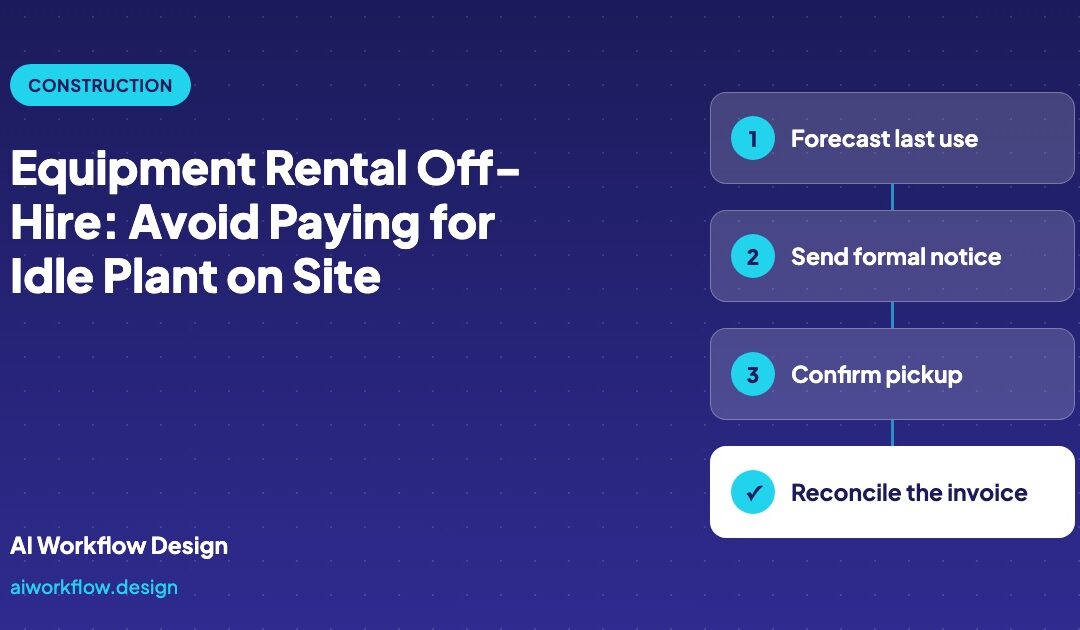
Quick answer: A construction equipment off hire checklist should record each rental asset, the contract’s off-hire notice requirement, its last needed date, a named release owner, collection readiness and the supplier’s written confirmation. A call can surface equipment that is sitting idle, but rental charges stop only under the agreed contract terms—not simply because someone has marked a task complete.
Why idle equipment turns into an invisible project cost
On a busy site, rental equipment may remain after its task ends because the foreman assumes procurement will arrange collection, procurement assumes the supplier knows, and the supplier is still awaiting formal notice. The equipment is physically unused but operationally unresolved. This can happen to lifts, compressors, pumps, temporary power units, breakers or hired access equipment.
The fix is not a once-a-month hire reconciliation. It is a visible chain from last planned use to contractually effective off-hire. Because rental agreements differ, never assume the charge ends at the last engine-hour reading, the moment a worker sends a text, or the day the equipment is moved to a gate. An example of published construction equipment rental conditions is the Graham equipment rental order terms, which tie rental periods to specific order provisions and notice. Use your own signed agreement as the controlling record.
One asset, one record, one accountable owner
Create a register linking the site asset identifier to the supplier agreement. The item description must be specific enough to prevent collection errors: “electric scissor lift” is not enough if multiple lifts have been hired from the same supplier. Record the manufacturer or rental ID where available, hire start date, agreed rate basis, cost code and responsible trade.
| Register field | Required information | Typical failure prevented |
|---|---|---|
| Asset / supplier reference | Supplier order, equipment ID and site location | Wrong unit scheduled for pickup |
| Rate and notice terms | Contract billing unit and required notice channel | Assuming charges stopped too early |
| Last required work | Task, owner and realistic last-use date | Off-hiring before work is finished |
| Safety and condition checks | Required isolation, cleaning and inspection | Unsafe or disputed return |
| Off-hire notice | Sent time, channel, sender and acknowledgement | Unproven termination request |
| Pickup evidence | Collection appointment, handover record and condition notes | Disputes about damage or possession |
| Invoice reconciliation | Final charge period and adjustment request | Continued billing after closeout |
Do not store sensitive supplier account credentials in a general project board. A link to the controlled rental agreement is usually more appropriate than a public attachment.
Three dates that should never be merged
The last needed date is the forecast final day of productive use. The notice date is when the appropriate person informs the supplier using the contractually required method. The effective off-hire date is determined by the contract and the supplier’s acknowledgement or agreed procedure. These dates can differ substantially.
For example, a site team may finish a lift task at noon, but the contract may require advance notice, collection coordination or different billing treatment. Do not promise a specific savings amount before the commercial lead checks the actual tariff and notice provisions. If the supplier cannot collect promptly, the contract determines whether billing continues; preserve all communication so the issue can be resolved fairly.
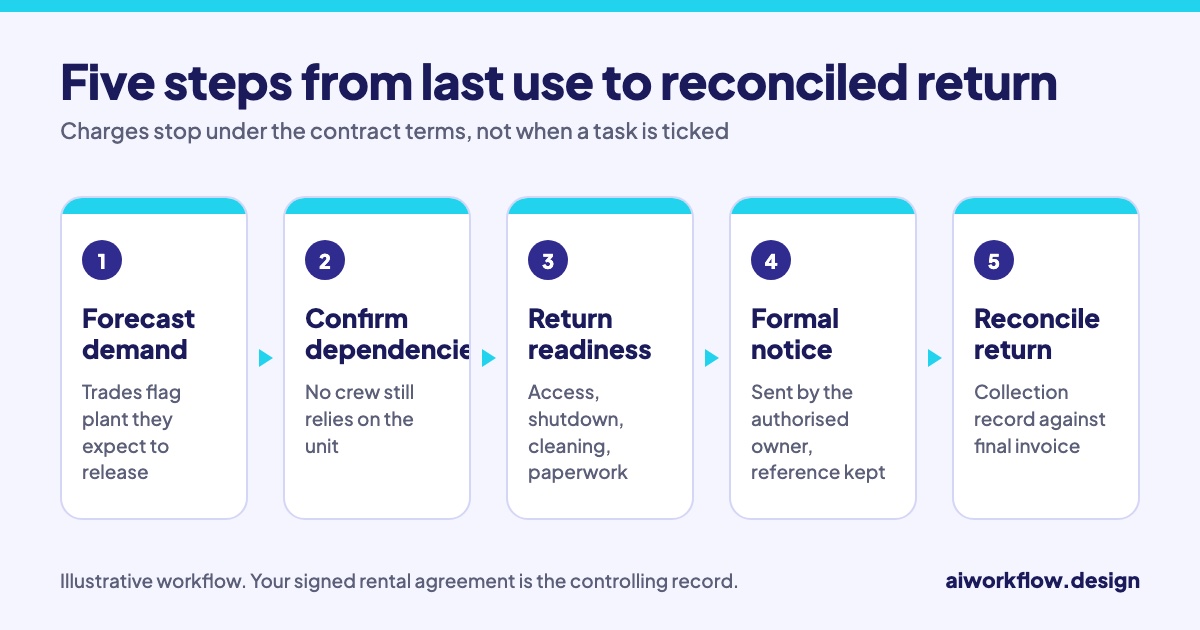
A practical five-step off-hire workflow
1. Forecast demand. During the look-ahead meeting, ask each trade which hired plant it expects to release during the next reporting window. Link the answer to a task end date, not just a feeling that the equipment is idle.
2. Confirm no further dependencies. The superintendent checks whether another crew is relying on the same equipment, whether a contingency booking is required, and whether a replacement would be costly. Shared equipment needs a single release owner.
3. Confirm return readiness. The plant coordinator verifies access, safe shutdown, fuel or battery conditions, removal of attachments, cleaning and the documentation required by the supplier. Qualified operators handle disconnection and isolation where required.
4. Send formal notice. Procurement or the authorised commercial owner sends the off-hire request through the specified channel and captures the reference. A conversation with a driver does not necessarily satisfy the notice requirement.
5. Reconcile the return. After pickup, capture the collection record and review the final invoice against the applicable terms. Raise discrepancies using evidence rather than relying on memory.
Which calls should be automated?
Short status calls are valuable early in the workflow. Ask the relevant foreman: “Is the specified rental asset still required for the planned work?”, “What task would be affected if it left tomorrow?” and “Has the release been confirmed with the site manager?” A plant coordinator can be asked whether the unit is accessible and whether pickup requirements are complete.
A supplier-facing call, where permitted and agreed, can ask whether an authorised notice was received or whether a pickup slot has been confirmed. It should not renegotiate rates, waive charges, or declare contractual termination. Those actions belong to authorised commercial personnel.
Businesses using monday.com might configure AI Workflow Design’s scheduled status-call products to capture readiness and blockers in mapped task fields. This is a proposed implementation pattern; automated supplier off-hire, contract parsing and rental billing reconciliation are not verified built-in Autoza capabilities.
Use an exception view instead of calling every person every day
A useful exception dashboard highlights assets with a last-use date in the past but no notice reference, notices sent without acknowledgement, pickups delayed by site access, and open invoice discrepancies. Assign each exception an owner and a next action. Keep the equipment marked “Off-hire requested” until its contractually relevant confirmation is documented.
Weekly cost reviews should cross-check rental records against site diaries and supplier invoices. If a trade says equipment is still needed “just in case,” ask for a concrete dependency and expected date. The aim is not to pressure teams into unsafe or premature returns; it is to remove undefined ownership and repeated idle time.
Why off-hire tracking improves more than rental spend
Good tracking makes site logistics more predictable. Unneeded units free circulation space, reduce confusion over who controls equipment and avoid last-minute collections during critical activities. The procurement team gets better data for future hire periods and can ask more informed questions when comparing suppliers.
Use the same register template across projects, but keep each site’s contract terms and collection constraints separate. A global rule such as “notify 24 hours before pickup” is dangerous if it is not actually stated in the relevant agreement.
If site teams work in several tracking systems, compare Autoza and the general Daily Check-in Agent before choosing a process. Published pricing and product scope can help avoid assuming that supplier contract administration is included.
Frequently asked questions
What is a construction equipment off hire checklist?
It is a practical record of an asset’s identity, last use, rental terms, release approval, formal notice, collection readiness, supplier acknowledgement, return evidence and invoice reconciliation.
Does off-hire begin when a foreman says the machine is no longer needed?
Not necessarily. That statement can trigger the internal workflow, but the effective off-hire date follows the contract and required notice or return process.
Who should own the equipment return decision?
A nominated site or plant lead should confirm operational release; procurement or another authorised commercial role should send the contractual notice and reconcile the supplier account. Assign both steps visibly.
Can an AI caller tell the supplier to stop charging?
It can collect an agreed status update or relay an authorised request if that workflow is specifically approved. It should not independently decide the contractual end date, settle a dispute or promise a refund.
How do we stop duplicate rentals across multiple sites?
Maintain a cross-site asset view showing unit identity, current location, expected release date and responsible coordinator. Confirm transport and safety requirements before moving equipment rather than treating a spare unit as instantly available.
Next step: pilot a controlled off-hire queue
Start with one rental category and compare the live asset list with the supplier statement. Map who confirms last use, who sends notice and who checks the final charge. Explore AI Workflow Design’s check-in products to see how scheduled progress calls can support those handoffs without inventing contractual authority.
Related reading
- Construction Submittal Approvals: A Follow-Up Matrix for Shop Drawings and Product Data
- Pre-Pour Readiness: Who Confirms Concrete Inspection Hold Points?
- Long-Lead Materials: A Supplier Follow-Up Plan for Construction Projects
- Managing Multiple Construction Sites: Standardise Foreman Status Reports
- Phone Calls vs monday.com Notifications for Subcontractor Updates
- Explore workflows by industry
- Autoza AI for monday.com