
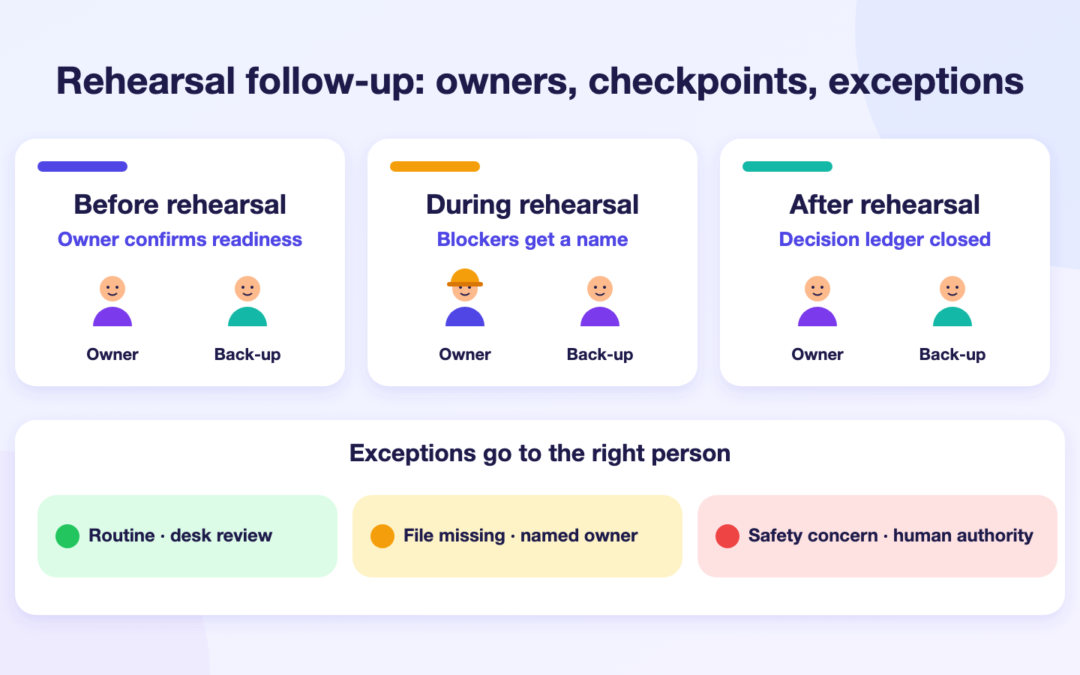
Event rehearsal task follow-up is the process of checking the people and prerequisites needed for a rehearsal before the rehearsal window begins. Its job is to reveal missing scripts, assets, crew access or approvals while the event team still has time to respond. It does not replace the stage manager, technical rehearsal or authority of the venue’s safety team.
Rehearsals are where a project plan meets the real sequence of cues. A speaker may be confirmed but not have a usable presentation; an audio kit may be on site but not tested; an operator may be booked but unavailable for the sound check. A useful check-in workflow distinguishes those conditions and routes each problem to the right person.
Define what ‘rehearsal ready’ means by department
Avoid a single yes/no readiness question. Break the rehearsal into inputs, technical preparations, participant availability and authorised approvals. For a main-stage rehearsal, inputs might include the latest cue sheet, programme rundown, media files, presenter names and a confirmed rehearsal sequence. Preparation tasks include power allocation, signal routing, playback testing and safe access.
A work package is ready for its next agreed step only when its owner reports that the relevant prerequisites have been met and the qualified reviewer has made any necessary approval. monday.com’s event-planning template guide supports assigning owners and dates across the preparation, live event and wrap-up phases. The operational lesson is to link every ‘ready’ statement to an identifiable action.
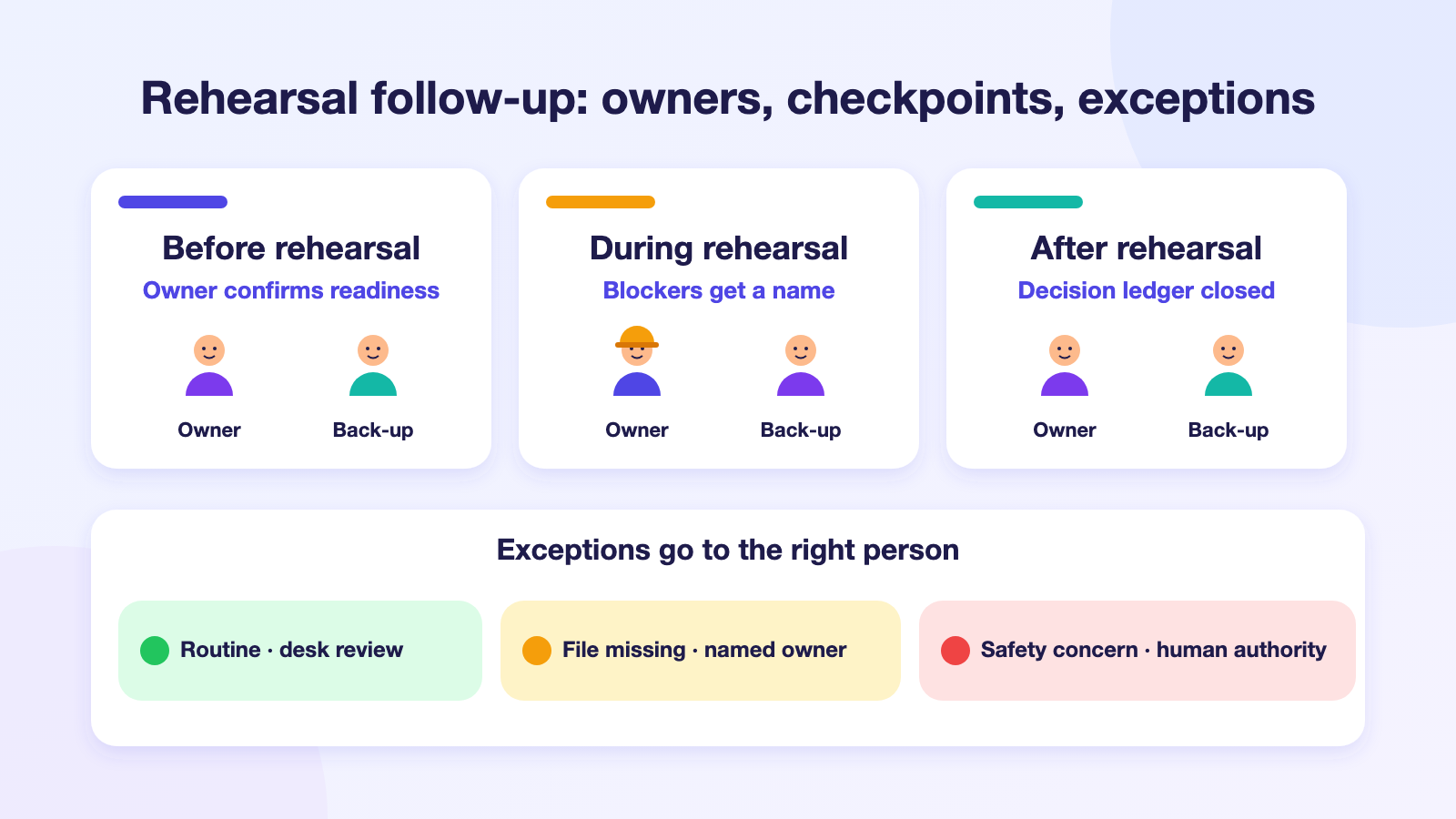
Create an owner list with a back-up contact
Rehearsal calls should reach nominated task owners, not everyone on the event contact spreadsheet. A useful list names the show caller, stage manager, venue operations lead, audio lead, video lead, lighting lead, programme coordinator and speaker liaison. One person can hold more than one role, but the escalation route must still be explicit.
For each task record what the owner can report, what they can approve, their agreed contact window and the person who takes over if they are unavailable. An audio technician may confirm that microphone batteries were replaced. That statement is not equivalent to the production manager approving the whole rehearsal as safe to start.
Follow up at three natural rehearsal checkpoints
The first checkpoint is the day before the rehearsal: confirm the programme version, required people, access windows, pending asset transfers and any material constraints. The second is a short pre-rehearsal readiness check after planned setup work, conducted during a safe contact window. The third is the post-rehearsal issues review, when the team records corrections, accountable owners and deadlines for retesting.
Keep these checkpoints flexible. A second check is not useful when the same person has nothing new to report or is occupied with a live technical operation. AV and stage setup check-ins explain why contact must avoid rigging, live power work and active cue operation. The stage manager should approve when a verbal check is acceptable and when the event uses radio or direct human coordination instead.
Use an exception matrix, not a flat reminder list
A bounded exception policy protects rehearsal time. The following framework is an example to adapt, not a universal safety protocol.
| Reported condition | Board record | Response owner |
|---|---|---|
| Presenter is delayed but alternate slot exists | Reported delay; new estimate pending confirmation | Programme coordinator |
| Media file is missing before playback test | Test blocked; named file owner | Speaker liaison and video lead |
| Call unanswered before a routine desk review | No answer / update outstanding | Coordinator using approved retry window |
| Rigging, electrical or crowd-safety concern | Human safety escalation; no automated clearance | Competent site/venue authority |
| Request to change cue sequence or spend | Decision requested; not approved | Show caller or authorised producer |
The distinction is authority. The AI can help collect a task owner’s stated progress and produce a call summary; it should not interpret a statement as an approval to change budgets, operate equipment, override a show stop or waive a safety control.
Script the questions so answers become usable actions
Start with “I’m following up on your assigned rehearsal task for [event/room]. Is this a safe and agreed time to talk?” Ask which requirement has been completed since the last checkpoint, what remains outstanding, whether the next department can proceed, which evidence exists and when the next update will be available. A concise follow-up question is “Who must make the decision if that item stays unresolved?”
Avoid asking generic questions that invite optimism: “Is everything fine?” is difficult to audit. “Has the approved keynote deck been delivered to video, and has the video lead acknowledged receipt?” creates an identifiable handoff. If the answer is “I think so”, record uncertainty instead of a verified status.
Map reported status separately from sign-off
A recommended monday.com configuration includes Event, Space, Rehearsal milestone, Task owner, Evidence received, Reported readiness, Formal approval, Blocker type, Decision owner, Last call and Next review. Use subitems when one rehearsal segment contains multiple independently owned tasks, such as stage plot confirmation, media ingestion and mic assignment.
Autoza AI for monday.com describes scheduled calls, updates to items, smart retries and summaries. The proposed rehearsal field structure is an editorial implementation example; managers should validate the actual fields, permitted values and update rules during setup. A call is one form of status evidence, not the entire quality-control process.
Example: an unresolved rehearsal cue
Imagine a sponsor presentation scheduled for Thursday’s rehearsal. The speaker liaison says the deck is submitted, the video operator reports the link requires access permission, and the sponsor coordinator is unavailable. All three answers can be true. The useful project status is not “Slides complete”; it is “File reported submitted; operator access blocked; sponsor permissions owner needed before 14:00.”
The producer can choose a permitted alternate file or reschedule the cue test. An AI agent should not make that choice on its own. If the sponsor owner misses the first scheduled call, use the agreed exception rule, rather than repeatedly calling operators who cannot change document permissions.
Close the rehearsal with a decision ledger
Immediately after the rehearsal, maintain a short issues list: cue/segment, observed problem, evidence, required correction, named owner, deadline, next validation step and authorised sign-off. Calls after rehearsal should address only open actions. Put any high-severity show-stop issue in the venue’s human-led procedure, even if the planned next check-in is hours away.
A good learning measure is how many issues had a responsible owner before the final rehearsal and how many were actually retested. It is not appropriate to measure productivity by the total calls placed or to assume a missed call proves an employee did not perform the work.
Introduce a clear, respectful calling policy
Explain to vendors and workers when AI calls occur, what questions are asked, how responses are stored, who can view them and what alternatives are available. Obtain any legally necessary permissions and disclose AI involvement, using rules appropriate to the recipients’ jurisdiction. Never record or use sensitive personal data merely because it was volunteered during a routine status call.
For upstream vendor dependencies, see the event vendor readiness guide. To review an approved pilot workflow with real task fields but no sensitive participant data, contact AI Workflow Design.
Frequently asked questions
Who should receive rehearsal check-in calls?
Only designated task owners who have been informed of the process and are permitted to receive the calls. Producers should avoid calling unrelated vendors or staff whose tasks are already complete.
When should the rehearsal follow-up happen?
Choose useful moments before the rehearsal, shortly before agreed readiness reviews and after the rehearsal for open corrections. Avoid calls during cue operation or other safety-critical activities.
What is an exception rule for an event rehearsal?
A rule that classifies an uncertain or blocked task, gives it an accountable human owner and sets the next allowed action or deadline. It is not authorisation for AI to make technical or contractual decisions.
Can an AI call confirm that a rehearsal passed a safety check?
No. A call may capture a participant’s reported status; the competent site or technical authority must conduct and record any required inspection or sign-off.
How do you handle a missed rehearsal follow-up call?
Record the contact attempt as unanswered, consider one approved retry if time allows and escalate material unresolved dependencies to the nominated producer ahead of the rehearsal cutoff.
Next step: review one real workflow
See how your project questions, permitted board fields and escalation owners could fit a controlled implementation. Explore Autoza AI for monday.com or request a guided workflow review.
Related reading
- AV and Stage Setup Check-Ins: What an Event Producer Should Ask
- How to Run Vendor Readiness Calls Before a Major Event
- Speaker Materials Running Late? A Follow-Up Workflow for Event Teams
- Building a Run-of-Show Follow-Up Schedule Across Multiple Vendors
- Autoza AI for monday.com: scheduled status calls
- Workflow automation services
- Daily Check-in Agent