
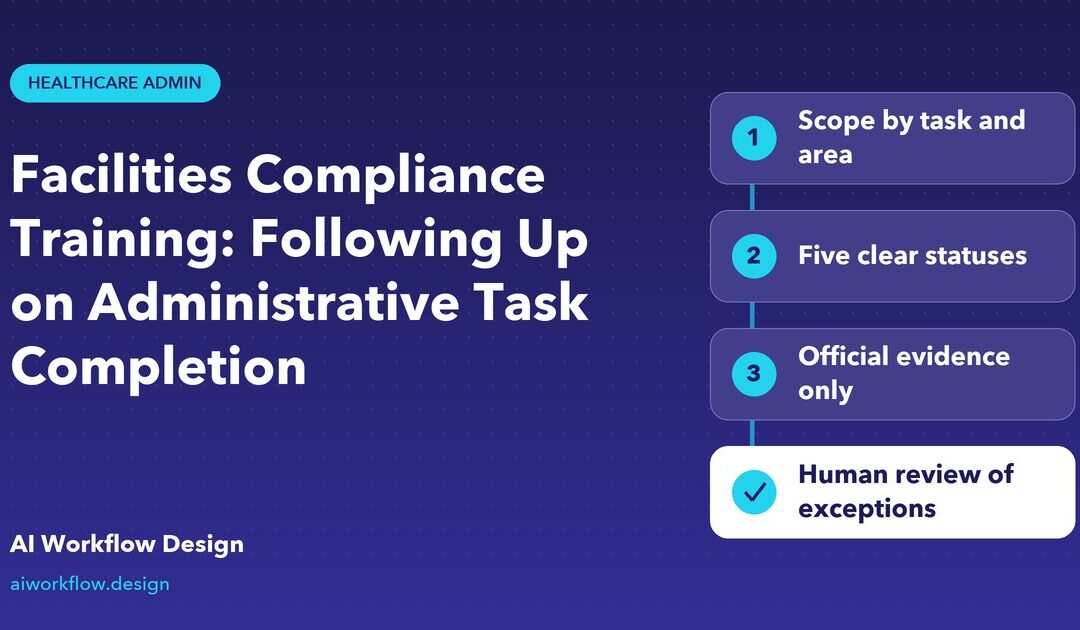
Quick answer: Healthcare facilities training task tracking should distinguish training assigned, attendance recorded, assessment submitted, competency verified and access approved. Administrative reminders may chase missing evidence, but only authorised reviewers can certify competence or release staff to restricted work.
A hospital facilities contractor has been booked to service equipment in a controlled area. The job order is ready and the supervisor believes the worker completed induction last month. But the required course record is missing, a site-specific assessment has not been reviewed, and the facilities manager has no reliable way to see which administrative step is still outstanding. Healthcare facilities training task tracking should make those gaps visible without allowing a reminder system to certify someone’s competence.
A training record is not just a box labelled “done.” Healthcare facilities have different roles, tasks, access conditions and infection-prevention requirements. The useful process connects assignment, completion evidence, competent review and authorisation to work as distinct steps.
Define the training scope by task and work area
Start with the facility’s approved role matrix. Environmental services personnel may need task-specific cleaning and disinfection training; maintenance contractors may need relevant infection-prevention, hazardous-energy or access procedures; security, transport and other workers may have separate orientation requirements. Do not impose an invented universal course list. The facility’s occupational health, infection prevention, safety and HR leads must define what is necessary.
The CDC’s healthcare infection-prevention training recommendations support initial, periodic and as-needed training matched to staff roles and risks. They also emphasise practical competencies, not merely the existence of a generic completion record.
Use five states that cannot be confused
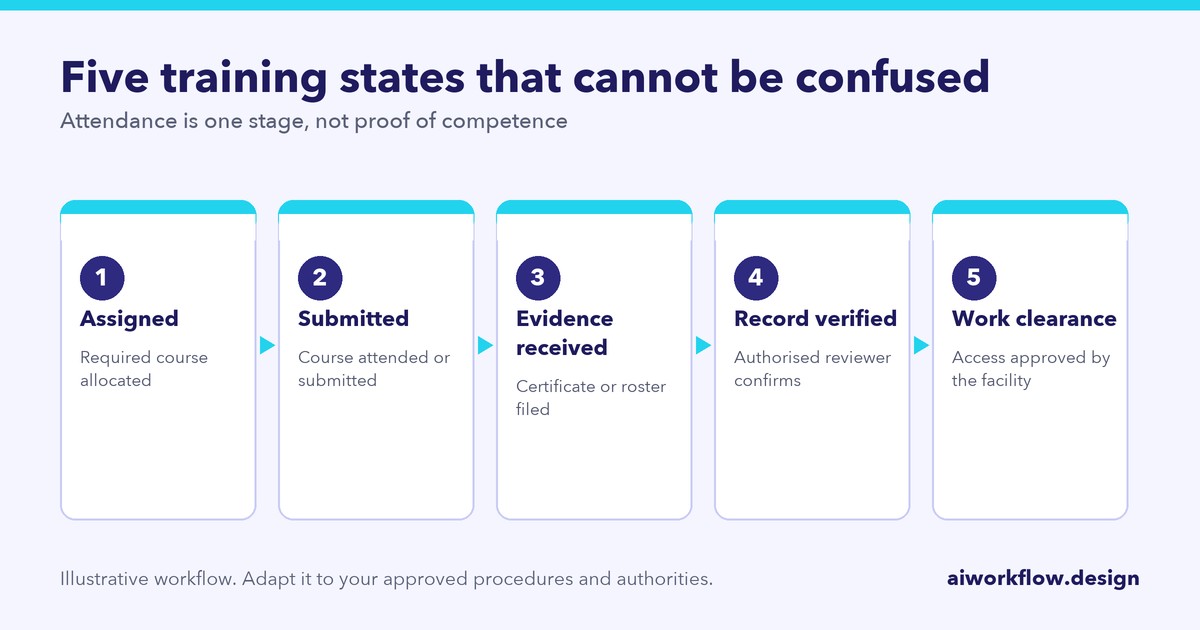
A useful status model includes assigned, course attended or submitted, assessment evidence received, competency or record verified by authorised reviewer, and access/work clearance approved. A course attendance email supports one stage; it does not necessarily establish demonstrated ability to perform a safety-sensitive job.
Add expired, retraining required and exception awaiting review where applicable. Expiration dates should come from authoritative facility policy or the governing credential requirement, not an AI-generated guess. Each status needs a named owner and evidence reference so a reviewer can follow what happened without asking the worker repeatedly.
Keep the official evidence in the designated training system
Training records may include signed rosters, learning-system completion records, certificates, observation checklists, assessment results, refresher requirements and supervisor authorisation. Store them in the learning management, HR, contractor compliance or credentialing system approved by the hospital. A general-purpose project board should reference a record or verification decision, not copy all personnel information.
The CDC’s guidance for environmental cleaning teams highlights training in cleaning policies, safe chemicals, protective equipment and risk awareness. For contractors, facilities should confirm whether equivalent training is supplied and accepted under the local contract and policies, rather than assuming an outside certificate automatically meets every site requirement.
Create ownership around the actual missing item
If a course has not been started, the assigned worker or supervisor may need an administrative reminder. If the course was completed but the certificate never reached the LMS, the training administrator is the next contact. If the assessment is present but not reviewed, the qualified assessor owns the decision. If competency was confirmed but site access remains pending, the authorised access controller needs to act.
This distinction prevents a daily call from landing on the wrong person. For an illustrative board, record role or contractor ID, required course, due date, submitted evidence status, verifier, approved record link, current blocker, renewal date and escalation owner. Protect personnel information according to hospital policy and contract, and exclude any patient-related data from the calling process.
Ask administrative questions without testing competence by phone
A responsible check-in might ask: “Have you been assigned the required course? Have you uploaded the completion record to the approved portal? Is a supervisor or training administrator waiting on anything? Do you need help accessing the course?” These are process questions, not an examination or fitness-for-duty decision.
Do not ask the caller to test practical safety competence, assess infection-control technique, verify licensure or certify staff over a general AI voice call. Do not collect passwords, medical history, patient details or confidential disciplinary information. When a worker reports an unsafe condition or a missing protective measure, contact the relevant human safety lead according to the facility’s immediate escalation process.
Schedule follow-up around real entry requirements
Training deadlines should be tied to the role’s start date, contractor mobilisation, annual refresher or a new procedure. A reminder a week before contractor access may prevent a cancelled visit; a last-minute reminder after an access refusal only documents the problem. Set escalation points early enough for a human reviewer to conduct the assessment and communicate the result.
For example, an external maintenance team arriving Tuesday might need records checked several days before mobilisation. The training coordinator confirms administrative submissions; the infection prevention or safety team reviews required competence; site security receives a formal approval from its authorised source. The AI caller never upgrades an outstanding training status into access clearance.
Include contract staff in the governance design
The CDC’s isolation-precautions guidance addresses staff employed by outside agencies and recommends systems that ensure relevant education and training requirements apply. Procurement contracts should identify who supplies training, who retains proof, and how hospital-specific induction or assessment works.
Because personnel may rotate between sites, a record verified at Hospital A should not automatically trigger clearance at Hospital B. Local policies, task risks and course equivalence need the appropriate reviewer. An administrative system can flag the difference and request a decision; it should not silently assume the qualification carries over.
Treat exceptions as human decisions, not call failures
If a contractor reports a completed course but evidence is unavailable, use “evidence missing,” not “not trained.” If the course is expired, follow the defined retraining and access protocol. If required practical assessment is not passed, only the designated assessor can determine next steps. A no-answer creates an unconfirmed reminder outcome, never a disciplinary or competency conclusion.
Define urgent paths for unsafe work conditions and separate routine compliance notifications from the hospital’s emergency communications. Ensure calls respect shift schedules, appropriate disclosure and recording laws, accessibility needs, and data minimisation. The most valuable automation may be one well-timed reminder to an administrator, not repeated calls to a clinician or contractor during active care.
Use monday.com for administrative visibility
An organisation using Autoza AI for monday.com can assess scheduled phone check-ins for the narrow task of gathering administrative follow-up status. The proposed board and review workflow are configuration recommendations, not a claim that the product verifies certificates or maintains an accredited learning record. Competency evidence and access clearance stay with the authorised systems and reviewers.
Start with one facilities team and a single mandatory training category. Track late documentation, time to authorised verification, prevented scheduling conflicts and incorrect status escalations. A mature process improves visibility without confusing attendance, learning, verified competence or permission to perform restricted work.
Frequently asked questions
Can AI verify staff competency?
Not through a routine administrative check-in. Competency requires whatever qualified assessment, practical observation and verification the facility and applicable rules prescribe. AI may help follow up on missing administrative evidence, but must not certify a person fit for safety-sensitive work.
Which training evidence stays in the official system?
Certificates, signed attendance records, assessment outcomes, supervisor approvals, refresher requirements and relevant personnel records belong in the facility’s approved LMS, HR or contractor system, with only suitable task-status references in a general project board.
How should missing training be escalated?
Identify which step is missing, notify the responsible training administrator or supervisor early enough for review, and apply the facility’s access and work restrictions until the authorised decision has been documented.
Should contractors receive the same training as employees?
Requirements depend on the role, hazard and facility policy. Hospitals should ensure outside personnel receive applicable job- or task-specific infection-prevention and safety training and have acceptable evidence of competence before restricted duties.
Does a certificate automatically authorise hospital access?
No. A certificate can support a training requirement, but site access may also need identity checks, work permits, infection-control induction, supervision arrangements and a separate authorised clearance.
See the monday.com project follow-up workflow
For scheduled status calls and controlled updates to an existing project board, explore Autoza AI for monday.com. Request a workflow review to confirm call scope, field mappings, consent requirements, limitations and human escalation rules before deployment.
Related reading
- Healthcare IT Rollouts: A Non-Patient-Data Project Status Workflow
- Hospital Renovation Readiness: Track Contractor Tasks Around Infection Control
- Hospital Facilities Projects: A Status-Update Plan for Maintenance Tasks
- Hospital Planned Shutdowns: Who Must Confirm Facility Communications?
- Non-Clinical Healthcare Project Check-Ins: A Safer AI Calling Workflow
- Explore workflows by industry
- Autoza AI for monday.com