
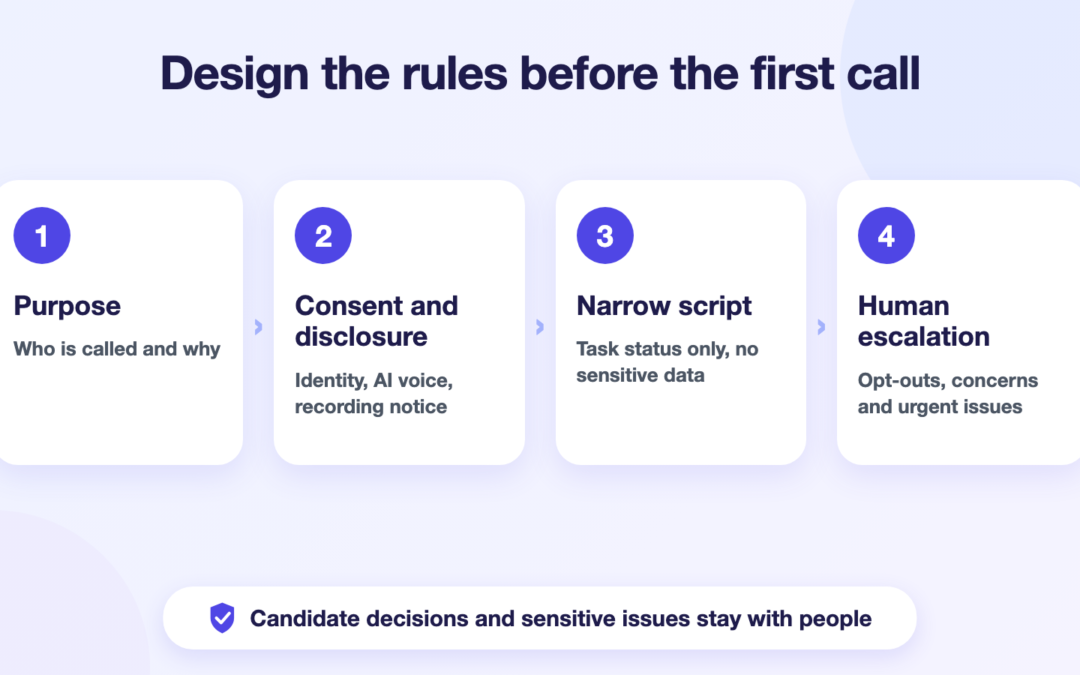
A staffing agency may need to check whether a hiring manager has supplied feedback, a new starter has confirmed a time or a recruiter has finished an administrative task. Automated calling can make those follow-ups predictable, but responsible use requires more than a good script. Staffing AI calling consent, recording notices, candidate privacy, reasonable frequency and an effective human escalation path should be designed before calls begin.
This is a governance framework for routine operational communication. It is not a legal determination that a particular campaign, audience or technology is compliant. The correct requirements depend on who is called, where the caller and recipient are located, why the call is made, whether it is recorded and the laws that apply.
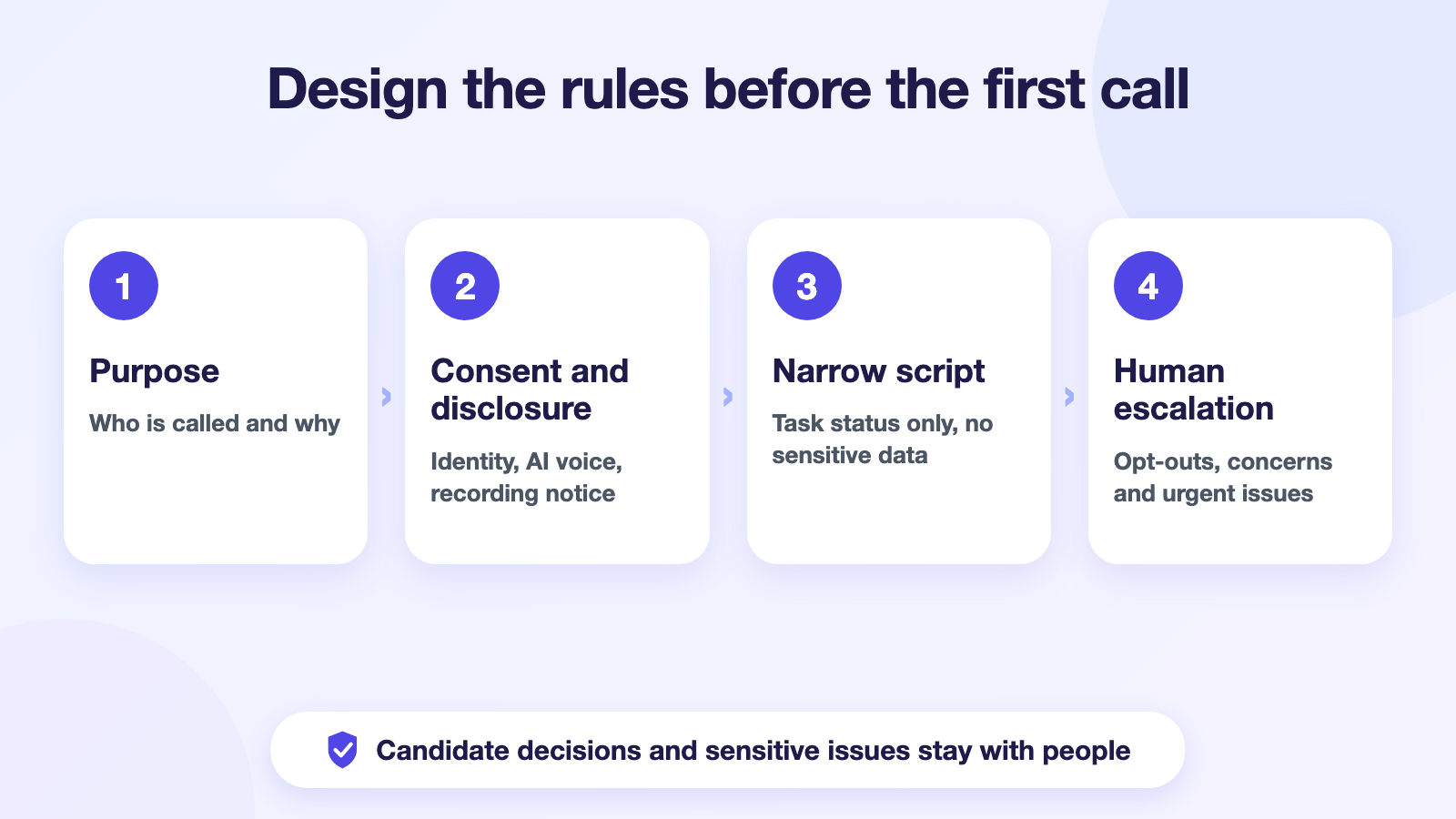
Decide who may be called and for what purpose
List recipients by role: internal recruiter, hiring manager at a client company, onboarding coordinator, current worker or job applicant. A daily internal task check-in is not automatically governed by the same rules as a call to an external applicant. Treat every call type as a separate purpose, with its own lawful basis, approved contact source, communication notice and retention rules.
For each call category, document: the business need; exact questions; the permitted contact list; allowed time window; who reviews results; opt-out or alternate-channel routes; and which systems receive an update. Avoid pulling all available personal information into the calling tool “just in case”. If the task only requires confirming an interview time, the agent does not need identity documents or the person’s career history.
Consent and disclosure are workflow requirements
In the United States, the FCC AI-voice declaratory ruling explains that calls using AI-generated voices can fall under TCPA rules for artificial or prerecorded voice calls, including applicable prior express consent, identification and other requirements. The exact treatment depends on the call and applicable exceptions; this article does not assume every staffing call has the same legal treatment. Recording and privacy laws can add further obligations, including state-level requirements.
Explain the caller’s identity and automated nature where required; describe any recording or transcription appropriately; provide a working path to a human; and respect contact preferences. The website’s AI Workflow Design privacy policy explains its data and call-recording practices, but each deploying organisation remains responsible for validating its own compliance arrangements and vendor contracts.
Build a deliberately narrow calling script
A routine recruiter follow-up might ask: “Have you scheduled the candidate’s interview?” “Has the client approved the proposed start date?” or “Do you need the coordinator to resolve a paperwork blocker?” The ideal response maps to a small set of task statuses. Ask a follow-up only when needed to identify an owner or next action.
Do not ask for Social Security numbers, bank details, passport scans, medical conditions, protected demographic traits, disciplinary allegations or detailed background-check findings. Do not prompt a recipient to describe why a candidate may be unsuitable in a recorded status call. Secure systems and authorised human personnel should handle those matters under the correct policies.
Keep recruitment decisions human-controlled
The EEOC’s employment AI resources discuss risks when automated systems influence selection. A calling workflow that checks whether a task is finished should never silently become a candidate scoring tool. Define a blocked-questions list and prevent free-form responses from being translated into selection outcomes. When somebody volunteers a sensitive explanation, a safe process redirects them to a private and appropriate human channel.
Candidate and worker accessibility also matters. Some people cannot or do not wish to receive voice calls. Offer a practical alternative such as secure email, an accessible portal or human contact. Do not treat failure to answer an automated call as a negative candidate signal.
Set escalation tiers rather than unlimited retries
Use an ordinary tier for overdue but low-risk tasks; a time-sensitive tier for an imminent interview or start date; and a sensitive tier for privacy, safeguarding, harassment, discrimination or other serious concerns. Routine tasks can be routed through approved retries and a named coordinator. Sensitive concerns should exit automated handling promptly and go to the right human specialist. Never place an unverified concern into a broad team transcript or public board comment.
A no-answer status means only that contact was unsuccessful at that moment. It is not evidence that a candidate has withdrawn or a worker is absent. Repeatedly retrying personal numbers can harm trust, especially outside agreed contact hours. Document and honour any opt-out or preference change before subsequent calls.
Configure monday.com without creating an unnecessary data store
For operational tracking, use task reference, contact role, call permitted yes/no, last outreach date, action status, next due date and escalation owner. Keep identity verification records, applicant evaluations and sensitive documents in the correct secure system. Configure least-privilege access to board items, transcripts and call histories. When testing a vendor, review its retention practices, contracts and how recordings are controlled.
The published Autoza AI for monday.com page describes scheduled calls, board item updates, retries and call summaries. It does not by itself establish lawful calling permissions for a staffing agency. Teams should verify their contact lists, notices and field mappings before using those features in live recruitment workflows.
Audit quality, not only call counts
A helpful monthly review checks whether consent and preference records are current, how many calls were unnecessary, whether escalation reached a human promptly, whether people could use an alternative channel and whether sensitive data appeared in any transcript. If the same question repeatedly produces confusing answers, revise the script. If respondents report unwanted contact, change the cadence rather than assuming more calls will solve the workflow.
Responsible staffing AI calling is an operational policy implemented through technology. Begin with one low-risk internal task type, train the humans who receive exceptions and have legal and privacy reviewers assess the launch. To explore a bounded monday.com calling configuration, contact AI Workflow Design. For related guidance, see our placement start-date check-ins and recruitment onboarding document checklist.
Frequently asked questions
Does every automated staffing call require the same consent?
No. Requirements vary by jurisdiction, recipient, purpose, technology and possible exemptions. Get qualified legal review and document the specific basis before calling; do not treat internal and external audiences as automatically equivalent.
Should an AI agent record candidate interviews?
Not by default. Recording and evaluation introduce separate privacy, consent, accessibility and hiring-risk questions. A routine task follow-up tool should avoid becoming an interview assessment system.
What should happen when someone asks not to be called again?
Honor the request under applicable rules, update contact preferences promptly, stop the relevant automated workflow and offer an approved alternative channel where needed.
Can recruiters use call summaries in monday.com?
Only for authorised, minimally necessary task information with appropriate access controls. Avoid storing medical, demographic, background-check or detailed candidate assessment information in broad project boards.
When should the AI hand a staffing issue to a person?
Escalate privacy concerns, discrimination or accommodation issues, unclear identity, complaints, urgent start-date barriers and any matter outside the approved status script. Record the task reference and route it securely.
Related reading
- Interview Panel Follow-Up Calls: What Can and Cannot Be Automated?
- Placement Start-Date Check-Ins: How to Confirm Every Stakeholder Is Ready
- Hiring Manager Feedback Delays: A Follow-Up Workflow for Staffing Teams
- Missing Onboarding Documents? A Recruitment Task Follow-Up Checklist
- Autoza AI for monday.com: scheduled status calls
- Workflow automation services
- Daily Check-in Agent