
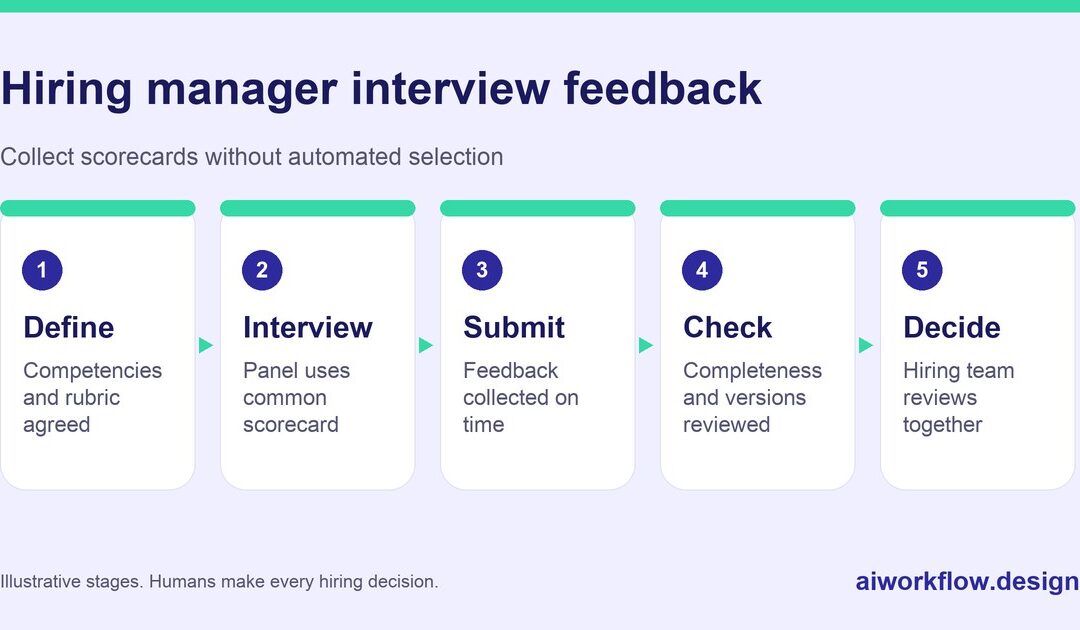
Quick answer: A hiring manager interview feedback workflow should collect job-related scorecards from each interviewer, identify missing assessments, reconcile inconsistent versions and deliver the complete evaluation packet to the authorised decision-maker. A task reminder may chase an overdue scorecard, but AI should not independently rank candidates, infer protected characteristics or turn missing feedback into an automatic rejection.
Many recruiting teams know the familiar delay: the interview ended yesterday, three panel members said they would submit notes, and the hiring manager wants to make an offer before everyone has recorded their assessment. A shared comment such as “strong candidate” is not a structured record. At the same time, chasing feedback with repeated emails can encourage hurried, retrospective scoring. The solution is a consistent evaluation method and a narrow administrative follow-up process.
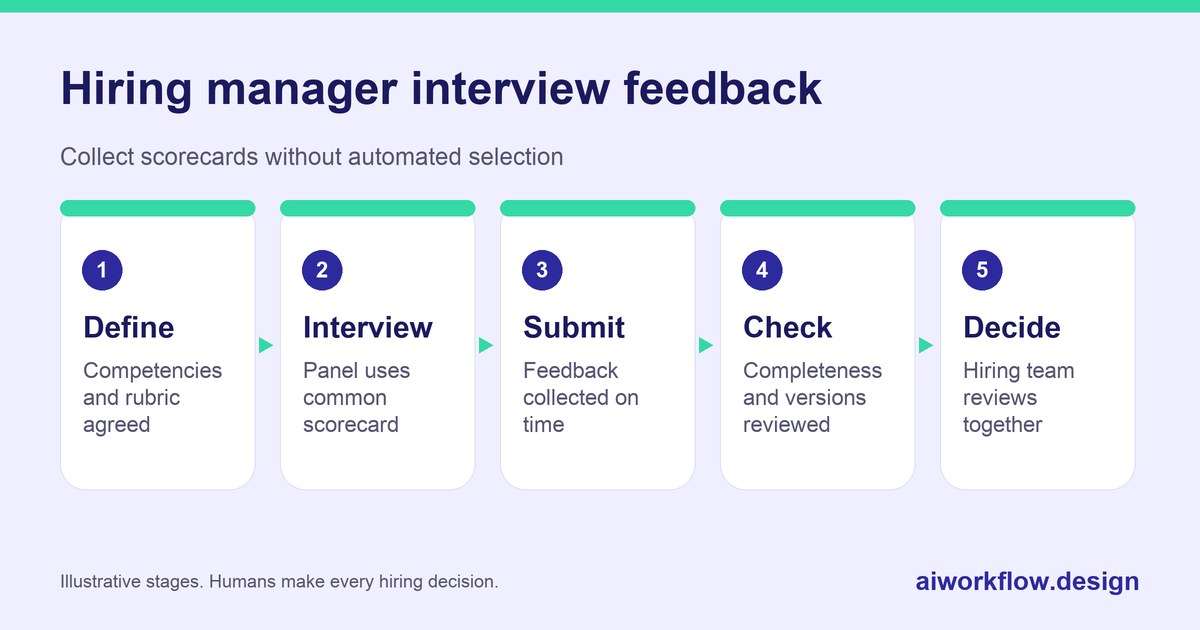
Establish criteria before interviews start
Structured interviewing means asking consistent, job-related questions to assess defined competencies, with standardised scoring. Private employers can adapt these principles to their own approved processes, while legal and organisational requirements may differ. The key operational rule is that the scoring rubric should exist before an interviewer forms an opinion about a particular candidate.
For each requisition, agree the job analysis, essential competencies, interview stage, questions or prompts, rating scale, evidence guidance and panel responsibilities. Do not measure vague “culture fit” without defining objective job-related behaviour. Confirm which competencies are evaluated in each stage so the same panel is not repeatedly rating the same issue without purpose.
The recruiting coordinator can confirm that the rubric is distributed and version controlled. The hiring manager and HR own the assessment design. A workflow tool should not generate a new standard for one candidate after seeing their background.
Create a scorecard that captures evidence as well as ratings
A useful scorecard identifies the requisition, interview stage, approved rubric version, interviewer, date, competency, rating and supporting observations. Ask interviewers to distinguish observable evidence from interpretation. For example, “described the steps used to troubleshoot an incident” provides more relevant context than “seems technical.” The latter may reflect an impression that cannot be compared consistently.
Keep an option for “not assessed” rather than forcing a neutral score. If a question was skipped due to time, the proper record is a missing assessment, not an invented midpoint. Avoid collecting unnecessary personal information or irrelevant observations. Interview notes may contain sensitive data even when the process is administrative; use the employer’s approved applicant-tracking or HR records for detailed evaluations.
Give interviewers clear instructions on when to submit their own scorecards. Where panel independence is important, ask individuals to enter ratings before a group discussion to reduce anchoring on the first person’s opinion. The hiring team should decide how to handle disagreement, not simply average every number.
Build a controlled follow-up sequence
The scorecard workflow begins when the interview is marked complete by the scheduler. The interviewer receives the correct evaluation link and an agreed deadline. A neutral reminder can ask whether the form has been submitted or whether there was a technical problem. If a deadline passes, notify the recruiting owner and, where approved, the panel lead.
A reminder must not ask the interviewer for a verdict over an informal call. “Has the scorecard been submitted?” is appropriate; “Would you hire this candidate?” can create a parallel, unrecorded assessment channel. If a manager wants to discuss concerns, direct them to the approved evaluation process rather than capturing spontaneous remarks in a general task log.
Handle leave, time zones and panel changes in the same workflow. If an interviewer becomes unavailable, the hiring manager and HR decide whether an existing assessment is sufficient, whether a replacement interviewer should conduct an interview or whether the decision should wait.
Check completeness without altering the evaluation
A completeness review can verify that the right rubric version was used, the required fields are filled, interviewer identities match the panel and relevant evidence is available. It must not “correct” a rating or invent missing notes. If an assessment is inconsistent with the scale, return it to the author or the authorised HR reviewer for clarification with an audit trail.
Distinguish a complete scorecard from a positive scorecard. Recruitment operations can confirm the former without deciding the latter. A panel may produce differing ratings; the discrepancy is a reason for documented discussion, not evidence that one interviewer made an error. A final decision-maker may consider all permitted evidence and any applicable selection rules.
Before transmitting the packet, confirm that no candidate was evaluated against an outdated set of questions. If a process change occurred mid-campaign, the hiring team should document how comparability and fairness were addressed.
Use monday.com for workflow visibility, not candidate ranking
Create administrative statuses such as Interview Completed, Scorecard Awaited, Reminder Sent, Submitted, Completeness Review, Clarification Needed and Ready for Hiring Review. Useful fields include Requisition ID, Candidate Reference, Stage, Interviewer, Interview Date, Rubric Version, Feedback Due Date, Secure Form Link, Completeness Owner and Next Action. Keep detailed ratings and notes in the approved HR/ATS system, with access limited to authorised people.
A monday.com item can display that an assessment is pending without revealing what the interviewer wrote. If a company uses Autoza AI or a Daily Check-in Agent, constrain check-ins to non-sensitive task questions: “Have you submitted the approved feedback form?” or “Do you need the recruiter to resend the link?” The agent must not ask for candidate evaluations, summarise protected information or select a preferred applicant.
If a custom integration moves status changes from the ATS to monday.com, define which system is authoritative. Deduplicate webhook events and test whether a withdrawn or deleted assessment is still shown as complete. Enforce the employer’s retention and privacy requirements rather than storing full scorecards in a second uncontrolled database.
Address late or conflicting scorecards fairly
An interviewer remembers only a general impression. Do not create a fictitious detailed record. The hiring team should decide whether the available observations support an assessment or whether another job-related evaluation is needed.
One person used an old scorecard. Preserve the original submission, note the version issue and route to HR for a documented resolution. Do not silently remap ratings to a newer scale.
Feedback mentions irrelevant personal information. Restrict access and seek HR guidance on correcting the record under the applicable process. Do not propagate irrelevant content into candidate summaries or team chat.
The hiring manager wants a decision without the full packet. Surface the missing status and escalate through the approved decision process. The authorised hiring owner determines whether the missing information is essential, not an automation.
Close the loop after a hiring decision
When the decision is recorded in the ATS, end administrative chasing and follow the employer’s retention and access policies. Do not leave open reminders that continue collecting interview information after the purpose has ended. Review repeated delays by interview stage and panel workload, not by labelling candidates or hiring managers without context.
Measure scorecard submission timeliness, incomplete forms, version mismatches, follow-up attempts and time spent waiting for authorised review. Interpret the results carefully: fast submission is helpful only when evaluators had adequate time to produce fair, job-related notes. A shorter time to decision is not a sufficient quality metric by itself.
The resulting audit trail explains what criteria were used, who submitted an assessment, whether the packet was complete and who made the hiring decision. It supports accountability without pretending an administrative board is an applicant-selection algorithm.
Calibrate interview panels before collecting decisions
Where several interviewers evaluate the same competency, arrange a short calibration session before candidates enter the process. Review the definitions of each rating, what counts as observable evidence and which questions are in scope. Discuss how to handle an unanswered question, technical interruption or candidate-requested clarification. Training panel members beforehand is more reliable than attempting to reconcile inconsistent assumptions after the final interview.
During a debrief, distinguish the individual assessments from the group’s conclusion. An interviewer may revise an interpretation after hearing verified evidence from another panel member, but the process should document material changes, the person making them and why. The selection owner should not overwrite an interviewer’s original score simply to produce consensus. Where policy requires a formal consensus score, retain its basis and the original individual inputs in the authorised record.
Look for process quality problems rather than patterns that imply a candidate’s worth. For example, if one competency is repeatedly marked “not assessed,” update the panel’s interview guide. If a particular question generates unclear answers from nearly every applicant, ask the assessment owner to review its relevance and clarity for future interviews. If a panel raises concerns about bias or inconsistent treatment, involve HR and follow the employer’s escalation process. An automation can highlight missing administrative steps; it must never decide that a candidate is too old, unlikely to fit or otherwise unsuitable based on inference.
Hiring manager feedback checklist
- Approve job-related competencies, prompts and scoring criteria before interviews.
- Assign each interviewer the correct version-controlled scorecard.
- Record scores with observable evidence and allow “not assessed.”
- Send administrative reminders without collecting informal verdicts.
- Verify completeness and version accuracy without changing ratings.
- Restrict candidate feedback to authorised HR or ATS records.
- Route discrepancies and final decisions to human reviewers.
- Stop collection and follow retention rules after the decision.
Next step
Want these follow-ups handled consistently? Explore Autoza AI for monday.com or talk to AI Workflow Design about scheduled, permissioned status follow-ups that leave approvals and decisions with the right people. For a companion workflow, read Candidate Interview Accommodations: A Privacy-Safe Scheduling Checklist. More guides: browse our recruiting workflow guides or see all industries we support.
Frequently asked questions
What makes interview feedback structured?
Use approved job-related competencies, common questions or prompts, consistent rating guidance and supporting evidence across comparable candidates.
Can AI select the strongest candidate from interview notes?
This workflow should not do that. It can flag missing administrative tasks, but selection decisions and fairness review belong to authorised hiring personnel.
What if an interviewer has not submitted a scorecard?
Send a neutral reminder or escalate to the recruiting owner. Do not convert a missing scorecard into a negative rating or automatic rejection.
Should different interviewer ratings be averaged automatically?
Not without an approved assessment method. Preserve the ratings and evidence, and let the hiring team resolve disagreements under its documented process.
Where should candidate feedback be stored?
Detailed evaluations should remain in the approved ATS or HR system, with limited-access status references in the coordination board.