
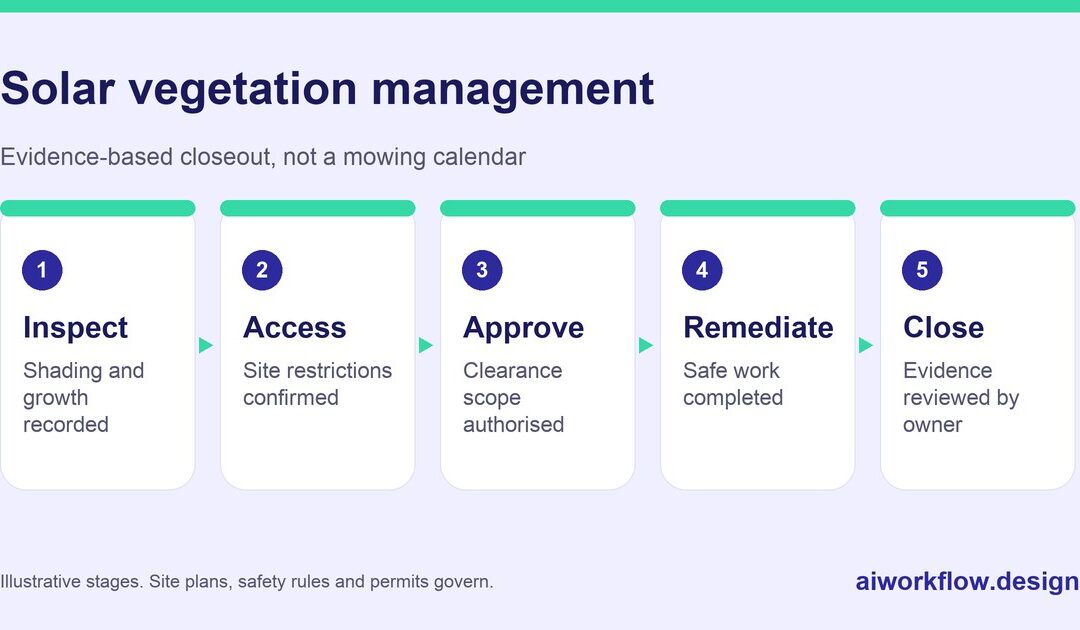
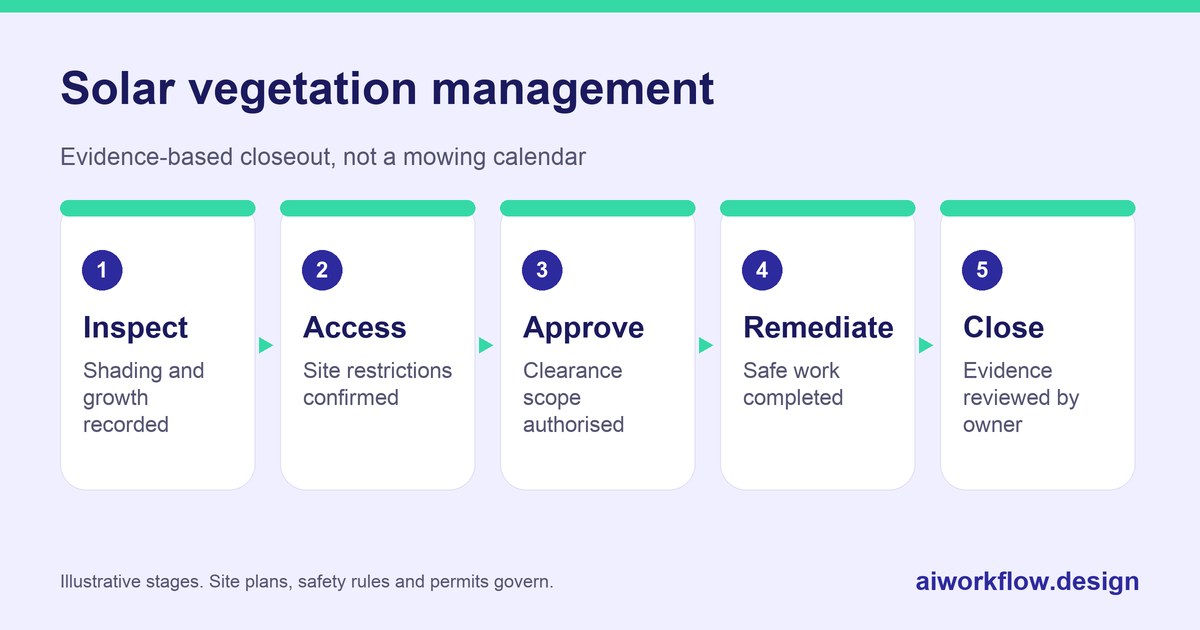
Quick answer: A solar vegetation management checklist should connect inspection findings to approved land-management work. Capture the location and nature of overgrowth, distinguish routine groundskeeping from electrical or environmental hazards, assign an authorised work owner, confirm site-access and environmental restrictions, and request photo or inspection evidence before closing the task. A status call can chase dates and records; it cannot decide whether a vegetation method is safe or whether a solar installation may resume operation.
Vegetation is easy to treat as a cosmetic issue at a solar site. It is not always one. Tall grass can restrict technician access; branches can introduce new shade; plants can block drainage routes; and poorly planned clearance can expose soil to erosion. A maintenance record that says “mowing completed” tells the asset manager very little about which risk was actually resolved. The better workflow connects each observation to a location, acceptance criteria and reviewer.
Define the maintenance objective before scheduling a crew
A rooftop array with nearby trees needs a different plan from a ground-mounted installation with rows of modules and an established habitat area. Identify whether the current issue is shading, access clearance, fire-risk management, drainage, equipment obstruction or a contractual landscaping requirement. Some findings may have several causes. A weed beside a fence is not necessarily a production problem; a branch shading part of an array may require further performance investigation.
Start with the site’s approved operations and maintenance plan, land-use obligations, landscape drawings, vegetation-management contract and any environmental approvals. Photovoltaic maintenance is an ongoing, site-specific responsibility, so one arbitrary mowing interval should not be applied to every installation. Seasonal growth, local weather, approved habitat management and access needs affect the inspection cadence.
Make a separate board item for each defined area or defect. “Trim whole site” is difficult to verify and easy to close prematurely. “Confirm access around inverter enclosure and submit approved completion evidence” creates a measurable outcome without instructing an unqualified person to approach electrical equipment.
Inspect and classify findings without guessing at causes
Record the solar site, array or field identifier, row or asset location, observation date, inspection method, source photo and responsible reviewer. Note whether the vegetation appears to obstruct an access route, shade modules, obstruct a cabinet, affect drainage or conflict with an approved habitat zone. Photographs should show context, not just a close-up of grass. Preserve before-and-after evidence using an approved file store linked from the board.
Do not infer energy loss from a photograph alone. Solar production changes with irradiance, orientation, temperature, soiling, system health and meter quality. A technician or performance engineer should investigate whether shading is contributing to a measured production concern. If the issue could involve exposed cables, damaged modules, wildfire risk, nesting wildlife or erosion, apply the project’s hazard-escalation procedure instead of dispatching a standard landscaping crew.
Use three practical triage categories: routine maintenance awaiting scheduling; inspection or engineering review needed before work; and urgent safety or environmental escalation. Severity should be set by the competent site owner, not by a voice agent matching keywords in a call transcript.
Confirm site permissions and environmental constraints
Before making a booking, establish who controls site entry, which gates and tracks can be used, and whether any equipment areas are restricted. Ask the site owner about required inductions, contractors’ insurance, permit-to-work processes, electrical exclusion zones, lone-working rules and emergency arrangements. A vegetation contractor may be experienced with landscaping yet still lack authorisation to enter a live electrical compound.
Check wildlife and conservation restrictions, chemical-use approvals, local fire-management rules and erosion controls. If pollinator planting or grazing is part of the approved plan, a generic request to cut everything short may violate the site’s objectives. If the vegetation is stabilising a slope or drainage feature, removal may cause damage even while improving visibility. Have the environmental or land-management lead approve the proposed method where required.
The work order should state what needs attention, what is excluded and what evidence will be accepted. It should not prescribe an unsafe clearance distance or herbicide treatment in the absence of approved site procedures. The contractor confirms availability and method readiness; the authorised site manager decides whether to release the work.
Build a follow-up calendar around weather and dependencies
A useful vegetation calendar is inspection-led and seasonal, not a weekly reminder sent regardless of conditions. Schedule inspections before periods of expected growth, after notable storms and ahead of planned maintenance visits when access is important. If evidence of new shade appears in monitoring, add a technical inspection rather than assuming mowing will fix the problem.
For each work order, track proposed visit, confirmed access window, weather suitability, contractor readiness, equipment or environmental constraints and reviewer availability. A site that is too wet for machinery may need rescheduling; a protected area may require a different permitted season; a blocked track may stop technicians from reaching an inverter. Record the reason for the change so the next booking is not simply a repeat of the last failed appointment.
When several vendors share the site, place work in the right order. For example, a drainage inspection may need to precede clearance near a swale, while an electrical inspection may be needed before anyone approaches damaged infrastructure. A missed handoff can be more consequential than a late mow.
Verify completion by outcome, not by attendance
A contractor’s “job done” message confirms attendance or a claimed activity. It does not establish that the issue is resolved. Request the agreed photo angles, serviced area, date, exclusions, observations and any newly discovered hazards. Where appropriate, have a site representative confirm access routes are clear and the target area meets the accepted specification.
Keep three states distinct: contractor reports work complete; evidence received and checked; authorised owner accepts closure. If shading was the original trigger, an O&M engineer may need to compare updated observations and monitoring before closing that technical concern. If an environmental restoration task is required, it may remain open after the cutting work is complete.
Do not treat an unanswered reminder as approval. Escalate to the assigned asset manager, preserve the original evidence and add a new target date only when somebody authorised has agreed it.
Organise the workflow in monday.com
A practical board might group records by Site Inspection, Awaiting Method Review, Scheduled, Work Reported, Evidence Review and Closed. Useful columns include Site ID, Finding ID, Issue Type, Location, Risk Review Owner, Contractor, Planned Visit, Access Status, Environmental Restriction, Evidence Link, Acceptance Owner and Next Follow-Up. Keep permit documents, drawings and detailed safety records in their controlled systems and link to them rather than copying sensitive files into broad-access boards.
Autoza AI for monday.com or a Daily Check-in Agent could, where configured and authorised, ask a contractor whether the site visit occurred, whether evidence was submitted and which blocker needs a human response. Those products are coordination tools, not vegetation sensors or electrical-safety authorisation systems. The returned status should be marked as supplier-reported until a reviewer verifies it.
For a wider asset portfolio, a custom automation might send controlled due-date reminders or map contractor ticket references to the board. Test permissions, time zones and exception handling before running it across several operating sites. Do not feed unreviewed hazard reports into an automatic “safe” classification.
Handle the exceptions that routinely derail clearance work
The crew attends but cannot enter. Record who confirmed access, what failed at the gate and who owns the revised access arrangement. Keep the task open; attendance alone is not a completed visit.
A contractor reports suspected cable damage. Stop the routine landscaping instruction in the affected area, preserve the report and escalate through site electrical-safety rules. Do not ask the contractor to confirm energisation status or move conductors unless they are qualified and authorised.
The site is cleared but production remains low. Close only the accepted vegetation scope. Maintain a separate engineering investigation for performance. Clearing plants does not prove that an inverter, string or sensor is healthy.
Clearance conflicts with habitat or erosion requirements. Refer the method to the responsible environmental or land-use owner. A delayed landscaping activity may be the correct outcome if an alternative plan is necessary.
Measure a better maintenance process
Useful process measures include time from inspection to triage, work orders blocked by access, repeat clearance findings, proportion of completions with accepted evidence and overdue follow-up actions. Group them by site and issue type; a single portfolio average can hide a repeatedly inaccessible location. Use actual measurements rather than invented productivity savings or universal mowing-frequency claims.
The long-term benefit is a reliable record of why work happened, which constraints were respected and who accepted the result. It supports safer coordination and better planning; it does not replace technical performance analytics or a site’s formal O&M programme.
Solar vegetation management checklist
- Define the site area, observation and purpose of the work.
- Link inspection photographs and any monitored performance concern.
- Identify safety, electrical, environmental and access restrictions.
- Confirm contractor competence, method and approved working window.
- Record weather or permit dependencies and escalation contacts.
- Collect completion evidence and exceptions before review.
- Obtain the authorised owner’s acceptance before closure.
- Record repeat findings to improve the next inspection schedule.
Next step
Want these follow-ups handled consistently? Explore Autoza AI for monday.com or talk to AI Workflow Design about scheduled, permissioned status follow-ups that leave approvals and decisions with the right people. For a companion workflow, read Solar PV Spare Parts Inventory: Coordinate Critical Stock and Approved Replacements. More guides: browse our solar and renewable workflow guides or see all industries we support.
Frequently asked questions
What belongs in a solar vegetation management checklist?
Record the location, vegetation or shading observation, site restrictions, authorised work method, contractor, visit window, completion evidence and responsible acceptance owner.
How often should vegetation be cleared around solar panels?
There is no universal interval. Use the site O&M plan, local growth patterns, weather, access needs and environmental restrictions to set inspection and clearance timing.
Can an AI agent confirm vegetation clearance is safe?
No. It can collect an administrative progress update; qualified site, electrical and environmental personnel must assess hazards and authorise work.
Does removing plants prove a solar underperformance problem is solved?
No. Review the reported vegetation issue separately from technical performance data. A competent specialist must determine whether production has recovered and why.
What should happen if vegetation clearance conflicts with habitat rules?
Hold the routine work, refer the method to the site environmental owner, and document an approved alternative or revised timing before dispatch.