
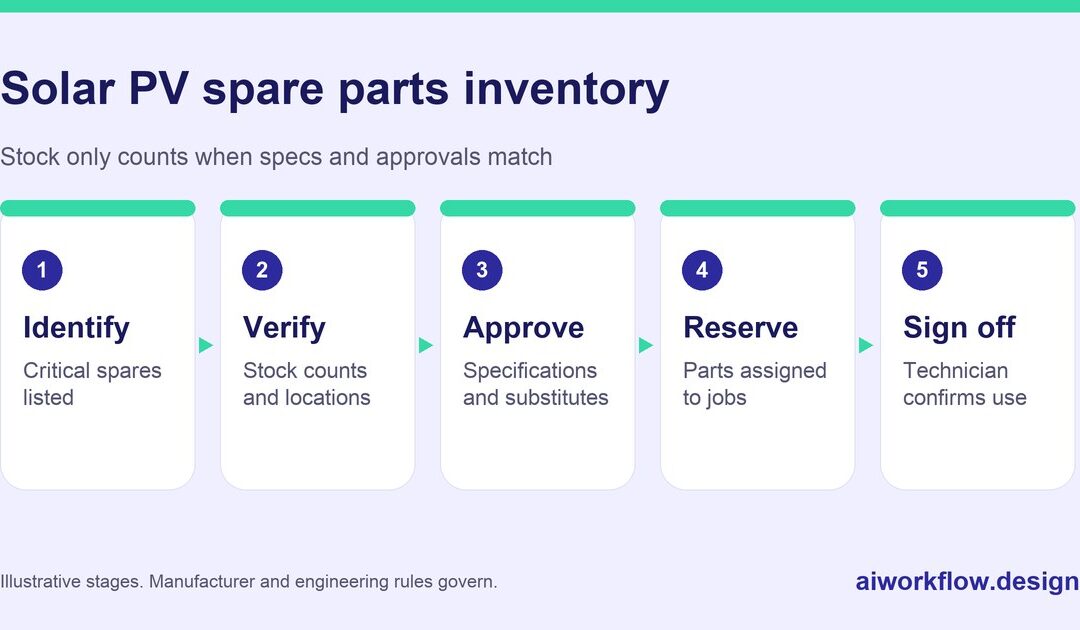
Quick answer: A solar PV spare parts inventory workflow should record what components are actually held, where they are stored, which sites they are compatible with, who may release them and how replenishment is approved. Link each replacement request to a technician’s diagnosis, approved part specification, delivery evidence and post-installation verification. A stock update can trigger a follow-up; it must not authorise a substitute component or declare a repaired system safe.
A solar operator can have a neat spreadsheet of spares and still lose days during a breakdown. The listed part is in another contractor’s warehouse, the revision differs from the installed equipment, or a replacement inverter has arrived but nobody has booked the qualified team needed to commission it. The core problem is not a lack of reminders. It is a missing chain between the asset register, engineering decision, purchasing record and work order.
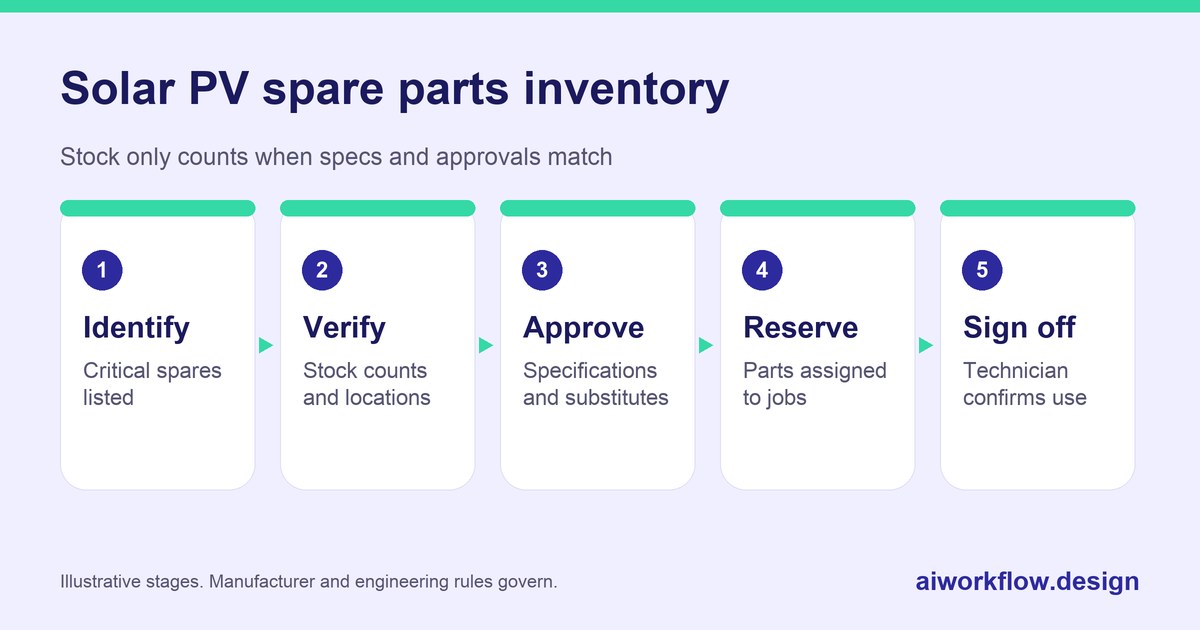
Start with assets and failure consequences, not purchase quantities
Build the inventory around real system configurations and maintenance obligations. The site owner should know which models and serial ranges are installed, their relevant manuals, approved firmware or hardware variants, warranty arrangements and common failure points. The US National Renewable Energy Laboratory’s PV O&M best-practices material recommends maintaining a spare-parts inventory with names, part numbers, counts and locations. That is a useful starting point—not a universal stocking prescription.
A commercial rooftop system with readily available components may need different stocking rules from a remote utility-scale plant with difficult site access. Ask the technical owner to classify components by impact of failure, lead-time exposure, compatibility restrictions, replacement competency and availability under existing vendor agreements. Use that review to propose minimum stock or reserved supply, then obtain the commercial owner’s approval.
Do not mix consumables such as approved labels or fuses with major electrical devices as though they present the same risk. A “fuse available” indicator is meaningless unless the exact rating, type, manufacturer constraints and approved replacement procedure have been checked by the responsible specialist.
Create a reliable parts master
For each approved item, maintain manufacturer, model, part number, revision or configuration, applicable site or equipment family, storage location, quantity available, quantity reserved, condition, procurement lead time and inventory owner. Where serial-number tracking is needed, use a serialised asset record instead of one quantity field. Some items require storage-condition controls, shelf-life reviews, battery handling rules or special packaging; link to the governing procedure.
Use unambiguous categories for new stock, tested serviceable returns, quarantine items and scrap. A faulty component placed on the shelf can make stock appear sufficient while increasing the risk of a repeat visit. Quarantined and awaiting-inspection equipment should never count as available for an urgent job. For high-value spares, maintain receiving, movement and release evidence rather than relying on manual count edits alone.
Location is not a vague label like “main stores.” A usable record identifies the site, store, bin or contractor custodian that can actually provide the item. If a supplier holds consignment stock, document the release process and contract terms; possession and ownership are not necessarily the same.
Separate a part request from an engineering decision
A technician may report that an inverter communication board appears defective, but that observation is not permission to ship the closest spare. Open a replacement request referencing the affected asset and work order. Attach the diagnostic evidence in the appropriate technical system and request a named engineer’s review of fault confirmation, approved replacement specification and any warranty conditions.
Only after approval should procurement reserve or order the item. Record whether the part is sourced under warranty, purchased, transferred from another site or supplied through an approved service agreement. Keep the financial authorisation separate from the technical substitution decision. A purchaser may approve spend; a competent engineer determines whether a revision or alternative part is technically acceptable.
Where the original model is discontinued, retain the manufacturer’s approved equivalence or change-control evidence. Do not use an AI-generated compatibility suggestion as authority. Replacement can affect electrical ratings, communications, protection settings, cybersecurity arrangements, compliance records and warranty rights.
Manage reservations and replenishment without creating phantom stock
A spare must move through explicit states: available, reserved, released, in transit, received onsite, installed, returned unused or quarantined. Reduce available inventory when an authorised reservation becomes firm, and record who can release the reservation if a job is cancelled. Without this separation, two urgent work orders can each appear to have claimed the same part.
Set replenishment triggers based on the owner’s stock policy, historical usage, approved criticality and actual supplier lead times. Do not automatically purchase every item below a number; a discontinued component or expiring contractual arrangement may need engineering or procurement review. Supplier acknowledgements should include part number and revision, delivery date, shipping conditions and any substitution notice.
If a delivery is short or damaged, log the discrepancy as a separate supplier claim and do not quietly mark the replacement job ready. Confirm whether packaging damage requires inspection before acceptance, particularly for electronics or fragile modules.
Tie spare-part dispatch to maintenance readiness
Having the right box onsite is only one part of the task. Check whether the qualified maintenance team, access permits, isolation procedure, lifting equipment, manufacturer instructions and test equipment are ready. A replacement that requires a programmed setting or firmware verification may have a different completion pathway from a simple consumable swap.
Link the inventory issue to the maintenance work order, recording the asset removed, asset installed, serial numbers, installation date, technician and technical test reference. Keep warranty return material authorisation (RMA) numbers and old-part disposition in a separate controlled chain when required. A vendor may require the removed component to be returned within a defined period; an installed part should not make that obligation disappear.
The maintenance supervisor or engineering authority—not the warehouse and not an automated phone call—must accept commissioning evidence and release the equipment for operation under the site’s rules.
Use monday.com as the coordination view
Create connected boards or groups for Approved Parts Master, Stock Locations, Reservations, Purchase Follow-Up, Installation Work Orders and Quarantined/Returned Items. Useful fields include Part Number, Revision, Compatible Asset, Custodian, Count, Reserved Count, Need-by Date, Requestor, Technical Approver, PO/RMA Reference, Receiving Evidence and Next Action. Restrict technical approval and quantity-adjustment rights to the appropriate roles.
A scheduled Autoza or Daily Check-in Agent call can ask a warehouse or supplier to confirm a promised shipment, revised ETA or missing receiving document, and surface that as a reported status in monday.com if the workflow is configured. It cannot perform a physical count, inspect an inverter board, approve a substitute part or sign a commissioning record. Treat every automated status as an input for review.
Where systems are integrated, make the inventory or enterprise asset management system authoritative for stock balances. Do not let two-way automations silently overwrite physical inventory with a caller’s estimate. Test duplicate orders, offline updates, cancelled jobs and delayed delivery acknowledgements before relying on an integration.
Work through three common inventory exceptions
The correct model is listed but not found. Hold allocation, initiate a cycle count or custodian check and record the discrepancy. Do not transfer an unverified quantity to a technician’s work order.
The vendor offers a newer revision. Route the notice to engineering with data sheets and manufacturer guidance; request a formal acceptance or rejection before procurement changes the purchase order.
A replacement is installed but the old unit is not returned. Keep the warranty-return or disposal item open, assigning the equipment custodian a deadline and evidence requirement. The installation ticket and contractual return requirement are two different obligations.
Measure reliability, not just stock volume
Review critical-spare availability at the time of a valid request, stock-record accuracy, orders with specification changes, time lost to incomplete receiving evidence, unresolved RMA returns and inventory write-offs. Measure by part category and site. “Stock value” alone tells little about whether the right component is available when a crew can access the site.
The best workflow produces traceability: why a replacement was needed, who approved the specification, where the stock came from, who installed it and which authorised record confirms the return to service. It complements—not replaces—engineering, warranty and asset-management systems.
PV spare parts inventory checklist
- Map approved components to installed assets and revisions.
- Verify physical location, condition, count and custodian.
- Classify critical parts using documented technical and commercial criteria.
- Obtain engineering approval before substituting components.
- Keep reserved, in-transit, available and quarantined stock distinct.
- Link procurement, delivery, installation and old-part disposition records.
- Confirm commissioning or functional test evidence with the authorised reviewer.
- Review accuracy and stock-out causes on a defined cadence.
Next step
Want these follow-ups handled consistently? Explore Autoza AI for monday.com or talk to AI Workflow Design about scheduled, permissioned status follow-ups that leave approvals and decisions with the right people. For a companion workflow, read Solar Vegetation Management: Track Shading, Site Access and Safe Remediation. More guides: browse our solar and renewable workflow guides or see all industries we support.
Frequently asked questions
What information should a solar spare parts inventory contain?
Include manufacturer, model, part number, revision, compatible assets, storage location, quantity, condition, reservations, custodian and approved replenishment rules.
Should a supplier automatically substitute a newer inverter part?
No. Engineering must confirm technical compatibility, required settings, safety, warranty and change-control requirements before the purchase or installation proceeds.
How do you prevent two jobs from claiming one spare?
Keep available, reserved, released and in-transit quantities separate, with a named inventory owner and documented reservation and cancellation rules.
Can a monday.com board be the only stock system?
It may serve as a coordination view, but the designated inventory or asset-management system should remain authoritative where it owns stock counts and movements.
When can a replacement work order be closed?
After the right component is documented as installed, required tests are accepted by authorised personnel and any remaining warranty or old-part return tasks are tracked.