
Quick answer: A regulated medical waste collection checklist should verify the facility’s approved waste stream, authorised vendor, ready-for-collection status, scheduled pickup, handoff documentation and evidence of receipt or processing required by local rules and contract. An AI follow-up can confirm a truck’s arrival or request a missing administrative record. It must not classify waste, instruct staff to open containers, approve unsafe transport or replace environmental health and safety oversight.
Waste collection becomes an administrative problem when schedules, site access, vendor records and compliance documentation do not match. A healthcare facility may have a pickup on the calendar but no receiving confirmation, or several departments may report that their designated storage area is nearing its approved limit. A supervisor needs to know what was collected and what remains unresolved—without turning a general-purpose task board into a hazardous-material control system.
Define regulated waste using the local rules
The term “medical waste” covers more than one category, and not all healthcare waste requires the same handling. Medical waste management is primarily governed at the state and local level, while infection-control and occupational exposure rules add further obligations. Sharps, microbiology waste, pathological material, certain pharmaceuticals, chemical waste and other special streams can follow different regulatory pathways. Do not merge them into one unspecific “biohazard pickup” task.
Before configuring reminders, obtain the facility’s approved waste-management plan, applicable state or jurisdiction rules, contractual schedules, transport requirements, emergency arrangements and named environmental health and safety (EHS) owner. Ask the EHS team to define which waste streams are in scope and which documentation is required for each. Where hazardous waste law imposes a formal manifest, use the legally required process; do not call every commercial pickup slip a regulatory manifest.
The administrative workflow should use approved waste-stream labels from the compliance system. A receptionist or automated assistant should never decide that a bag or container is non-regulated based on a caller’s description.
Keep operational readiness distinct from waste classification
A pickup can be scheduled only when the facility has confirmed that storage, segregation, packaging and collection arrangements meet the applicable procedure. The EHS or infection-prevention team owns those conditions. A scheduling coordinator may ask whether approved containers are ready, whether the designated collection area is accessible and whether there is an authorised handoff contact; the coordinator should not inspect waste content or direct staff to open sealed containers.
Regulated medical waste calls for appropriate containment, handling and disposal plans, and healthcare waste workers face biological, chemical and physical hazards. Those are reasons to establish clear procedures and training—not evidence that an AI agent can verify compliance by asking someone to say “all good.”
Use a limited readiness status: pending EHS review, ready under approved procedure, collection arranged, or issue escalated. If there is a damaged container, suspicious leak, missing label or other unsafe condition, follow the facility’s emergency or exposure-control protocol rather than the normal pickup workflow.
Build a collection record that follows the handoff
A reliable record includes Facility, Storage Area, Approved Waste Stream Code, Vendor, Service Agreement, Requested Pickup Date, Confirmed Window, Facility Contact, Collection Status, Vendor Reference, Required Document Type, Evidence Link, Review Owner and Next Action. Capture quantities or weights only from the facility’s approved measurement and vendor records; do not estimate volumes from a photograph or transfer personal information into the log.
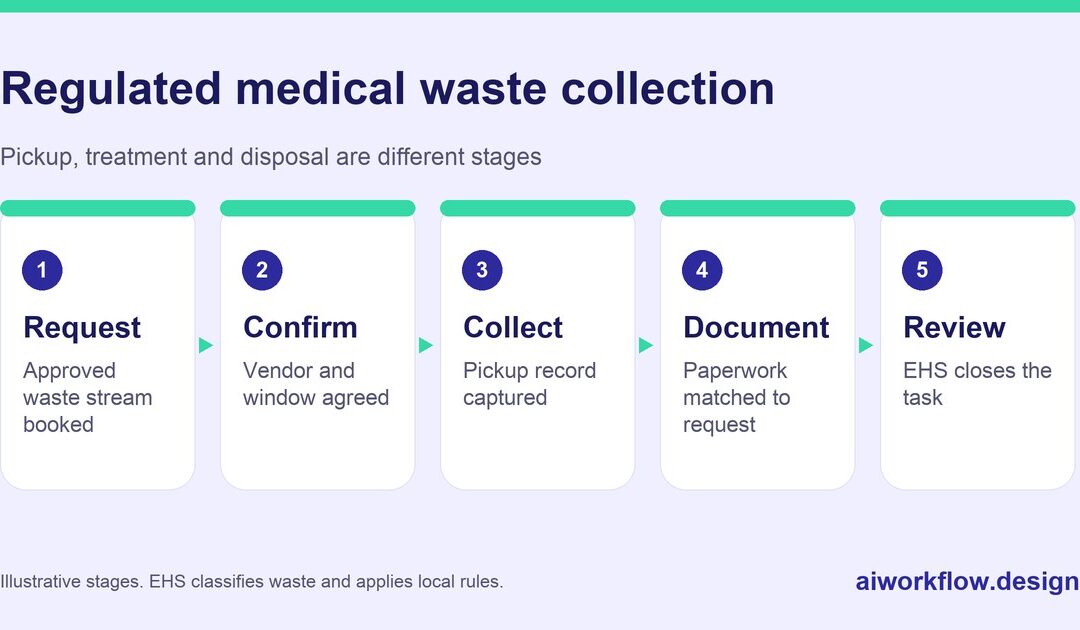
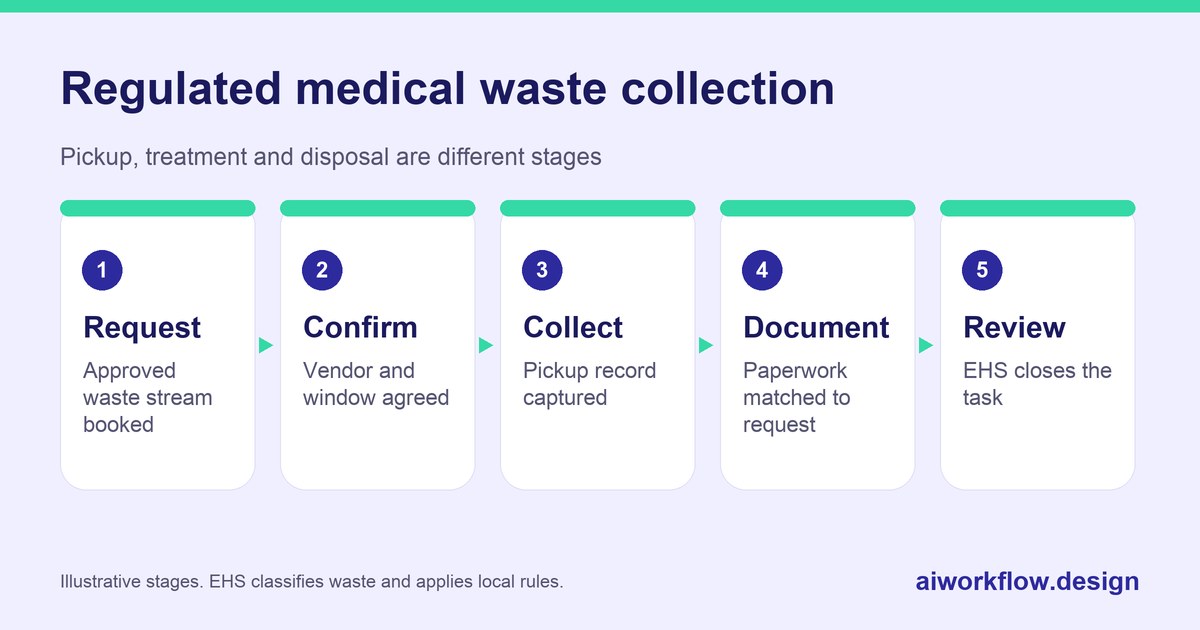
Separate at least four milestones: collection requested, vendor confirmed, pickup performed and receipt or other required documentation reconciled. A driver’s signature may prove a transfer event but may not prove downstream treatment or final disposition. The required end state depends on the waste stream, local law and contractual terms. If the facility requires confirmation beyond collection, keep the item open until the appropriate evidence arrives.
Confirm that the vendor is authorised for the waste and service in question. EHS and procurement should verify credentials, permits or approvals as relevant; an administrative scheduler should not infer legal eligibility from a truck logo or familiar supplier name.
Follow up on missing paperwork without changing source records
Decide in advance which document is expected: service ticket, pickup acknowledgment, chain-of-custody record, tracking form, regulated-waste documentation or legally required hazardous-waste manifest. Record its expected issuer, reference number, relevant date and retention location. Different documents may be needed for different streams; one generic attachment field can conceal an incomplete legal record.
When a document is missing, send the vendor a precise request that includes the authorised collection reference, facility and date—not patient details. Note the response and the accountable reviewer. If a recorded quantity, date or waste stream differs between facility and vendor evidence, preserve both originals and refer the discrepancy to EHS and the vendor. Do not silently overwrite one number to make the records match.
If a collection cannot be confirmed, escalate within the facility’s defined timescale and inspect storage constraints through authorised personnel. A missed pickup can create operational risk; rescheduling it is not equivalent to deciding that on-site storage is still permissible.
Plan around restricted access and failed collections
Healthcare waste pickup routes may cross loading docks, locked yards, patient-facing zones or other controlled areas. Confirm vendor arrival instructions, access authorisation, loading arrangements and the designated handoff person. Contractor credentialing, vehicle restrictions and approved collection times may differ between hospitals and smaller clinics.
Where collections are disrupted by holidays, weather, vehicle problems or access denial, document the failed attempt and who is accountable for the next arrangement. Do not copy a standard cadence from another hospital without checking local storage rules and waste-generation patterns. If operational conditions change, the EHS team should determine whether additional controls, alternate authorised vendors or urgent action are necessary.
An access failure should not be resolved by instructing an unverified driver to use another door or leaving regulated waste in an uncontrolled location. Follow the facility’s incident and security procedures.
Coordinate via monday.com without storing sensitive detail
A monday.com board can display the status of scheduled services, missing vendor records, contractual reminders and assigned follow-ups. Group by collection location, vendor or document status. Restrict board access according to need and link to approved compliance repositories for source evidence. Do not upload patient identifiers, incident details, photographs of potentially identifiable material or sensitive staff health information into a general operations board.
If configured and permitted, Autoza AI for monday.com or a Daily Check-in Agent can ask the vendor’s dispatch contact whether the scheduled pickup occurred and which reference number was issued. Its response is vendor-reported administrative information. The tool does not inspect waste, validate container integrity, classify hazardous material or sign legal documents. Use human review for compliance closure.
Custom workflow automations could route outstanding collection documents to the EHS owner or flag a booking without a vendor acknowledgment. Build safeguards against duplicate tickets, mistaken location matches and cancelled services. Keep a way to escalate a safety incident immediately outside the normal reminder sequence.
Investigate recurring exceptions
The driver reports the waste is not ready. Record the reason supplied, tell the EHS owner and do not mark the pickup complete. Avoid asking reception staff to determine whether a container is compliant.
A pickup receipt shows a different quantity. Retain both records, verify the measurement basis with the authorised parties and document any approved correction. Do not substitute an average value to clear the task.
A collection was performed but treatment evidence is outstanding. Check which downstream record is actually required. Follow up with the contract owner and vendor without claiming that collection equals final disposal.
The normal vendor cannot attend. Ask procurement and EHS whether an approved alternative exists and whether the site’s contingency plan applies. Do not choose a new carrier from a search result during an urgent situation.
Measure records and resolution, not waste volume alone
Review missed scheduled pickups, document reconciliation time, collections with unresolved discrepancies, repeat access failures, vendor-response delays and overdue corrective actions. Segment the results by site and approved waste stream where appropriate. Do not present lower waste volume as a success metric without understanding changes in clinical activity or classification.
The objective is a traceable administrative handoff that helps authorised staff manage compliance. The collection board is valuable precisely because it shows incomplete evidence and open exceptions; it should never become a substitute for proper waste handling, medical safety rules or environmental regulation.
Regulated medical waste collection checklist
- Confirm the approved waste stream and applicable local requirements.
- Identify the authorised vendor and required pickup documents.
- Have EHS verify the approved readiness and storage process.
- Record the booked time, facility contact and access instructions.
- Keep request, confirmation, pickup and documentation review separate.
- Escalate damaged containers, leaks or other hazards through site procedures.
- Reconcile missing or conflicting vendor records without overwriting originals.
- Close the administrative task only after authorised evidence review.
Next step
Want these follow-ups handled consistently? Explore Autoza AI for monday.com or talk to AI Workflow Design about scheduled, permissioned status follow-ups that leave approvals and decisions with the right people. For a companion workflow, read Hospital Loaner Equipment Returns: Confirm Decontamination and Vendor Pickup. More guides: browse our healthcare administration workflow guides or see all industries we support.
Frequently asked questions
What must be tracked for a regulated medical waste pickup?
Track the approved waste stream, licensed or authorised vendor as applicable, pickup window, facility contact, collection record, required document and unresolved discrepancies.
Does every hospital medical waste pickup need a federal hazardous waste manifest?
No. Documentation obligations depend on the waste stream and applicable federal, state and local rules. EHS should determine which specific forms are required.
Can a pickup receipt prove final disposal?
Not necessarily. Pickup, vendor receipt, treatment and final disposition are different stages; track the evidence required by law, contract and facility policy.
Can AI classify waste from a phone description?
No. Classification, safe handling, packaging, and incident decisions belong to authorised EHS and infection-prevention personnel.
How should a missed medical waste pickup be handled?
Document the failed collection, alert the approved vendor and EHS owner, and follow the facility’s contingency and storage procedures before arranging a new visit.