
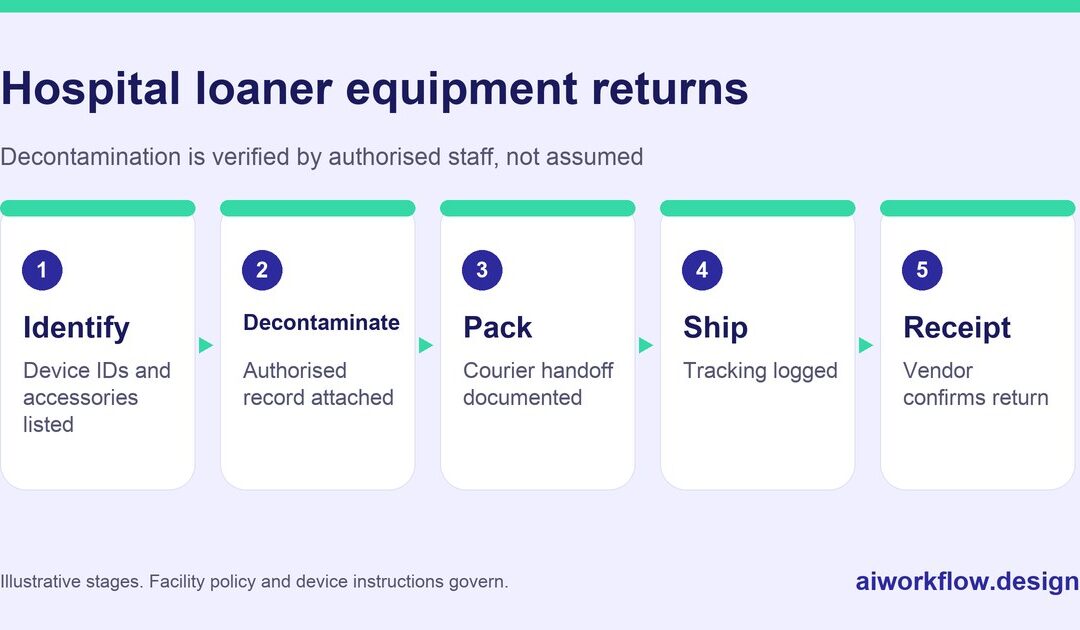
Quick answer: A hospital loaner equipment return workflow should match the physical device to its loan agreement, verify its service status and accessories, route cleaning or decontamination through authorised infection-prevention procedures, obtain the required release evidence, and confirm vendor collection and receipt. A scheduling assistant may chase a pickup confirmation, but it must not certify decontamination, approve device reuse or expose patient information.
Loaner medical equipment solves an immediate operational need and creates an easily overlooked second job: returning it correctly. A borrowed pump, monitor or non-invasive device may be moved between departments, held while a permanent unit is repaired, or left in a store after a procedure. The original delivery ticket says the asset arrived; it may say nothing about where the device is now, whether all accessories are present or whether it can safely leave the facility. Those are separate records with separate owners.
Identify the exact device and the return obligation
Start from the loan, trial or rental agreement. Record the vendor, agreed return process, asset type, manufacturer, model, serial or unique device identifier when available, hospital equipment reference, accessories, loan start date, contractual end or return trigger, and equipment custodian. Match these details against the physical device before creating a shipping request.
A return may be triggered by the end of a trial, delivery of a purchased replacement, completion of a repair, a vendor recall or a clinical department’s decision to stop using the equipment. Each has different consequences. A vendor recall may need urgent technical and safety escalation; a routine end-of-loan return may primarily require scheduling and documentation. Do not treat both as generic overdue pickups.
Confirm who has authority to release the item. The clinical department may confirm it no longer needs the loaner, while biomedical engineering, infection prevention and materials management have other responsibilities. A courier collection date should be booked only after the necessary local release checks are planned.
Reconcile accessories and remove the device from service correctly
Use an itemised return list: main unit, cables, batteries, chargers, sensors, mounts, carrying cases and manufacturer-supplied consumables where relevant. If an accessory is missing, note what is missing, who is searching, whether the vendor permits a partial return and whether a separate replacement or charge requires commercial review. Do not place an unverified “complete kit” flag on the record because a driver is already scheduled.
The department must follow its established procedure to take the item out of use. Confirm whether any clinical data, network configurations, storage media or user accounts require approved handling before transfer. This can be particularly important for connected devices. The manufacturer and hospital IT or biomedical team should decide what information may be removed and how. An administrative agent should never ask for patient records or execute a data wipe.
If the device is suspected of malfunction or has been involved in an adverse event, preserve relevant evidence and follow the hospital’s incident reporting and investigation procedures. Routine cleaning and shipment may need to be paused until authorised personnel determine the correct process.
Make infection-prevention release a separate gate
A device may look visibly clean and still require a documented cleaning or decontamination step before it is handled or shipped. The applicable procedure depends on the device, its use, manufacturer’s instructions for use, local infection-prevention policy and the destination. Cleaning, disinfection and sterilization are risk-based categories; there is no single process appropriate to every loaner.
Reusable equipment is commonly accompanied by a decontamination-status certification before a third party inspects, services or repairs it. A hospital should follow its own governing policies, device instructions, vendor requirements and applicable rules rather than assuming that any one form is automatically mandatory. The transferable lesson is that cleanliness claims and release responsibility must be explicit.
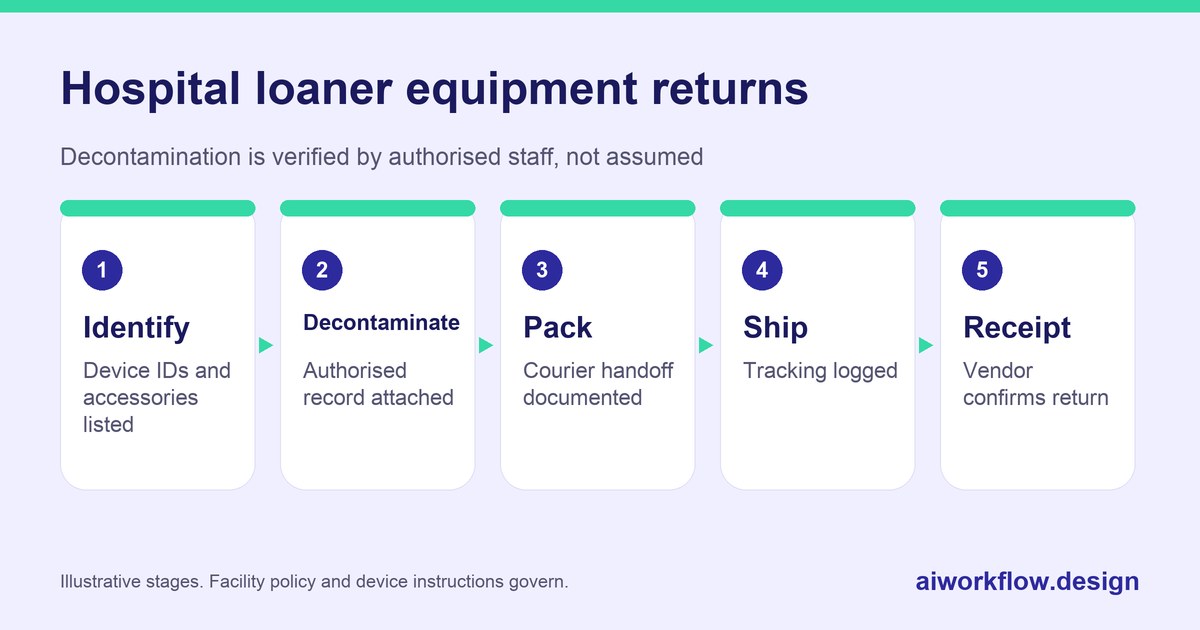
Create statuses for Decontamination Needed, Completed by Authorised Team, Certificate or Record Attached, and Reviewed for Shipment. The person who cleaned or assessed the device should supply the required documentation. Neither a vendor pickup acknowledgment nor an automated status question can substitute for that professional confirmation.
Protect people and information during packaging
Before collection, confirm the manufacturer’s return packaging requirements, appropriate labels, security controls, transport method and documentation. Some devices need protective cases, special battery handling or separate arrangements for contaminated or damaged equipment. The shipping team should not guess at biological hazards, battery classification or permitted packaging. Refer uncertainties to biomedical engineering, infection prevention, logistics and the vendor.
Do not store patient labels, clinical screenshots, diagnosis details or sensitive device logs in a general project board. Keep the required technical or data-removal records in approved systems. Share with the courier only the information legitimately necessary for collection and transport. Where chains of custody are required, retain sender, recipient, dates, identifiers and any seal or tracking evidence.
A collection booking is not the same as an item leaving the hospital. A tracking number is not proof that the vendor has accepted all returned components. Retain these steps as separate milestones.
Build a return workflow in monday.com
A practical record can contain Return ID, Vendor, Device Reference, Department Custodian, Loan End Trigger, Accessory Check, Technical Hold, Decontamination Status, Authorised Release Owner, Packaging Ready, Pickup Window, Courier Tracking, Vendor Receipt and Next Follow-Up. Use restricted links for sensitive evidence rather than open attachments. The hospital’s asset-management and infection-control systems remain authoritative for the underlying decisions.
Autoza AI for monday.com or the Daily Check-in Agent could ask an administrative owner whether the vendor has sent a label, whether the courier attended or whether a receipt confirmation is outstanding, provided the integration and permissions are approved. It must not confirm that a device is sterile, request clinical details, change its clinical availability or issue an infection-prevention certificate.
If an integration syncs a vendor’s ticketing system, avoid automatic closure on “picked up.” Close only after the chosen acceptance condition is met, such as documented vendor receipt and reconciliation of disputed accessories. Retain a human override and a clear exception owner.
Resolve the exceptions that cause lost loaners
The device is still needed when the loan ends. Route an extension request to the clinical sponsor and contracting owner before telling the vendor that the agreement has changed. Do not assume ongoing use equals a renewed contract.
A nurse reports an accessory is missing. Preserve the discrepancy, check storage locations and notify the vendor under the agreed process. The inventory custodian and commercial owner handle responsibility for replacement costs.
The courier arrives before release evidence is complete. Hold the shipment and notify the vendor. Avoid asking receiving or transport staff to sign a decontamination assertion outside their competence.
The vendor receives the device but disputes condition. Keep photographs, chain-of-custody records, the condition noted at release and the vendor’s written finding. Direct the issue to biomedical engineering and procurement rather than inventing a damage conclusion in the workflow board.
Measure closure beyond the pickup date
Useful indicators include loaners past agreed return triggers, equipment with unmatched serial numbers, missing accessory records, return bookings held for release evidence, collected items without vendor receipts and unresolved vendor discrepancies. Each measure should have a responsible owner and a documented data source.
The goal is not to force faster shipment at the expense of safe handling. It is to reduce untraceable devices, prevent repeated chases and keep clinical, technical and infection-prevention authority intact. A complete return record shows what was returned, how it was cleared, who took possession and which obligations remain open.
Confirm vendor acceptance and the end of financial obligations
Physical return is not always the end of the loan agreement. The vendor may need to inspect the device, acknowledge all serialised accessories, issue a final statement, or confirm that recurring rental charges have stopped. Procurement should verify which contractual conditions apply. Do not assume that a courier tracking page showing “delivered” is equivalent to vendor acceptance of the equipment’s condition and completeness.
Maintain an exceptions subrecord for any contested device identifier, damage allegation, incomplete kit or disputed return date. Link the original loan terms, authorised release record, shipping reference, vendor findings and commercial response in the appropriate systems. When a vendor sends a replacement charge, the finance owner should check whether the charge is supported rather than treating every invoice as proof of damage.
If the hospital regularly uses loaners, a monthly reconciliation between biomedical engineering, the clinical custodian and procurement can identify forgotten items before renewals or charges accumulate. Review equipment still in clinical use separately from items physically stored but awaiting shipment. The first may need an approved extension; the second may need a packaging or collection intervention. Neither status should be automatically classified as a vendor fault.
Hospital loaner equipment return checklist
- Match the physical unit and accessories to the loan record.
- Confirm the clinical and contractual return trigger.
- Check for technical holds, incidents and data-handling requirements.
- Obtain required cleaning or decontamination evidence from authorised personnel.
- Verify approved packaging, labels and transport arrangements.
- Record courier collection separately from vendor acceptance.
- Reconcile missing items, charges and condition disputes with named owners.
- Close only when the required return evidence is complete.
Next step
Want these follow-ups handled consistently? Explore Autoza AI for monday.com or talk to AI Workflow Design about scheduled, permissioned status follow-ups that leave approvals and decisions with the right people. For a companion workflow, read Regulated Medical Waste Collections: Track Pickup Records and Exceptions. More guides: browse our healthcare administration workflow guides or see all industries we support.
Frequently asked questions
What should a hospital loaner equipment return checklist include?
Match the device and accessories to the loan, confirm service release, required cleaning or decontamination evidence, approved packaging, pickup and vendor acceptance.
Can a courier pickup receipt prove the device was decontaminated?
No. Cleaning or decontamination must follow the device-specific facility process and be documented by authorised personnel before shipment where required.
What if a loaner has patient data or network settings?
Refer it to the hospital’s approved biomedical and IT data-handling process. Do not copy sensitive device records into an unrestricted coordination board.
Can an AI status call approve a loaner device return?
It can chase an administrative booking or receipt. It cannot certify infection-prevention compliance, clear a technical incident or approve clinical reuse.
When is a hospital loaner return closed?
When the agreed evidence is complete, including vendor receipt and reconciliation of any missing parts, condition disputes or contractual return obligations.