
Answer in brief: An after-hours property maintenance process needs an immediately reachable human for safety-critical situations, a documented method to route repair requests, and a controlled follow-up record for non-emergency vendor tasks. Automated calls can check whether a contractor has accepted an assigned job and when an update is expected. They should not diagnose emergencies, decide that a property is safe or delay access to emergency services.
The operational problem after the office closes
A resident reports a leak at 10 p.m. The property manager needs to know whether an emergency responder is required, who is on call, which vendor has been contacted, whether the resident has received the appropriate instructions and who will check the repair the next morning. Without a clear on-call process, repeated messages go to the wrong inbox, vendors may receive incomplete details and the morning team cannot tell whether the issue is active.
A good after-hours system does not try to make every request fit into a single chatbot label. It separates urgent human response from routine administrative follow-up. The process must reflect the property’s service agreement, applicable local law, resident communication obligations and real building conditions. Those cannot safely be inferred from a short automated conversation.
Establish emergency routes before defining call schedules
People must know how to reach emergency services, the on-call manager and relevant utility or building contacts without waiting for an AI callback. Immediate threats such as suspected fire, a gas leak, severe electrical danger or another life-safety concern should follow emergency instructions and local response arrangements. A maintenance assistant must not be presented as an emergency operator.
Other reported problems may be urgent for comfort, property protection or tenancy requirements, even if no immediate threat is known. Loss of heating, water supply, active intrusion or a leak can require prompt action under location-specific rules. The authorised on-call manager, not the AI, should assess the situation and assign priority based on verified information and policies.
Use a human-owned triage and escalation matrix
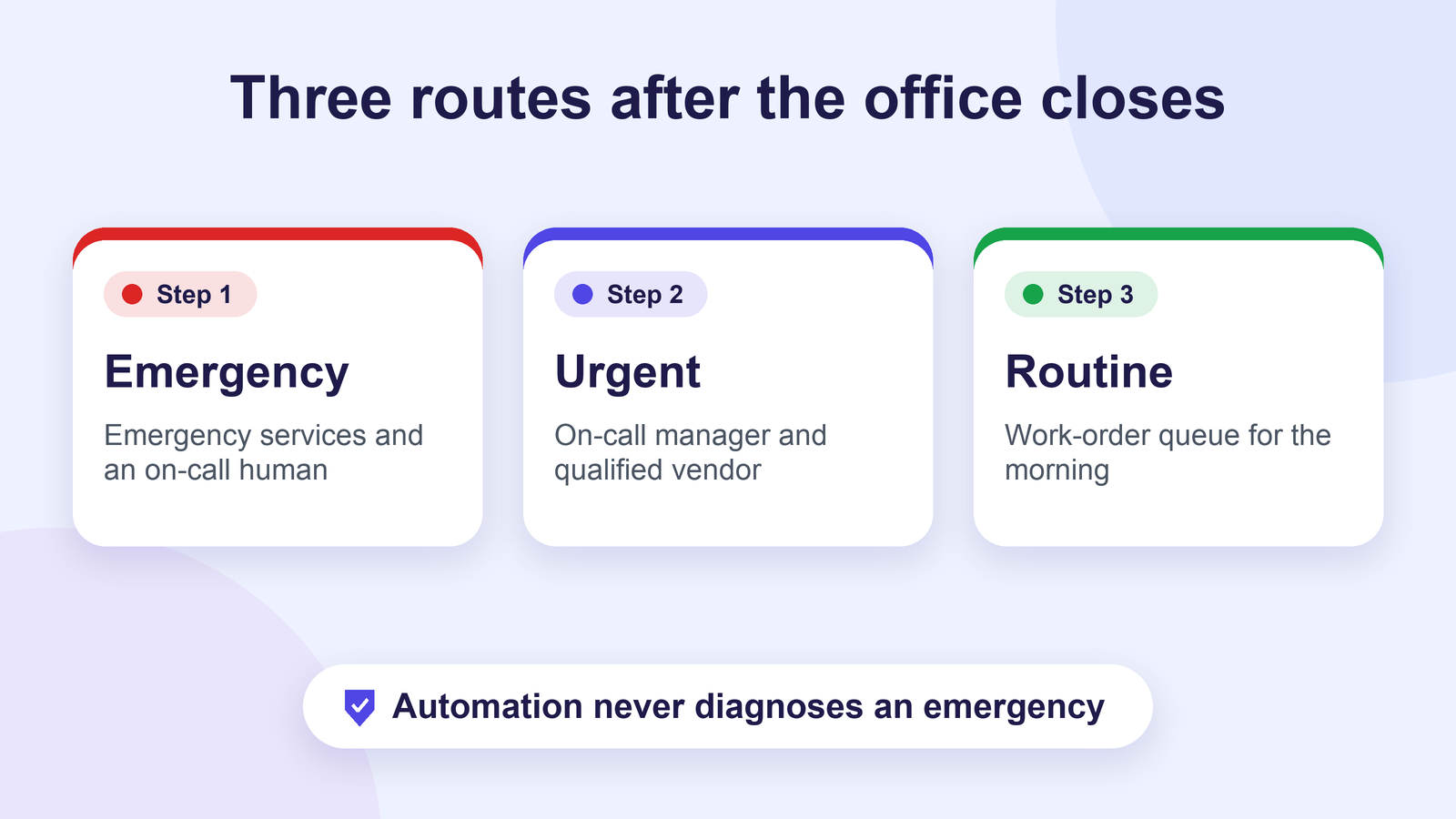
| Reported situation | First route | Follow-up information to track |
|---|---|---|
| Immediate threat to life or safety | Emergency services and designated building response | Incident reference and human owner; no automated diagnosis |
| Potentially serious building-system failure | On-call manager and qualified service provider | Contact time, vendor acknowledgment and next update |
| Active damage without confirmed immediate danger | On-call manager following property protocol | Area affected, protective actions assigned and work order |
| Routine non-urgent repair request | Normal service queue and working-hours team | Work order, access preference and planned appointment |
This table is an illustrative routing framework, not a universally applicable legal classification. Local habitability rules and the specific circumstances determine obligations. Do not label a request non-urgent simply because the caller provided limited information.
Give every incident a clear accountable owner
For each work order, record the property and unit identifier only within the appropriate secured system, request category, receipt time, on-call decision maker, selected vendor, acknowledgment status, next update time and secure evidence location. If a contractor says it will attend, separate the promise from confirmed arrival. If the resident has not been reached, do not assume access has been granted.
A useful status vocabulary is ‘Reported’, ‘Manager assessing’, ‘Vendor contacted’, ‘Vendor accepted’, ‘On site reported’, ‘Work pending verification’ and ‘Closed after authorised review’. Use the organisation’s real terminology where appropriate. Avoid a single ‘Resolved’ button that can be triggered merely by a vendor’s verbal ‘finished’.
Define when to follow up with vendors
Once a human has assigned a repair, a scheduled vendor follow-up may ask whether the work order was received, whether the vendor can attend within the agreed window, what access or materials are needed and when the manager should expect the next update. If the vendor cannot attend, the next step is a human decision about a replacement provider or an alternative plan, not an automatic promise to the resident.
Set the frequency according to urgency, service-level commitments and permitted contact hours. An unanswered vendor call means contact has not been established. It does not prove the technician failed to travel or the repair was neglected. Escalate through the defined backup number or on-call supervisor if the response deadline is missed.
Keep sensitive resident information out of routine calls
An automated status check generally does not need a resident’s medical details, intimate circumstances, payment data, entry codes or unrelated personal history. Provide the contractor only the minimum authorised information needed to identify and carry out the assignment. Use a secure work-order system for sensitive access instructions and approved contact details.
Protect recordings and transcripts where they are used, including notice, lawful basis, retention, access and deletion rules relevant to the jurisdiction. If a resident reports a vulnerable person’s immediate need, route it promptly to the designated human response process rather than asking the AI to assess welfare or medical risk.
Create a morning handover that shows what is still unresolved
The morning property team should receive a concise list of overnight reports with ownership, last verified status, resident-contact status, planned attendance and next decision. Show which cases still require an inspection, repair evidence, manager confirmation or resident update. Do not automatically close the work order when an external vendor says ‘done’.
For example, a contractor might report that a leak has stopped and a temporary repair was performed. The morning team still needs to check whether a permanent repair is scheduled, whether affected areas require further assessment and whether the resident received an accurate update. A status call helped collect information; closure required additional human review.
Using monday.com and scheduled check-ins responsibly
For property teams already using monday.com, a proposed approach is to maintain each repair as a work item with an assigned owner and a linked vendor follow-up. AI Workflow Design describes Autoza AI as a scheduled check-in and board-update product. Confirm the actual available field mappings and call workflows before connecting it to any resident or vendor process.
Our earlier guide on mapping vendor call answers to maintenance status fields offers more detail about separating reported status from verified completion. After-hours escalation adds an important layer: calls for routine updates must never obstruct direct access to an on-call person or emergency response.
A practical implementation checklist
Review emergency routes and verify they work. Assign an on-call primary and backup. Define which jobs need urgent human assessment; document the vendor list and access rules; set permissible follow-up windows; build the work-order fields; test no-answer and rejected-assignment scenarios; and train the next-day team to review unresolved issues. Repeat the exercise with local legal and safety requirements in mind. A process that looks efficient on a dashboard must still work for a resident facing a real problem at night.
Next step: If your team uses monday.com to manage authorised contractor follow-ups, discuss an Autoza workflow review for routine status collection while keeping emergency triage and dispatch under human control.
Frequently asked questions
Which repairs need emergency escalation?
Any report suggesting an immediate risk to life or safety should be routed through emergency services and the property’s response procedure. Other urgency categories depend on local requirements, building conditions and a qualified human assessment, not an AI-generated diagnosis.
Who authorises an emergency contractor?
The on-call property manager or another person with the authority defined in the property’s policies and contracts. The AI may record whether an assignment has been accepted, but should not independently authorise spending or emergency works.
What should not go into a routine status call?
Avoid unnecessary medical or personal information, payment details, door codes, secrets, unrelated tenant data and unverified judgments about safety. Use secure systems and approved processes to share essential information with the correct people.
Can a missed vendor call be counted as a missed appointment?
No. A failed call establishes only that the vendor did not answer that attempt. Confirm actual attendance through the work-order record, vendor follow-up and authorised on-site verification before making a conclusion.
Does a vendor saying ‘fixed’ automatically close the work order?
No. A reported completion may require evidence, a follow-up inspection, documentation and resident communication. The property manager should apply the defined acceptance standard before closure.
Related reading
- Mapping Vendor Call Answers to monday.com Maintenance Status Fields
- Vendor Calls vs Portal Notifications: Which Repair Updates Need Human Attention?
- How to Follow Up With Maintenance Vendors Without Chasing Every Work Order
- Open Maintenance Work Orders: What Property Managers Should Check Each Morning
- Storm Recovery Work Orders: A Property Vendor Update Checklist
- Autoza AI for monday.com: scheduled status calls
- Workflow automation services
- Daily Check-in Agent