
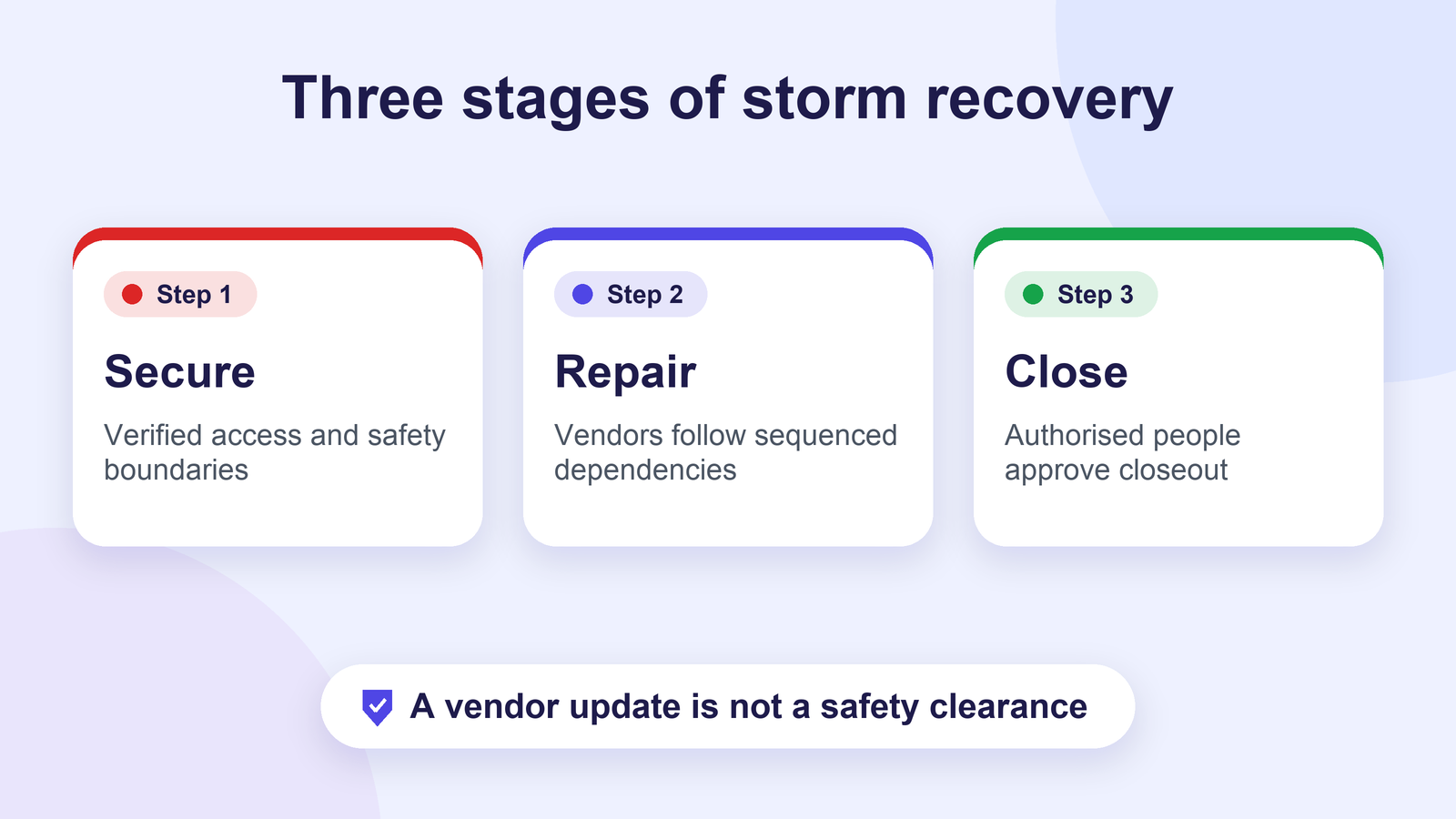
Answer in brief: After a storm, property teams should organise recovery work orders by verified safety access, damage documentation, emergency stabilisation, professional assessment, repair dependencies and human approval. A vendor’s phone update can document progress against an assigned task, but it cannot establish that a building is safe, that the insurer has accepted a claim or that a resident may reoccupy a damaged unit.
Why storm recovery needs a different workflow
A storm can create dozens of related property tasks in one day: blocked access routes, roof damage, water intrusion, temporary protection, drying, electrical inspections, contractor scheduling, insurer documentation and resident updates. A single ticket marked ‘Storm damage’ cannot show which actions are safe to begin or which trade is blocked by another. Speed is important, but rushing an unsafe inspection or incomplete repair can create more damage.
The project manager needs a sequence, an accountable owner and a record of what was observed versus what was verified. Build the workflow around the property, affected area and event date. Do not assume all locations suffered the same conditions. One building may need temporary roof protection while another requires an electrical safety assessment before anyone enters.
First: establish access and safety boundaries
Emergency officials, qualified building professionals and the property’s designated safety response process govern re-entry and critical work. The CDC’s guidance on returning home after a disaster recommends professional safety inspection when damage is apparent and warns against electrical hazards, contaminated water and unsafe structures. The EPA’s flooded-home guidance stresses waiting for professionals to confirm safe re-entry.
That means a scheduled AI caller must not ask a technician to certify structural safety, advise a resident that water is safe or bypass electrical controls. If a person reports suspected structural instability, a gas hazard, downed electricity, flooding or another urgent concern, the matter needs direct human and emergency routing. No automated green status should override the applicable authority or qualified inspection.
Break the response into six work-order categories
| Category | Example tasks | Completion evidence |
|---|---|---|
| Immediate protection | Control access, emergency response, temporary weather protection | Authorised response record |
| Initial documentation | Date-stamped photographs, affected areas and incident notes | Controlled photo and inspection files |
| Specialist assessment | Electrical, structural, roof or water-damage assessment | Report by the qualified specialist |
| Remediation | Water removal, drying, safe debris clearance, temporary works | Contractor logs and appropriate verification |
| Permanent repair | Roof, facade, service or interior restoration | Work evidence and inspection/acceptance records |
| Resident and insurer coordination | Status notices, claim evidence and repair scheduling | Recorded communications and submissions |
The categories are not a mandatory universal sequence. A site-specific emergency plan may change the order, and some activities can overlap after safety conditions have been established. Each task needs a separate owner and a record of any dependencies or approvals.
Record the right details without overloading the board
For every work order, include site or building ID, affected area, responsible vendor, task category, priority assigned by the human response team, last verified update, evidence location, access status, next dependency and decision owner. Where residents are involved, maintain appropriate privacy controls and avoid putting sensitive personal details in broad project notes.
A contractor’s ‘cleanup complete’ update is not the same as a moisture assessment, a specialist clearance, an accepted insurance estimate or a completed permanent repair. Keep the status of each separate. Use source documents for facts that matter to the insurer or building authority and preserve the timestamps and authorship of evidence.
Prepare vendor calls around specific milestones
A storm recovery check-in should not ask only ‘Are you finished?’ For temporary protection, ask whether the assigned protective action was attempted and whether a qualified person identified any unresolved risk. For a remediation contractor, ask what area was treated, what evidence was logged and which specialist review remains outstanding. For a roofing contractor, ask whether the correct materials and access plan are available and what work is still dependent on inspection or weather conditions.
The call should refer to a specific work-order ID and must allow ‘unable to assess’, ‘access restricted’, and ‘awaiting professional decision’. Do not force workers to give a completion percentage where the scope of damage is still unknown. Weather conditions and contractor safety procedures may prevent attendance even when a job is urgent.
Track insurance documentation separately from repair progress
Property owners and managers should contact their insurer according to the policy’s requirements and document damage before cleanup where it is safe and appropriate. The CDC’s disaster guidance also advises photographing belongings and contacting insurers before cleanup. Do not assume the insurer has accepted a claim merely because photographs have been uploaded.
Store claim references, authorised estimates, change instructions and receipts in the appropriate controlled document repository. A general status call can ask whether the documents have been submitted and to whom, but should not take sensitive policy details or make representations about coverage and payment decisions. Those belong to the insurer and authorised representatives.
Map repair dependencies so contractors do not work out of sequence
A permanent interior finish may depend on stopping water entry, completing necessary drying and obtaining the relevant inspection or clearance. A roof repair may depend on a safe access plan and suitable weather. A resident return may depend on official or professional determinations beyond the contractor’s scope. Represent these relationships explicitly, using a dependency field or linked tasks if the system supports them.
monday.com has dependency-column functionality that can help show predecessor relationships. However, the board does not make a building safe. It communicates that a named, authorised person has reviewed the actual prerequisites and recorded the result.
Create a daily recovery briefing that supports decisions
Sort work orders by safety restriction, outstanding specialist input, active damage, temporary protection, access limitation, resident communication and repair sequencing. For each issue, show who must act next and by when the next reliable update is expected. Separate ‘work reported complete’ from ‘work accepted’ to avoid premature closeout.
For example, an illustrative event might involve roof water entry and three affected rooms. The temporary-protection vendor reports attendance; a drying contractor records mitigation activity; a qualified electrical professional still needs to assess affected circuits. The dashboard should display the unresolved electrical dependency clearly. It should not suggest that the rooms are fit for use because two other tasks are marked complete.
How scheduled AI calls can help the recovery coordinator
AI Workflow Design’s Autoza AI for monday.com is described as providing scheduled check-ins and updates into monday.com. A suitable proposed application is to follow up on non-emergency vendor task status, record an estimated next update and notify the assigned coordinator about a blocker. Confirm available configuration, consent and call permissions before deploying it into disaster operations.
For details about status mapping, see mapping vendor answers into monday.com maintenance fields. The recovery version should add strict access and approval controls, because contractor-reported updates are not evidence of habitability, safe reoccupation or insurance coverage.
The closeout checklist
Before the final work order is closed, review whether temporary works have been superseded or documented, required inspections and certifications are stored, remaining defects have an owner, the insurance and financial documents are reconciled where appropriate, and residents received accurate instructions from authorised personnel. Retain records under the property’s applicable legal and policy requirements. A concise, truthful recovery record is more valuable than a dashboard that prematurely shows everything complete.
Next step: Property teams using monday.com can explore an Autoza vendor follow-up review for controlled project updates while preserving human-led emergency response, inspection and reoccupation decisions.
Frequently asked questions
How do property teams track multiple storm repairs?
Use a work order for each distinct task or location, group them by response phase, and assign owners, evidence links, dependencies and next update dates. Keep the source documents for inspections, insurer communications and completion verification outside casual call notes.
Who confirms a unit is safe to reoccupy?
The appropriate local authorities and qualified professionals, according to the damage and jurisdiction. A property manager should follow the required clearance and resident communication process; an AI call or contractor self-report alone is not sufficient.
What evidence belongs off the call?
Detailed photos, specialist inspection findings, insurance submissions, estimates, permits, test results and documents containing sensitive personal data belong in controlled systems. A routine call can reference the document or confirm whether it was submitted.
Can an AI caller assign emergency priority to a damaged building?
Not independently. Potential life-safety reports must follow emergency response procedures and qualified human assessment. Routine automation should collect operational status only after the appropriate response owner has assigned the work.
When should a storm-recovery work order be closed?
Only after the organisation’s authorised reviewer checks the required evidence, dependencies, inspections and resident communications for that task. A vendor’s spoken completion claim is one piece of information, not automatic acceptance.
Related reading
- Mapping Vendor Call Answers to monday.com Maintenance Status Fields
- Vendor Calls vs Portal Notifications: Which Repair Updates Need Human Attention?
- How to Follow Up With Maintenance Vendors Without Chasing Every Work Order
- Open Maintenance Work Orders: What Property Managers Should Check Each Morning
- After-Hours Property Repairs: A Triage and Human Escalation Plan
- Autoza AI for monday.com: scheduled status calls
- Workflow automation services
- Daily Check-in Agent