
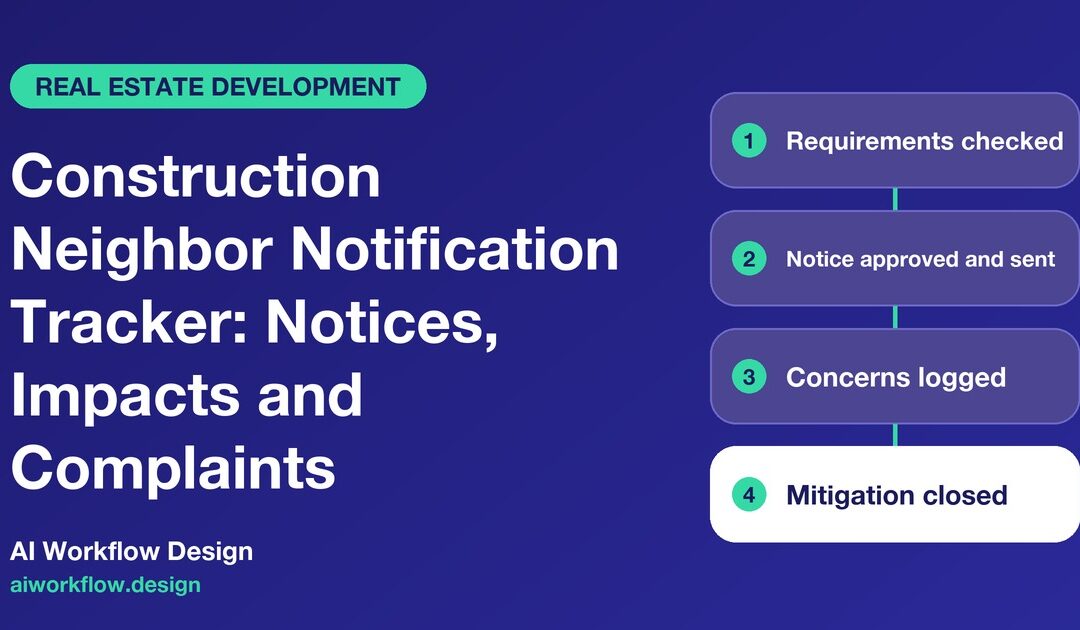
Quick answer: A construction neighbor notification tracker helps developers document who may be affected by upcoming works, which notice is required, the approved message, delivery evidence, incoming concerns, response owners and unresolved mitigations. It separates routine communications from the site’s legal obligations, safety controls and incident response. An automated reminder can chase an unanswered contractor update; it must not promise that noisy or disruptive work is authorized to proceed.
On a mixed-use development, the site team plans overnight deliveries, a temporary footpath change and a week of demolition activity. The planning team has one set of conditions, the contractor’s look-ahead schedule has another, and the community liaison officer is answering neighbours with information from last month’s program. Even when site work is lawful, inconsistent communication can create avoidable friction and make genuine hazards harder to recognize.
This is not simply a reputation problem. Advance notices, monitoring, permits and complaint routes may be specified in local approvals or codes. The developer needs one traceable process that connects planned activities to the people responsible for the impacts and the communications.
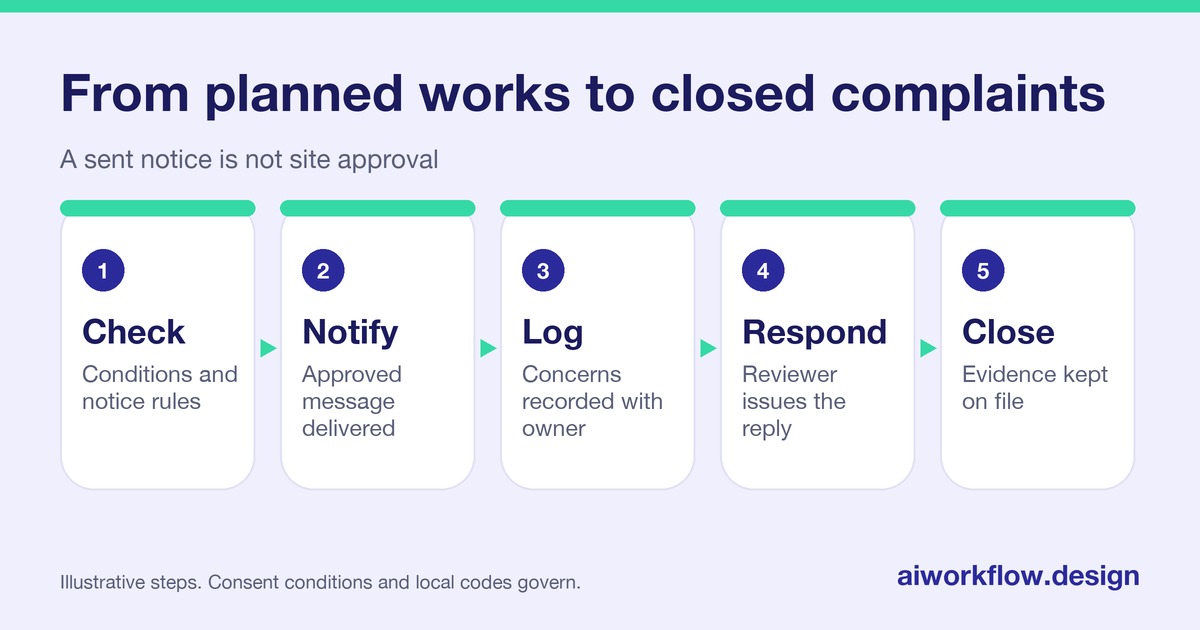
Identify the applicable requirements before sending notices
Start with the planning permission or development consent, approved environmental or construction-management plans, traffic management approvals, local working-hour restrictions, permit conditions and relevant contractual commitments. A notice may be mandatory for certain activities or purely good practice for others. Do not assume one jurisdiction’s standard wording or notice period applies everywhere.
The developer’s planning or legal owner should identify the rule, affected area, notification deadline, required audience, approved communication method and responsible signatory. The construction manager should confirm whether the described work and mitigation reflect the actual plan. The community liaison officer can prepare and distribute messages but should not interpret a permit independently.
Keep the obligation register separate from neighbor contacts. It should answer: What must happen? Who authorized it? What evidence must be retained? Contact information answers a different question: Who needs to receive a specific message through an appropriate channel?
Build a look-ahead of likely neighbourhood impacts
Ask the construction manager for a credible activity-based look-ahead, not just a calendar of subcontractor attendance. Identify activities that may affect neighbours: demolition, piling, concrete pours, road or footpath occupations, utility interruptions, abnormal deliveries, dust-producing works, temporary lighting, crane operations, vibration and changes to site access.
For each activity, capture the actual location, likely dates or windows, approved working hours, affected routes or properties, responsible subcontractor, the controls in the approved plan and the owner who will report changes. Do not turn an estimated program into a definite public promise until the site team confirms the window. Weather, permits and supply constraints can move the date.
A useful program distinguishes Planned, Approved for notice, Notice issued, Work confirmed, Changed, Completed and Follow-up required. A notice distributed last week does not by itself prove the work occurred as described or complied with the approved controls.
Draft notices around what residents need to know
A practical neighbor notice identifies the development and contact route, the specific work, expected dates and times, nature of the likely impact, approved public access changes, relevant mitigation measures and what to do if conditions differ from the notice. Write in plain language and provide accessible formats where appropriate.
Do not minimize uncertainty with unsupported assurances. ‘There will be no dust’ is usually too absolute for groundworks. ‘Dust controls will be implemented in accordance with the approved plan; report concerns through this contact route’ is clearer, provided the controls and route actually exist. Do not disclose private resident or staff information in a mass notification.
For high-impact activities, confirm the message with planning, traffic or environment specialists where required. If routes are changing, include a verified diagram rather than directions copied from an outdated site drawing. If temporary access arrangements affect an accessible route, the competent access and traffic team must approve the arrangement.
Keep a delivery record, not only a sent email
Record the version, approval date, intended audience, distribution method, actual distribution date and evidence. Email sends, postal drops, door-to-door distribution and community portal posts have different evidence requirements. A returned letter or bounced email should create an exception rather than a completed task. Do not claim every recipient read a notice just because the system shows ‘sent’.
Privacy matters. Collect only the contact details needed for a legitimate project purpose, limit access, explain the purpose where required and apply a retention rule. If a resident asks not to receive optional project news, distinguish that preference from any communication the developer is legally required to issue. Applicable local data-protection rules and legal guidance govern that decision.
A property or business may have more than one relevant contact. Use controlled household or organization identifiers to prevent repeated duplicate messages while preserving specific accessibility or delivery instructions where valid.
Create a complaint pathway that reaches the right person
A complaint about noise, dust, parking, vibration, access or behavior should create a case with received time, location, concern type, exact observation, urgency, contact preference, assigned owner, response due, action, evidence and closure decision. Capture the resident’s words fairly. Avoid automatically describing a complaint as ‘unsubstantiated’ before it is investigated.
Triage urgent safety concerns separately. A report of an unstable hoarding, dangerous vehicle movement or blocked emergency access requires the site’s emergency and safety process, not an ordinary public-relations response target. A complaint about a missed information leaflet might be resolved administratively. There is no single response clock appropriate for every case.
Do not ask a resident to collect hazardous evidence or enter a worksite. The appointed site and environmental specialists should inspect as required. If monitoring data is involved, a qualified person should interpret it in the context of the applicable permit or standard.
Close the loop without declaring the issue solved prematurely
A case should progress from Received → Acknowledged → Assigned → Under review → Action planned → Response issued → Follow-up confirmed → Closed, with a separate urgent escalation. An acknowledgement is not a resolution. A contractor’s ‘we checked it’ note is not necessarily evidence that the issue was investigated adequately.
The final response should explain what was established, what action was taken or is planned, any continuing controls, and a contact for unresolved concerns. Where facts are disputed, state that clearly. Some complaints may require regulator reporting, planning-authority consultation or third-party assessment; the community team cannot settle such obligations by closing a board item.
For repeat reports, group related cases for analysis while keeping each person’s enquiry and communication history intact. A cluster of complaints from one street may suggest a control or communication issue that a single-site average misses.
Use monday.com to coordinate without overriding site controls
Create linked views for Upcoming impacts, Notice obligations, Contact delivery, Complaints and Corrective actions. Suggested fields are Activity ID, Permission or condition reference, Approved message version, Distribution owner, Notice evidence, Site owner, Risk category, Related case IDs, Next action and Reviewer. Keep sensitive contact details outside broadly accessible contractor boards.
Autoza AI for monday.com or a Daily Check-in Agent can help with authorised follow-ups: ‘Has the approved notice been distributed?’, ‘Is the contractor’s revised timetable confirmed?’, or ‘Has the assigned officer uploaded a response?’ It must not issue a legal approval, determine compliance from a phone transcript, or respond automatically to an emergency.
When external systems are involved, AI Workflow Design’s custom automation service may be suitable for controlled task routing or status updates after technical and privacy review. Use human-approved external messages; inaccurate mass communication can be harder to repair than an internal missing update.
Handle changes before they reach neighbours as surprises
The contractor moves high-impact work to Saturday. Check the authorized working hours and permit conditions first. If the revised activity is permissible, the responsible team must determine whether an additional notice is required and issue an approved update.
A resident reports an unexplained overnight vibration. Route to the relevant site and technical owner, retain the observation accurately and follow the investigation and escalation procedure. Do not dismiss it because the program did not show night work.
The authority requests evidence of previous notices. Provide the versioned delivery register and associated approvals, not a retroactively edited spreadsheet. If evidence is missing, disclose the gap and assign corrective action.
The site completes the works early. Confirm that access routes and temporary controls have actually been restored before telling neighbours the disruption has ended.
Measure communication and operational outcomes separately
Useful measures include notices issued by the required date, unresolved distribution exceptions, complaints by impact type, time to first appropriate response, open corrective actions, repeated cases and discrepancies between announced and actual activity windows. Avoid calling an increasing complaint count a failure without context; better awareness of the complaint channel can initially increase reporting.
Review the results with construction, environment, planning and community teams. If repeated unannounced changes cause problems, improve the contractor look-ahead process. If enquiries are unresolved because the owner cannot access evidence, address the workflow. The point is to make obligations and concerns visible early enough to act.
Development neighbor communication checklist
- Identify permit and planning conditions affecting notifications.
- Obtain a verified look-ahead for disruptive activities.
- Approve plain-language notices with the relevant specialists.
- Record audience, version, distribution and failed-delivery exceptions.
- Route urgent safety reports outside the routine complaint queue.
- Retain investigation evidence and named response ownership.
- Communicate schedule changes through approved channels.
- Review recurring concerns and confirm corrective action.
Next step
Want these follow-ups handled consistently? Explore Autoza AI for monday.com or talk to AI Workflow Design about scheduled, permissioned status follow-ups that leave approvals and decisions with the right people. For a companion workflow, read Development Pre-Sales Disclosures: Verify Plans and Approvals Before Launch. Related guidance: see our industry automation guides page.
Frequently asked questions
What should a construction neighbor notification tracker contain?
It should record the activity, approval or permit condition, affected audience, approved notice, distribution evidence, complaints, response owners and unresolved mitigations.
Does every construction activity require a neighbor notice?
Not necessarily. Requirements vary by local law, consent conditions and project commitments. The planning or legal owner should establish which activities require formal notification.
Can an AI agent decide whether noisy work is permitted?
No. It may collect timetable and notice-status updates, but working-hour permissions, safety decisions and environmental compliance require authorized human review.
How should a developer handle an urgent complaint about site safety?
Use the established emergency or safety escalation route immediately. Record the report, notify competent personnel and do not leave it in an ordinary communications queue.
When should a neighbor complaint be closed?
Only after the assigned reviewer has considered the relevant evidence, documented actions and issued the appropriate response; unresolved or disputed issues should remain visible.