
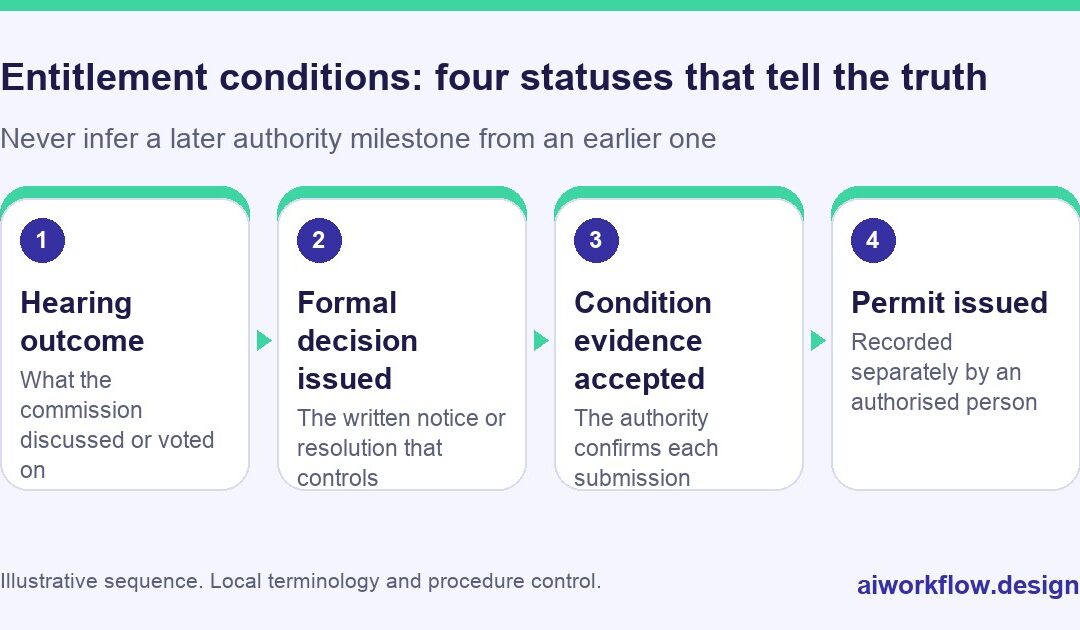
A land development entitlement condition tracker should begin with a deceptively simple question: What did the public authority actually decide? A planning commission’s favourable discussion, a staff recommendation, a conditional vote, a written notice of decision and an issued permit are not interchangeable milestones. Development teams lose time when a meeting summary saying “approved” becomes a start-work assumption before the formal process is complete.

For developers, land-use consultants and project managers, the purpose of follow-up is to make every municipal response and post-hearing condition actionable. A task-tracking system can help the team submit evidence and meet dates; it cannot exercise the jurisdiction’s legal powers or decide that permission has been granted.
Identify the exact entitlement pathway
Begin with the application type: rezoning, conditional-use or special-use approval, site-plan review, subdivision, variance, development agreement or another local procedure. The required hearing body, notice, decision, appeal process and downstream permits differ widely. Collect the official application number, project address, parcel identifier, governing ordinance or application instructions and the municipality’s published milestone sequence.
A real example of procedural distinctions appears in the City of Seattle’s land-use permit guidance, which explains that a published decision can include conditions to be met before permit issuance and that appeal rights may apply. This illustrates why hearing outcome and issued permit should be recorded separately; it does not establish rules for another city.
Assign a municipal liaison authorised to use the jurisdiction’s official portal or communication channel. Give internal project managers access to the record, but keep authority statuses anchored to official communications rather than recollections from a meeting.
Turn hearing minutes and conditions into separate tasks
After the hearing, obtain the official notice, resolution, draft conditions or other controlling record through the proper route. Use a distinct item for every numbered condition and link it to the exact text and source version. An illustrative field set includes Application ID, Condition reference, Decision source, Required submission, Preparing owner, Reviewing specialist, City contact, Due date, Dependency, Date submitted, Official response, Evidence link and Next action. These fields are recommended, not preloaded Autoza or monday.com templates.
Separate a “condition precedent to permit issue” from a commitment to be satisfied later in construction or before occupancy. The project planner or lawyer should determine that classification under the actual decision. A traffic impact update, revised landscaping detail, public improvement agreement and dedication document may all involve different preparation and municipal review routes.
Do not truncate the condition’s meaning in the status label. A board item saying “landscaping done” may be inaccurate where the condition requires both approved drawings and a performance bond. Preserve the original condition text, version and the person responsible for interpreting its requirements.
Build a follow-up sequence around decisions, not arbitrary daily calls
The first check follows the hearing: confirm when official minutes or a notice will be available and whether the municipality identifies an appeal or reconsideration period. The second is internal: assign each condition to the professional who can produce the required item. The third verifies that submissions actually reached the prescribed portal or department. The fourth checks for written corrections or an official acceptance response.
Follow-up frequency should be informed by response windows, consultant availability and the construction programme. A weekly internal status check may be enough during drawing preparation; an urgent signature dependency may need a shorter cadence. Use approved channels for municipal staff. Unsolicited high-volume automated calls to public offices are inappropriate and may be restricted.
Ask specific internal questions: “Which revision of the traffic study is planned for resubmission?” “Has legal counsel reviewed the dedication language?” “What official acknowledgement confirms the correction packet was received?” “Which condition remains a prerequisite to permit issuance?” A single “planning approved” question will not expose those differences.
Keep five statuses that tell the truth
Use staff recommendation, hearing outcome, formal decision issued, condition evidence accepted, and separate permit issued as distinct event types where applicable. A project may not require each of them, and local terminology controls, but the management principle holds: no later authority milestone should be inferred from an earlier one.
Store the latest official notice or case reference with a verifier’s name. A staff email about a potential correction is not necessarily a formal requirement. A contractor saying the site can proceed is not a permit. If a condition is disputed or appealed, counsel and the municipal liaison should identify the lawful process rather than attempting to solve it by editing the board.
This discipline works alongside the development utility energisation dependency guide, which keeps service installation, authority approvals and usable connection separate. A municipal entitlement does not automatically clear utility access or permission to occupy.
Flag schedule exposure without making legal claims
Link every critical condition to the activity it actually blocks: tender, grading, building-permit issue, public works, utility connection or occupancy. Distinguish a confirmed constraint from a scenario. For example, “revised drainage report due Thursday” may be an internal commitment, while “building permit cannot issue until the stormwater bond is accepted” must be supported by a formal condition or written guidance.
Create an escalation threshold when a decision date affects a contractor mobilisation, land option, financing commitment or required public notice. Present the issue to the project’s counsel, planner and commercial owner. They may choose to change the programme, seek a formal extension, revise the design or pursue an appeal. The tracking workflow does not choose that route.
Avoid publishing personal contact details of residents who spoke at hearings. Public-comment processes can involve sensitive information, and staff should work with the municipality’s official records and retention rules rather than building informal contact lists from meeting attendance.
Use a simple evidence pack for each condition
A reviewer should be able to open the item and find the controlling decision extract, responsible preparation owner, current drawing or report revision, submission receipt, latest official response and unresolved action. Store documents in controlled systems, use clear filenames and avoid attaching draft drawings to completed-permit fields.
An illustrative three-phase site might have a condition requiring revised vehicle access drawings before a site permit and a landscaping completion condition before occupancy. Record them against different downstream stages. When the civil engineer reports the first drawing complete, update “prepared”, not “accepted”. When the authority confirms acceptance and issues the applicable permit, an authorised person records the real outcome. The landscaping condition remains open on its own timeline.
Where AI check-ins fit
AI Workflow Design’s monday.com and check-in products describe scheduled calls, status summaries and board logging. With permission and approved field mappings, a team could ask its civil engineer whether a revision is ready, the document controller whether a submission was acknowledged, or the project lead who owns an overdue response. The caller cannot grant a variance, interpret a council decision, bypass an appeal or issue any municipal permit.
Start with one condition category and review each captured answer against its source. A good workflow reduces unanswered internal commitments rather than pretending to speed up municipal decision-making. For related controls, see the tenant fit-out approval coordination guide, where landlord consent and statutory permission are also separate gates.
Make the next hearing useful
Before the next public meeting or authority review, circulate a one-page action log: open conditions, last official decision, outstanding evidence, accountable preparer, potential schedule effect and the next date for a human decision. This provides clarity without turning policy, law or professional judgment into a traffic-light score.
If collecting internal progress is taking too much staff time, review whether scheduled project check-ins can keep those administrative dates current while the municipal liaison retains control of external communication and all final approvals. You can also browse more workflow guides.
Frequently asked questions
What should a land development entitlement condition tracker include?
Record the application and condition reference, controlling municipal document, required evidence, preparation and review owners, due date, submission acknowledgement, official decision, downstream dependency and next action. Keep hearing notes and formal permit milestones distinct.
Does a favourable planning hearing mean construction can begin?
Not necessarily. The project may still require a formal written decision, satisfaction of conditions, other permits and completion of applicable appeal or review procedures. Verify the actual legal status with the municipality and qualified advisers before commencing work.
Who decides whether a municipal condition has been satisfied?
The authority or other party designated by applicable law and the controlling decision determines official acceptance. A developer’s project manager may coordinate submissions and record evidence but cannot replace the relevant decision-maker.
How often should the team follow up on planning conditions?
Use the real decision timetable, internal deliverable dates and project critical path. Prioritise near-term corrections or missing submissions, and use official contact channels for the municipality. More calls do not necessarily mean faster external review.
Can AI update a development entitlement board?
An approved AI check-in configuration may record status from internal document owners and flag overdue work. Formal approvals, appeal outcomes, condition acceptance and permit issue must come from authoritative records verified by designated humans.
Related reading
- New Development Utility Energisation: Dependencies Before Occupation
- Tenant Fit-Out Projects: Coordinating Landlord, Tenant and Contractor Actions
- Permit and Inspection Follow-Up for Real Estate Development Projects
- Easement and Title Conditions: A Development Closing Action Tracker
- Phase I Environmental Assessments: Track Consultant Evidence Requests