
A development easement title checklist needs more than a column marked “legal approved”. A development site may have a completed survey and a signed sale contract while the title commitment reveals an access easement, utility corridor, restrictive covenant or exception that still requires interpretation and a closing deliverable. The developer needs to know precisely which condition is unresolved, who can address it, and what evidence will close it—not whether someone sounded optimistic in a meeting.

This article presents an administrative tracking method for real estate development teams working with counsel, title insurers, surveyors, utilities, lenders and sellers. It is not title advice; property rights and closing conditions are controlled by the documents and applicable jurisdiction.
Read the title package and survey as related but separate sources
A title commitment identifies proposed insurance terms and exceptions; a land title survey depicts surveyed physical and record matters within its scope. Neither is a casual substitute for the other. The American Land Title Association explains that its 2026 ALTA/NSPS Land Title Survey Standards, effective February 23, 2026, establish minimum requirements that help parties consider boundaries, easements, encroachments and access. The need for a specific survey or optional item comes from the transaction team, not from an AI assistant.
Ask the title company and counsel which schedule, document revision and effective date are controlling. Ask the surveyor which record instruments were supplied and which matters were mapped or could not be plotted. A utility corridor shown on an old civil drawing, for example, is not necessarily evidence of the legal easement required for a new transformer. Legal access, physical access and construction access may be three distinct questions.
Never assume an easement is invalid merely because it is not obvious on a site walk. Nor should a coordinator interpret the scope of granted rights from a short description. The qualified specialists must compare record documents, the survey and the intended development.
Convert each exception into a closing dependency
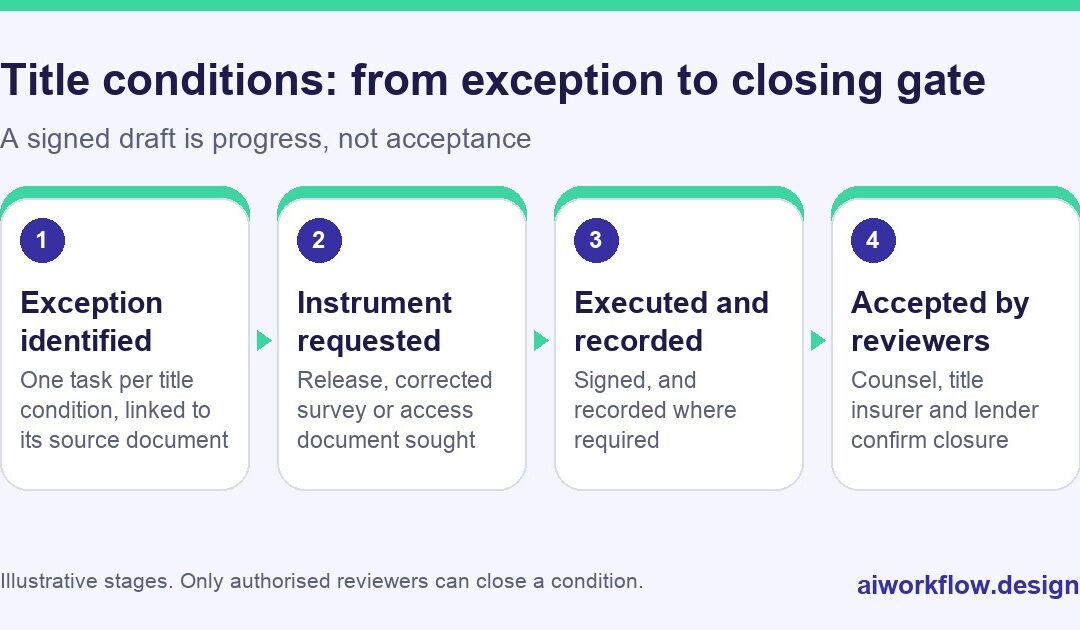
Use one task per condition. A practical register contains Condition ID, Source document and version, Parcel or phase, Affected area, Issue type, Required instrument or action, Preparing party, Reviewing counsel, External approval party, Target date, Secure evidence link and Closing gate. Add the exact contractual clause or title exception reference. These are suggested tracking fields, not built-in Autoza columns.
Classify the next action rather than the legal meaning: obtain a missing recorded instrument, ask for a corrected survey depiction, request a release or subordination for counsel to review, clarify an access description, obtain lender consent, or confirm whether a utility provider needs to execute an instrument. Avoid a generic “title issue” label that conceals whether the missing response comes from survey, seller, insurer, lender or municipality.
Maintain distinct stages: identified, document requested, draft under review, counterparty response pending, executed, recording confirmed where required, and accepted by the designated closing reviewers. An unsigned draft can represent significant progress without satisfying the condition. A signed instrument may still require recording, insurance review or other transaction-specific action before closing.
Spot the access problem early
Access problems are easy to miss when the site already has a driveway. Does the development parcel have legally enforceable access to a public road? Is access shared with a neighbour, limited by permitted use or width, or dependent on maintenance arrangements? Does heavy-construction traffic rely on rights that differ from permanent customer access? Answers should come from legal instruments, survey work and the responsible advisers.
For an illustrative infill project, the contractor plans to enter through an adjacent commercial lot during excavation. The civil team has drawn that route, but the seller has provided no signed access agreement. The developer should mark “construction access rights unverified” and assign counsel and the neighbour-contact owner to the issue. A phone call confirming that a neighbour is “fine with it” should not become a recorded legal right.
A related dependency may be a new utility easement whose route crosses the proposed landscaping or fire-access area. Link that condition to the land development utility coordination guide so the design and legal workstreams see the same constraint. Preserve their separate professional approvals.
Plan follow-up around the actual signing and recording chain
Start with the transaction schedule and required closing package. For each condition, identify the last sensible date for a draft to reach reviewers, the likely parties who must sign, any notarisation or recording steps, and the official source that will confirm completion. When lender or insurer review is needed, send the right version early instead of waiting until the day before closing.
Do not impose a universal five-day rule on every easement. One document may depend on a utility legal department; another may require owner signatures or county recording; another may involve a disputed boundary requiring additional survey work. Allocate buffers according to the real dependency. Where commercial documents contain confidential prices or personal information, keep them in an appropriate controlled repository rather than a routine call transcript.
Follow-up questions should seek a verifiable next action: “Has the updated survey been circulated to title counsel?” “Which party is currently reviewing the proposed access instrument?” “What document or decision is needed before the title company can reconsider this exception?” “Has the executed release been submitted for recording?” “Who will verify the official result?” They should not ask a call recipient to pronounce the title marketable.
Design escalation around closing risk
Escalate when a condition affects buildable area, lender security, legal access, utility service, an agreed closing deadline or a purchaser’s ability to use the site as intended. Record the consequence as a factual question for advisers: “civil plans assume unrestricted truck access; legal right not confirmed”. Avoid a red-green indicator that silently interprets whether a legal defect is material.
A useful closing dashboard separates three views. First, administrative progress: owner and latest response. Second, documentary evidence: the received instrument, survey revision or official recording reference. Third, legal and title acceptance: counsel/title/lender confirmation by the people authorised to give it. Only the third view can close a condition when the contract requires that acceptance.
See the earlier construction draw request evidence guide for a similar distinction between collecting paperwork and approving a transaction. The principle is the same, but title rights and lender disbursement have different decision authorities.
Where scheduled status calls can help
A developer with multiple parcels may lose hours asking document owners when a draft will be ready. Autoza AI for monday.com is described by AI Workflow Design as making scheduled check-in calls and writing status information to boards. With proper permissions, a narrowly defined workflow could collect whether a draft was sent or a reviewer has requested revisions. It should not interpret easements, give legal assurances, approve encumbrances or update protected title acceptance fields automatically.
Ask counsel to approve the question scope. Avoid reading full legal descriptions, confidential title exceptions or sensitive party information aloud unless privacy and security arrangements have been specifically reviewed. An unanswered call leaves the condition unverified; it does not become a rejected title item.
Make the closing meeting decision-ready
A useful meeting summary answers: Which conditions remain? What exact document will resolve each? Who controls its next step? What is the earliest credible completion date? Which approval authority remains? What happens to the construction programme if the issue is not resolved? Include a link to the controlling evidence and identify any proposed workaround that requires formal legal review.
Start with the highest-risk parcel. Build its exception register, then test whether a person unfamiliar with the deal can identify the next document owner without guessing. For repeated administrative reminders, explore a configured check-in process while leaving closing sign-off with the transaction’s qualified parties. You can also browse more workflow guides.
Frequently asked questions
What should a development easement title checklist contain?
Include the specific title exception or condition, relevant parcel, underlying instrument, associated survey reference, required action, preparer, reviewer, target date, evidence and authorised closing decision. Keep legal interpretation and official recording details under appropriate professional control.
Is a title commitment the same as a land title survey?
No. A commitment describes proposed insurance terms and exceptions, while a survey addresses locations and matters within its professional scope. Counsel, surveyor and insurer need to compare the relevant documents when resolving development rights and access questions.
Can the development team rely on verbal permission for access?
Verbal agreement is not a substitute for whatever enforceable rights and documented permissions the transaction and jurisdiction require. Where access is material, obtain legal advice and the applicable written, executed and recorded instruments or other formal evidence.
Who should mark an easement condition as closed?
The people designated by the contract and transaction governance—often counsel, title insurer, purchaser and lender where applicable—must determine acceptance. A project coordinator may mark the supporting documents received without making that final legal decision.
How does monday.com help with title-condition follow-ups?
A configured board can show request owners, due dates, document versions, dependencies and the latest reported responses. An authorised AI check-in may collect progress from task owners, while legal conclusions and controlled approvals stay with qualified reviewers.
Related reading
- Land Development Utilities: A Follow-Up Plan for Water, Power and Access
- Construction Draw Requests: Follow Up on Development Evidence and Signatures
- New Development Utility Energisation: Dependencies Before Occupation
- Phase I Environmental Assessments: Track Consultant Evidence Requests
- Municipal Hearing Conditions: Following Up on Development Entitlements