
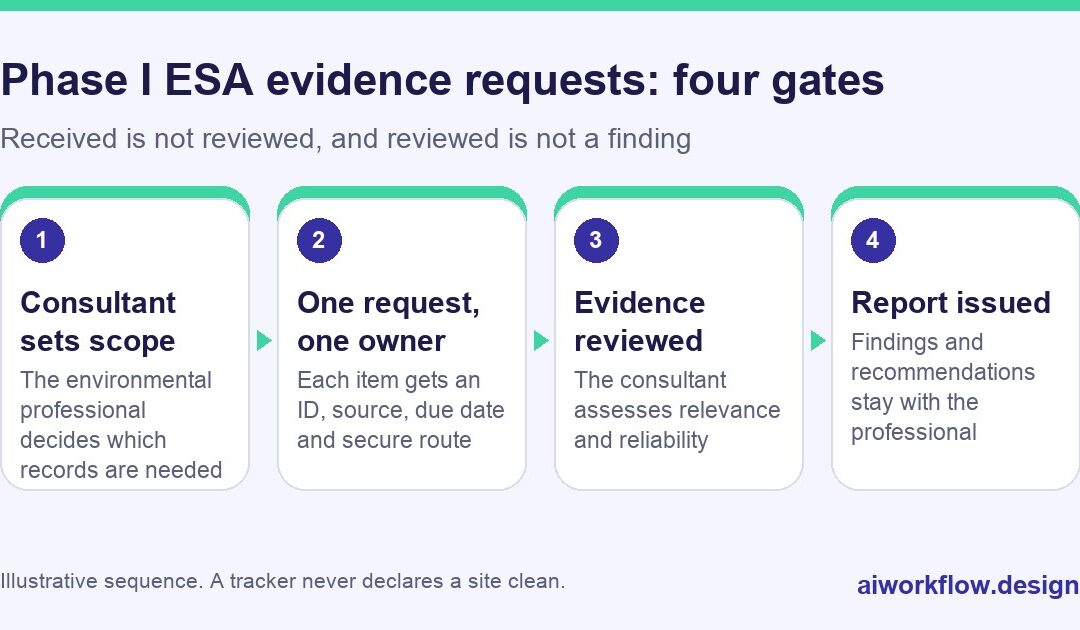
A phase 1 environmental assessment task tracker should tell a development team which evidence has been requested, who must provide it, and what the environmental professional is still evaluating. It should not attempt to declare a property clean. A Phase I Environmental Site Assessment (ESA) is a due-diligence inquiry into potential environmental conditions, not a casual checklist that a project coordinator can close after a few calls.

For a buyer considering a former repair yard, warehouse or mixed-use parcel, a late response from the seller about underground tanks can stall the consultant’s work. The acquisition team needs an efficient way to obtain records, protect the review timetable and avoid rewriting a professional conclusion as an administrative status. Here is a practical follow-up structure.
Begin with the environmental professional’s scope, not a generic template
In the United States, the EPA’s All Appropriate Inquiries guidance explains how environmental due diligence can relate to specified protections from CERCLA liability. EPA recognises ASTM E1527-21 as a standard consistent with the All Appropriate Inquiries rule. The ASTM standard reserves professional judgment to the qualified environmental professional and explains that an ESA cannot eliminate all uncertainty.
Before creating tasks, identify the actual purpose of the assessment, the intended purchaser, the report’s users, the property boundary, the consultant’s proposal, and the acquisition schedule. The consultant should determine which inquiries and information sources are required. A project manager may coordinate document collection, but must not decide whether a recognised environmental condition exists or whether the inquiry meets a liability-protection requirement.
The distinction matters when a closing date changes. ASTM describes timing requirements for components used in All Appropriate Inquiries, including certain work conducted or updated within 180 days of acquisition and other components within one year. Do not calculate compliance from the report issue date alone. Ask the environmental professional and legal adviser whether an update is needed in light of the actual transaction timeline.
Translate document requests into individually owned tasks
Create one tracker item for each identifiable request rather than one row labelled “ESA pending”. Typical requests, where appropriate to the consultant’s scope, might include historical site plans, prior environmental reports, current use information, tank or hazardous-material records, permits, spill documentation, leases that identify previous operations, and contact details for interviews. Public records and visual inspections remain part of the professional inquiry; the developer should not pretend that a missing private document is the entire assessment.
An illustrative field set is Request ID, Parcel, Requesting consultant, Evidence description, Party holding record, Authority to share, Due date, Received date, Document version, Secure link, Consultant acknowledgement, Open question and Next owner. These are proposed monday.com fields, not a pre-installed Autoza template. Record “not held by seller” or “source unknown” when that is the verified answer; do not overwrite a gap with an invented document reference.
When multiple sellers or property managers are involved, use a consistent parcel identifier. A tank closure certificate belonging to the adjacent lot should never be attached as evidence for the subject parcel without explicit clarification. Keep an audit trail of who supplied each file, when and under what access conditions.
Run a sequenced evidence follow-up cadence
Start by agreeing a cut-off with the consultant for information useful to the current review. Send a consolidated request list to the authorised seller representative rather than separate messages from every buyer-side specialist. At the first check, ask whether the request was received and who owns the answer. At the second, identify the actual records located or a reason they cannot be provided. At the third, confirm that files were transferred securely and that the consultant could open them.
These are workflow stages, not mandatory regulatory intervals. A ten-day acquisition timetable may require much tighter coordination than an early feasibility study. Prioritise questions that could change scope, require additional specialist work or affect the contractual diligence period. If a site visit is blocked by tenant access, escalate the access issue through the lawful property contact; a caller must not invite entry without permission.
The best follow-up question is specific: “Has the previous heating-oil tank record for the south building been located, and who can release it to the environmental professional?” Asking “Is the environmental report done?” hides whether the missing item is a seller response, agency record, interview, site access or the consultant’s analysis.
Separate source receipt, consultant review and professional findings
Use three independent milestones. Evidence received means the coordinator has a file or confirmed response. Evidence reviewed means the environmental professional has assessed its relevance and reliability. Report issued means the responsible professional has produced the applicable deliverable. None of these should automatically indicate that the site is contamination-free or appropriate for a planned use.
Keep professional conclusions, recommendations for further investigation, recognised environmental conditions, and any transaction implications in the consultant’s report and counsel’s controlled process. An AI call summary saying “the old tank was removed” is a reported statement, not a verified closure record. If an environmental concern emerges, the consultant, legal adviser and developer must determine the next due-diligence step.
For wider acquisition coordination, connect environmental requests to the team’s development utility coordination workflow without mixing their approval gates. An underground utility plan may be useful to several workstreams, but its status in one board does not certify another.
Protect confidentiality and avoid indiscriminate calling
Environmental reports can include sensitive site information, tenant contacts, commercial negotiations and regulated records. Restrict access, use controlled file storage and keep detailed records out of generic voice transcripts. If approved, a scheduled call should ask internal administrators or authorised seller-side contacts whether an agreed item has been found and when it can be securely transmitted. Do not solicit confidential tenant histories or open-ended allegations about former occupants.
AI Workflow Design’s products include Autoza AI for monday.com, which is described as making scheduled status calls and writing summaries to boards. A project-specific pilot can use these administrative check-ins where consent, permissions and the actual field configuration allow. It cannot conduct an ASTM assessment, interpret environmental law or make a professional recommendation.
Build an acquisition decision view without inventing certainty
At the weekly diligence meeting, report the number of open information requests, those with an identified owner, the items blocking consultant work, the age of unanswered questions and the next decision deadline. Keep the consultant’s findings in a separate review area. The deal team should be able to say, “three seller documents remain outstanding; the consultant will advise whether the report can proceed”, rather than “environmental risk cleared”.
For an illustrative acquisition, assume the seller supplies a site plan and a previous investigation but cannot locate a tank removal certificate. Record the two verified receipts, preserve the missing-document issue and ask the environmental professional what further inquiry is appropriate. If the purchaser changes its closing date, ask the qualified team to review the age of the inquiry components. The tracker improves follow-through; it does not convert absence of evidence into proof of absence.
Next action: make every request answerable
Choose the ten most important outstanding requests for a live transaction. Give each a unique identifier, a named source owner, a secure delivery route and a consultant reviewer. If status chasing is consuming the project coordinator’s day, discuss an approved check-in workflow that collects administrative progress while professional judgments remain fully human.
Explore Autoza AI for monday.com or browse more workflow guides.
Frequently asked questions
What belongs in a Phase I environmental assessment task tracker?
Track the consultant’s specific information requests, the property or parcel, the responsible source, due date, evidence received, consultant acknowledgement, open questions and next action. Add the acquisition decision deadline and secure document location. Do not use a routine task field to substitute for the signed environmental report.
Can a project manager decide a Phase I ESA is complete?
A manager can confirm that requested documents were delivered, but the environmental professional is responsible for the professional assessment and report under the applicable scope and standards. The purchaser and legal counsel separately decide how the results affect the transaction.
Does a Phase I ESA prove that land has no contamination?
No. A Phase I ESA is an inquiry into potential environmental conditions within a defined scope. It does not wholly eliminate uncertainty, nor does it generally replace intrusive sampling or additional investigations when qualified professionals determine those are warranted.
When should an assessment be updated before closing?
Timing depends on the acquisition date, applicable All Appropriate Inquiries requirements and what work was completed when. ASTM and EPA address age of inquiry components, not just the report’s cover date. The environmental professional and legal counsel should confirm whether an update is necessary.
Can automated calls help gather environmental due-diligence documents?
Where authorised, calls can remind an internal owner or permitted counterpart about an outstanding document and record a delivery commitment. They cannot evaluate contamination, certify regulatory compliance, issue legal advice or turn a verbal claim into professional evidence.
Related reading
- Land Development Utilities: A Follow-Up Plan for Water, Power and Access
- Construction Draw Requests: Follow Up on Development Evidence and Signatures
- New Development Utility Energisation: Dependencies Before Occupation
- Easement and Title Conditions: A Development Closing Action Tracker
- Municipal Hearing Conditions: Following Up on Development Entitlements