

Quick answer: A property development pre-sales disclosure checklist links every proposed sales claim to an approved source: the current plans, permitted uses, specifications, project status, sale documents, buyer disclosures and a responsible legal or commercial reviewer. Marketing launch and legal permission to offer or take reservations are separate decisions. Automation can chase documents and flag version conflicts, but it must not decide that statutory disclosure duties have been satisfied or that an unapproved floor plan may be sold.
A residential developer schedules a launch campaign around a show suite opening. The brochure shows a landscaped courtyard, the sales team’s price sheet refers to a larger balcony and the architect has just issued an updated drawing. At the same time, the legal team is waiting for an external approval and the agency has already booked advertising.
The risk is not merely an embarrassing brochure correction. A purchaser may rely on representations about area, finishes, facilities, completion dates, shared costs or rights of use. Which documents must be supplied, when sales may legally begin and how changes must be disclosed depend on the jurisdiction and type of development. The response should be a controlled evidence and approval workflow, not an urgent ‘please confirm’ email sent to everyone.
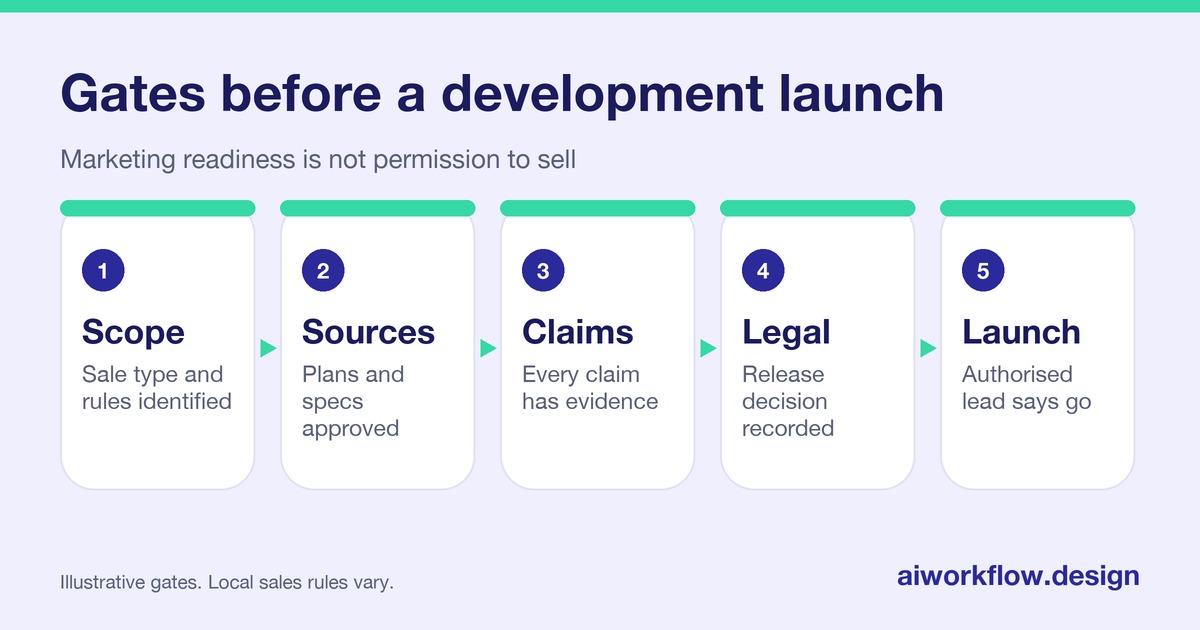
Decide what kind of sale is being prepared
Clarify whether the project involves land lots, completed homes, off-plan apartments, common-interest or strata properties, mixed-use units, investment offerings or another arrangement. Identify where the property is located and where it is being marketed. Rules on public reports, prospectuses, escrow, deposits, reservations, advertising, cooling-off periods and mandatory buyer disclosures can differ substantially.
Have qualified legal advisers map the applicable legal documents and the point at which an offer, reservation, deposit or contract may be accepted. A marketing manager should not infer legality from a finished website or a signed agency brief.
Create a claim-to-evidence register
List the material facts that prospective buyers may see: unit type and area, floor plans, room dimensions, specification, fixtures, common amenities, parking or storage rights, tenure, estimated completion, service charges or assessments, planning status, expected views, energy claims, incentives and pricing. For each claim identify Source document, Revision, Verification owner, Legal review, Marketing format, Approved wording, Expiry or review trigger.
Some claims are factual; others are forward-looking or subject to change. Label them accurately according to the approved disclosure and advertising requirements. Do not invent a surveyor-certified size from a concept plan. A photograph of a show home may not represent every unit. A proposed shared facility must not be described as delivered or guaranteed when the relevant conditions have not been satisfied.
Ask the design and commercial teams to reconcile the data used by the sales platform, brochures, advertisements, email templates and sales agent scripts. A correct PDF is not enough if the CRM’s unit database still shows the previous size or price.
Control drawings and revisions as commercial evidence
A change to a floor plan may affect the unit description, specification, marketing visual, pricing, parking allocation or legal disclosure. Build a revision register with the superseded version, changed elements, affected unit types, review owner, release date and the assets that must be updated. Store the original approved document and retain a clear record of what replaced it.
Do not automatically publish the latest architectural drawing. It may be issued for coordination, not approved for sale or construction. A technical issue status and legal or commercial publication approval are different gates. Ask the architect or appropriate professional to identify the approved representation, then give sales and marketing one controlled version.
When a unit already has interested prospects or reservations, a new revision may trigger additional disclosure or contractual review. The legal owner must determine the required response. Do not assume a mass email is sufficient to resolve an existing buyer’s rights.
Establish the legal-to-marketing release gate
A release checklist should answer four questions separately: Are the necessary permissions and documents available? Has counsel reviewed the proposed offer process? Are commercial claims reconciled against approved evidence? Have final public assets been proofed? Record a named decision-maker and a dated sign-off for each. A composite ‘approved’ status obscures which part is still pending.
A conditional or limited approval should state the permitted activity clearly. For example, a team may be authorized to run non-binding awareness advertising but not to accept deposits, or may be restricted to a specific audience or development phase. The distinction needs legal confirmation; it must not be inferred by an automation from a checklist’s colour.
Create a hard stop when an authoritative document is missing or inconsistent. Examples include conflicting area schedules, unreviewed tenure descriptions, a pending disclosure document or claims about a shared facility that no longer matches the approved plan. Resolve the conflict before launching the affected claim.
Make the sales team’s source of truth unmistakable
Sales agents need concise information they can use without improvising: approved unit descriptions, current price and availability, applicable incentives, the correct disclosure pack, deposit instructions if permitted, document delivery requirements, and an escalation contact for purchaser questions. Give every external agent the same version-controlled material and require acknowledgement of material updates.
Avoid turning unverified sales conversations into contractual promises. A buyer may ask whether an amenity will be finished by a particular date or whether a room can be redesigned. If no authorized answer exists, the agent should record the question and obtain review rather than offering a guess to secure the enquiry.
Where marketing uses CGI or illustrative plans, follow the applicable advertising rules and approved disclaimers. A disclaimer should not be treated as a blanket permission to make a misleading main claim. Legal and compliance review should consider the overall impression, not only the presence of small-print wording.
Keep buyer records separate from the project board
A development team may need proof that a purchaser received specific documents or communications. The correct repository may be the transaction, sales or conveyancing system rather than a general monday.com board. Record necessary document references and status, while restricting personal and financial data to authorized personnel.
A practical delivery log can show Buyer or transaction reference, Required document set, Approved version, Required timing, Delivery method, Receipt or acknowledgement status, Exception, Legal owner and Next action. Do not use project-board comments to store identity documents, bank details or private negotiation records. A missing acknowledgement should be escalated according to the applicable process rather than silently treated as accepted.
For multi-phase projects, maintain distinct launch gates and document sets for each phase. An approval for Phase 1 does not automatically authorize a different block with amended services, layouts or common-area obligations.
Use monday.com for readiness and change control
Set up connected boards for Project evidence, Unit data, Marketing assets, Legal release tasks, External agency actions and Change exceptions. Useful columns include Phase, Claim ID, Source reference, Current revision, Reviewer, Approved scope, Affected channels, Publication owner, Last verified date and Release status. Link each advertisement or brochure item to the appropriate approved source.
A scheduled Autoza AI for monday.com or Daily Check-in Agent status check may ask whether the latest approved drawing was uploaded, whether a named reviewer has responded, or whether the agency has taken a superseded brochure offline. It should not interpret real estate law, approve a deposit, represent a drawing as legally compliant or confirm a purchaser’s acceptance of terms.
The custom automation services may be relevant for syncing permitted project status and version references between document management, the marketing pipeline and a task board. Use controlled interfaces and verify which system remains authoritative. A failed sync should create an exception; it must not silently republish obsolete information.
Handle launch-week exceptions without improvising
A new plan changes a balcony area. Freeze the affected claim, identify all unit types and marketing assets using it, obtain professional and legal review, then release the corrected version. Keep the superseded asset archived with its publication history.
An agent has already sent an outdated brochure. Record who received it, seek guidance from the legal and customer team and issue the appropriate correction. Do not delete the original communication and pretend it never happened.
The public report or required disclosure is delayed. Respect the jurisdiction-specific restriction on offers, reservations or deposits. Reassess the promotional timetable with legal and commercial owners; do not hide the delay by changing the checklist label.
A buyer questions what is included in the price. Refer to the approved price schedule, contract and disclosure pack. If the answer is unclear or there is a discrepancy, send it for authorized clarification rather than relying on a salesperson’s recollection.
Measure launch readiness, not just marketing velocity
Useful indicators include the percentage of public claims with verified current sources, unresolved material discrepancies, age of legal review tasks, marketing assets awaiting approval, superseded files still in circulation and time taken to communicate approved changes. Marketing leads and reservations are commercial metrics, but they do not establish disclosure compliance.
Review the change history after each phase. If brochure revisions constantly follow the media-booking date, bring design and legal into planning earlier. If sales agents repeatedly ask the same unresolved question, improve the approved information pack. Effective pre-sales coordination shortens avoidable delays while protecting buyer understanding.
Development pre-sales disclosure checklist
- Identify the project type, jurisdiction and legally permitted offer stage.
- Map required buyer documents to named legal owners.
- Verify every material marketing claim against a current approved source.
- Reconcile drawings, unit data, brochures, ads and agent scripts.
- Keep version and distribution records for revised assets.
- Distinguish marketing clearance from authority to accept reservations or deposits.
- Record buyer-document delivery in the authorized transaction system.
- Escalate discrepancies before publication or further sales activity.
Next step
Want these follow-ups handled consistently? Explore Autoza AI for monday.com or talk to AI Workflow Design about scheduled, permissioned status follow-ups that leave approvals and decisions with the right people. For a companion workflow, read Development Neighbor Notices: Track Construction Impacts and Complaints. Related guidance: see our industry automation guides page.
Frequently asked questions
What is a property development pre-sales disclosure checklist?
It is a release-control process linking proposed property claims and buyer documents to current source evidence, legal review, approved marketing assets and the applicable sales-stage requirements.
Can a developer advertise before every approval is complete?
It depends on the development type, jurisdiction and proposed activity. Qualified local legal advisers must determine what awareness marketing, offers, reservations or deposits are permitted at each stage.
Should the newest architectural drawing automatically replace the brochure?
No. Drawings can be issued for different purposes. Confirm which revision is approved for marketing and whether its changes affect legal documents, prices or previous purchaser communications.
Can an AI tool confirm that statutory disclosures have been satisfied?
No. It can track missing files, reviewer responses and version changes, but the responsible legal or compliance team must decide whether obligations have been met.
How should an outdated brochure be handled after it was shared?
Preserve the distribution record, identify affected prospects or buyers, obtain legal and commercial guidance, and issue the required correction through an approved communication route.