

Quick answer: A permanent utility connection checklist for real estate development tracks each service from the approved application through design coordination, installation, utility-provider inspection, metering or energisation and the final handover record. It keeps water, wastewater, electricity, gas and communications on separate approval paths. A contractor saying a service is “ready” does not mean the utility has authorised connection or that the completed building can legally be occupied.
A new development appears almost ready for tenants. The finished corridors have lighting, mechanical equipment has been tested under temporary power and the facilities team is preparing to take keys. Then the developer learns that the permanent electrical meter has not been released, a water-service test certificate is missing and the telecoms provider cannot confirm its activation date. A single “utilities complete” item on the project dashboard concealed three different unfinished processes.
Permanent services connect a development to external networks and create obligations for the future owner or operator. The workflow should expose who needs to act, which external decision is outstanding and what evidence the building operator will eventually receive. It must not turn an AI status call into a technical authorisation.
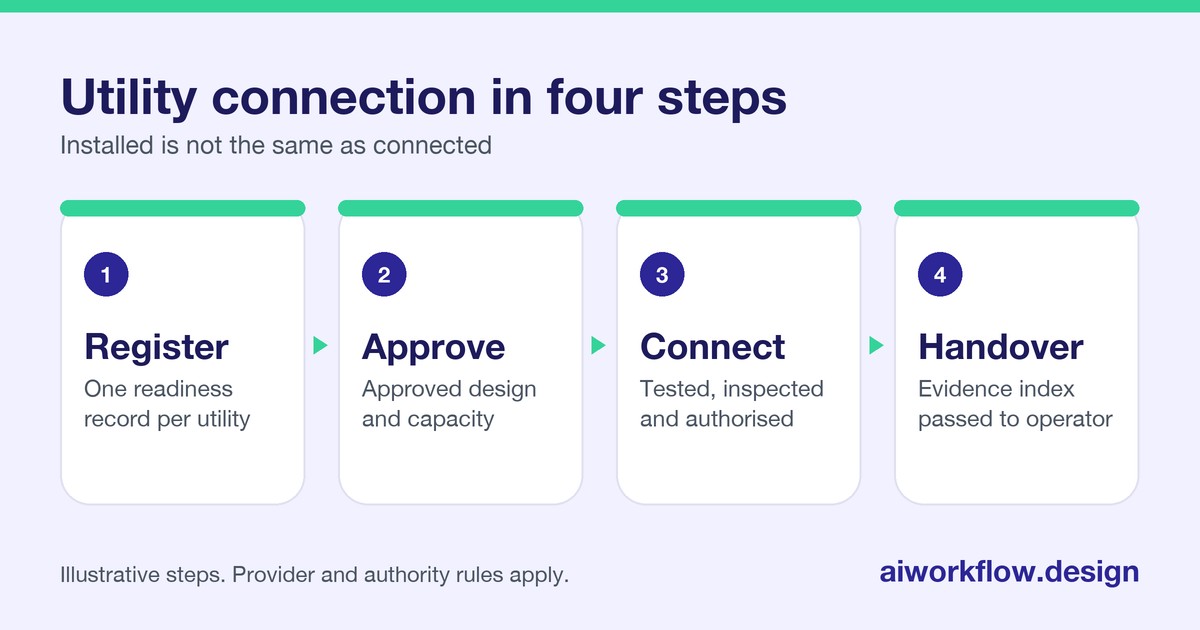
Create a separate readiness register for each utility
List electricity, potable water, wastewater, storm drainage, gas where applicable, heating/cooling district connections, and data or telecommunications where relevant. Not every project needs each service. Separate construction-stage temporary arrangements from permanent capacity and ownership. A development might have power available for contractors without the approved permanent service needed for normal operation.
For every connection capture the provider, network point, service application reference, agreed capacity or design parameters, consultant and contractor owner, external review stage, required certificates, expected metering or activation milestone, and final operations contact. The operating entity named on the account matters as much as the engineer who installs the connection.
A useful status set is Application preparing → Submitted → Provider queries → Design accepted → Installation in progress → Test evidence submitted → Provider inspection pending → Connection authorised → Activated → Operator handover complete. The exact milestones will vary by provider and locality, so configure them from the actual conditions rather than treating this template as an official code.
Start with approved design and capacity, not a target date
Early planning should identify likely utility demand and whether the relevant network can serve it. Capacity, connection method, metering arrangement and access conditions may require approvals well before onsite work begins. A requested connection date does not create an entitlement to service. Avoid building a lease or handover commitment around an unconfirmed provider estimate.
Link each utility item to the approved engineering package, drawings, provider correspondence and any required wayleave or access agreement. Keep the document versions clear. A contractor may install infrastructure to a superseded design if instructions change during construction and the field team is not notified. Record which revision was accepted and which party issued the change.
Where there are multiple buildings or phases, identify whether a network extension, shared plant or common service must be finished before a particular block can be activated. That relationship belongs in the schedule, not in somebody’s memory.
Distinguish installation, testing and authority to connect
A cable may be physically installed, pressure tests may be recorded and a meter request may be submitted, yet the service still may not be authorised for permanent use. Your board should have distinct fields for contractor completion evidence, competent inspection or testing, utility or statutory acceptance, and actual activation. Do not infer one from the other.
For electrical infrastructure, only appropriately qualified personnel and the authorised provider may undertake the activities allowed under the applicable rules. For water and gas, specialist testing, disinfection or commissioning may be required. The exact requirements depend on the system, locality, provider and asset classification. Status reminders should chase missing certificates or review responses, never instruct someone to energise, open a valve or bypass an inspection.
Where temporary services remain active during the transition, the construction manager must coordinate an approved changeover plan with the relevant technical teams. Include dependencies such as isolation windows, temporary supply removal, equipment protection and contingency arrangements, without presenting the administrative board as an isolation-control system.
Build an evidence index the future operator can understand
Each utility should have a structured closeout list: provider’s completion or acceptance notice, applicable test reports, as-built route or service drawings, meter identifiers, account details, operating instructions, emergency and fault-reporting contacts, warranty information and access restrictions. The exact package depends on the asset and contract. Some documents may contain sensitive network information and need restricted access.
The US Department of Energy commissioning guidance describes the importance of handing over systems information and documentation to operations staff. That is a broader commissioning principle, not a substitute for specific utility-provider rules. For water systems, the EPA’s building water-quality guidance illustrates why simply seeing water flow through a tap does not settle every safe-operation question. Qualified water-management professionals must determine and verify site-specific requirements.
Include evidence owner, version, acceptance reviewer and repository path. “Document uploaded” should not automatically mean “document accepted”; reviewers may find an outdated meter schedule or mismatched building designation.
Coordinate the utility provider without repeated unstructured chasing
Create an externally driven milestone calendar with appropriate response windows. Record the provider reference number and exact question awaiting response: design query, site inspection, account creation, meter booking, connection authorisation or service activation. A general weekly “any update?” email is less effective than a precise request with the correct reference and a named next action.
For internal engineering or contractor teams, a planned administrative check-in can ask whether their evidence has been submitted, what issue is blocking completion, and who owns the next response. Do not ask someone to disclose confidential access details or make an unsupported assertion of compliance. If the reported date changes, mark the date as reported until the provider formally confirms it.
If one connection threatens the handover milestone, escalate to the development manager with dependency and impact information. A financial or contractual change arising from delay should be handled through the authorised project process. The status board identifies the issue but does not change sale, lease or financing commitments automatically.
Design the owner and facilities transition as a separate gate
Activation is important, but handover is broader. The owner or property manager may need the right account name, billing setup, meter locations, operating guides, emergency response contacts, access keys and a list of defects or limitations. The service should be traceable from provider reference through installed asset to the future operator’s responsibility.
Schedule a structured handover review rather than sending a folder link and closing the work package. Confirm who will read meters, report faults, manage recurring inspections or coordinate planned shutdowns. If a temporary developer-managed account must transfer to an owner, record the provider’s actual confirmation. Do not assume a tenancy or ownership change automatically transfers utility liability.
Maintain a clear distinction between operational readiness, contractual handover and formal occupancy approval. These events may be related but the responsible authority and evidence are not necessarily the same.
Use monday.com for accountability across development phases
Set up one utility item per service and phase, with columns for Provider, Application ref, Designed capacity, Current milestone, Design revision, Contractor owner, Consultant reviewer, Provider status, Latest evidence, Critical dependency, Target activation, Confirmed activation and Handover owner. Link approvals to secure repositories rather than copying sensitive documents into unrestricted comments.
AI Workflow Design’s Daily Check-in Agent can be considered for permitted contractor status updates, while Autoza AI for monday.com supports status updates that write back to boards. For coordination between a provider portal, contractor records and a project tracker, a custom integration may be appropriate after confirming APIs, data permissions and the workflow specification. No AI agent should be described as connecting utility services or issuing provider approvals.
A useful dashboard groups each phase by provider-confirmed connection, evidence pending, at risk and operator handover incomplete. The point is to show which actor can resolve a dependency rather than a misleading overall percentage complete.
Review exception scenarios before they delay the building
The meter installation is delayed: preserve the provider’s actual message, update impacted commissioning and handover dependencies, and ask the development lead to review contingency plans. Do not treat an unconfirmed date as a commitment.
The utility requests revised drawings: log the specific query, assign the design lead, confirm which revision is now authoritative and resubmit through the approved process.
A service is activated but no as-built is available: keep operator handover open, identify the missing drawing and establish who must review its accuracy. Avoid closing it simply because the lights are on.
Phased occupation is proposed: escalate for review by the relevant building, life-safety and utility authorities. A status tracker cannot decide whether partial use is legally or technically acceptable.
Permanent utility connection checklist before handover
- Every required permanent utility has its own provider and reference.
- Temporary construction services are distinguished from permanent capacity.
- Current approved drawings and service requirements are identifiable.
- Contractor tests, external inspection and provider authorisation have separate statuses.
- Activation dates are labelled confirmed or reported.
- Evidence and emergency contact packages have designated reviewers.
- Account responsibility and meter information are transferred deliberately.
- Occupancy and safety approvals remain with the proper authorities.
Next step
Want these follow-ups handled consistently? Explore Autoza AI for monday.com or talk to AI Workflow Design about scheduled, permissioned status follow-ups that leave approvals with the right people.
Frequently asked questions
What does a permanent utility connection checklist include?
It tracks provider applications, agreed designs, installation progress, test evidence, external inspection, authorisation, activation, metering and the final information needed by the building’s operator.
Is a utility considered complete when the contractor finishes installation?
Not necessarily. Installation, required testing, utility-provider acceptance, activation and operational handover can be separate stages with different authorised decision-makers.
Can AI automate a utility connection approval?
No. It can help collect administrative updates or remind owners of outstanding documents. Network access, inspections, energisation and provider approvals are controlled by the applicable qualified parties.
How should a developer manage an unconfirmed utility activation date?
Record it as an estimate or reported status, identify the source, and avoid using it as a confirmed handover commitment. Escalate dependencies and obtain the provider’s formal confirmation when available.
How does monday.com help with utility handover?
A connected board can give consultants, contractors and the developer a shared list of applications, evidence gaps, activation milestones and operator handover tasks while preserving the original provider records.
Related reading
- New Development Utility Energisation: Dependencies Before Occupation
- Land Development Utilities: A Follow-Up Plan for Water, Power and Access
- Development Handover to Property Management: Transfer Asset Registers
- Post-Handover Defects: A Developer Follow-Up Plan for Warranty Items
- Construction Draw Requests: Track Evidence Before Lender Review