
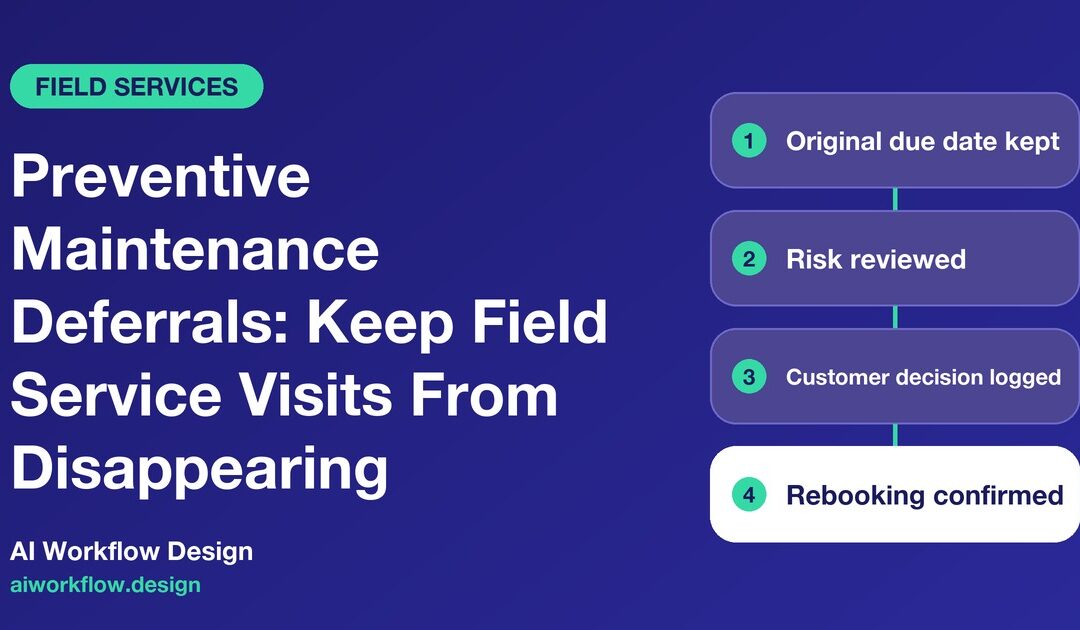
Quick answer: A defensible preventive maintenance deferral process records the original service obligation, why the visit cannot proceed, asset criticality, contractual or regulatory limits, the responsible risk reviewer, the customer’s decision and a confirmed replacement plan. A deferred task must stay visible until the work is performed or formally resolved. An automatic reschedule can coordinate calendars, but it cannot decide that a required inspection is safe to postpone.
A field-service dispatcher receives three familiar messages on a Monday morning: the customer’s production line is unavailable, a technician is sick and a replacement filter has not arrived. Each creates a different problem. Yet many teams make the same board change for all three—move the preventive maintenance visit to next month. Once the date changes, the old commitment vanishes from the daily schedule. The customer sees no explanation, and the contract manager loses sight of accumulated deferrals.
The right workflow keeps two things in view: the original due obligation and the revised operational appointment. They may be connected, but they should never be the same field.

Identify what may and may not be deferred
Start with the maintenance plan, not the scheduling tool. Tasks may be based on calendar periods, run-hours, cycles, observed condition or a combination. Some are routine manufacturer recommendations; others are linked to warranties, insurance requirements, statutory inspections, permits, safety cases or customer contracts. The same asset can have several obligations that are not interchangeable.
Record the source document, required activity, asset identifier, original due criterion and the organization responsible for deciding whether a delay is permissible. A service coordinator should not infer that a task can move because another visit at the site was recently completed. A technician’s inspection and a legally required examination may be different activities.
Where a task has safety or regulatory implications, the appropriate qualified owner must determine its disposition under the relevant standard and jurisdiction. A status call is not a risk assessment. It must not recommend continued use of equipment that may require inspection, isolation or repair.
Categorise the reason before changing a date
Use reason codes that support action: Customer access unavailable; Asset needed for operations; Technician capacity; Parts unavailable; Unsafe conditions; Permit or site authorization pending; Weather; Data or scope discrepancy. Include a short factual note and the person reporting it. Avoid using ‘customer cancelled’ when a supplier missed a part delivery; inaccurate categories hide where the process is failing.
Separate an unconfirmed request from a recognized deferral. A customer’s email saying ‘not this Friday’ creates a coordination task. It does not necessarily constitute valid contract approval, a risk acceptance or a revised legal due date. The authorized account owner must confirm those implications before the work order changes state.
If the original obligation has already passed, record it as overdue even if a new appointment is scheduled. A future booking can reduce uncertainty, but it cannot retroactively make the service on time.
Create a two-stage review gate
Stage one is technical and compliance review. Identify asset criticality, purpose of the work, manufacturer guidance, previous defects, recent failures, legal or permit conditions and whether temporary safeguards are prescribed by competent personnel. The result may be ‘deferral permissible with conditions’, ‘more information required’ or ‘do not defer’. Keep the review record and its author.
Stage two is commercial and scheduling review. Confirm whether the customer has authorized the revised window, whether there are call-out or missed-access charges, whether the contract requires notice and whether access or production downtime must be booked. A contract manager should not override the technical stop; a technician should not accept a new fee on behalf of the business unless authorized.
If a technical reviewer requires interim measures, communicate them using the approved instructions. The administrative team may log that the customer was notified, but compliance with the measure should be verified through the proper technical process.
Retain the original service obligation
An effective work-order record contains Asset ID, Maintenance task ID, Original due basis, Planned visit, Deferral reason, Requested by, Technical decision, Commercial approval, Interim controls reference, New proposed date, Confirmed access, Related customer message, and Final evidence. Use separate timestamps for when the issue was reported, reviewed and resolved.
Where software supports it, preserve the original task and attach a child item for each proposed reschedule. Otherwise use an immutable original-due column and a revision log. Multiple deferrals should be visible as a history, not overwritten with the latest appointment.
For recurring work, decide whether the next scheduled interval runs from the original obligation, the actual performance date, or another defined rule. The answer must come from the applicable maintenance plan or contract. A generic automation must not silently reset future inspections after a delay.
Communicate with customers before they chase you
A useful customer update states which asset and service activity are affected, the factual reason, whether the date is proposed or confirmed, the owner of the next decision and what information the customer needs to provide. If there is a safety concern, follow the approved emergency and technical-communication process, not a routine scheduling script.
For a customer-requested postponement, confirm who may authorize downtime and who can approve any fee or contractual change. For a supplier-driven delay, own the reason rather than presenting it as the customer’s choice. If a part is unavailable, give a supplier-confirmed status only; do not promise an arrival date because a stock system shows ‘expected’.
Offer options where the technical and contractual rules allow them, such as an alternative technician, partial service with a remaining-work record, an approved temporary change in access window or an earlier cancellation slot. ‘Partial completed’ should never hide inspection points that still remain open.
Use monday.com to expose the true backlog
Create an Active PM Obligations board or a connected view from the source maintenance platform. Give the dispatcher a scheduling view, the contract manager an approval view and the technical lead a risk-review queue. Useful status values include Due soon, Appointment planned, Deferral requested, Technical review, Customer confirmation pending, Deferred approved, Overdue, Completed pending evidence, Closed.
A monday.com automation can remind an owner that a deferral is waiting for review, or notify the customer team when an approved new date is recorded. A task should not become closed solely because a fresh date exists. Link the signed or otherwise authorized decision where required and retain audit information according to the customer’s terms.
An approved Daily Check-in Agent or Autoza AI for monday.com may ask a site contact whether access has been confirmed, or ask a technician whether assigned paperwork is ready. Those are bounded administrative questions. The agent should not classify asset risk, waive contractual rights or mark mandatory servicing compliant. See custom workflow integration services for permitted status updates between existing work-order and project systems.
Handle five common deferral scenarios
The customer cannot shut down a machine. Record the request, identify the correct maintenance category and obtain the equipment owner’s approved downtime plan. Do not carry forward a vague ‘customer busy’ note without an accountable new date.
A technician discovers unsafe access. Stop the administrative progression and escalate through the established safety procedure. The issue is not simply another scheduling conflict. Whether work may resume requires the appropriate competent decision.
The supplier misses a replacement component. Keep purchase-order confirmation and material status separate from the maintenance obligation. Confirm whether partial work is meaningful, and preserve any remainder as open work.
The customer asks to combine two PM visits. Check task frequencies, personnel competencies and equipment availability. Combining travel does not automatically permit consolidation of distinct required checks.
A task is postponed repeatedly. Escalate based on risk and the age of the original obligation. A string of accepted appointments can conceal a growing backlog if the review looks only at the newest due date.
Report the metrics that actually matter
Track preventive maintenance completion against original due criteria, outstanding approved deferrals, overdue tasks by risk category, average time awaiting a customer decision, repeated access failures and jobs closed with missing documentation. Do not treat all late tasks as equal, but also avoid removing high-risk work from the denominator to make the completion rate look better.
Review causes monthly with dispatch, service management, technical owners and customer account managers. If late access is recurring, revisit the site’s scheduling process. If parts are the main issue, improve procurement lead-time visibility. If technical reviews routinely stall, clarify authority and the information needed for decisions.
The desired result is not a perfect calendar. It is a defensible service record in which the customer, technicians and contract owners understand what remains due and who has accepted each deviation.
Preventive maintenance deferral checklist
- Record the maintenance source and original obligation before rescheduling.
- Classify the actual reason and preserve each request’s timestamp.
- Route technical, safety or statutory questions to competent reviewers.
- Obtain necessary customer and commercial approvals separately.
- Keep overdue tasks visible after a new booking is made.
- Confirm access, personnel, equipment and materials for the revised visit.
- Retain service evidence and unresolved follow-up tasks.
- Report repeat deferrals as a management issue, not just a diary change.
Next step
Want these follow-ups handled consistently? Explore Autoza AI for monday.com or talk to AI Workflow Design about scheduled, permissioned status follow-ups that leave approvals and decisions with the right people. For a companion workflow, read Field Service Equipment Recalls: Match Installed Assets to Approved Safety Actions. Related guidance: see our field service automation page.
Frequently asked questions
What is a preventive maintenance deferral?
It is a documented decision or request to move required planned maintenance beyond its original schedule or condition, with the reason, risk review, permissions and next action preserved.
Can a customer request automatically move a required inspection?
No. The request should trigger a review of the applicable maintenance plan, legal or contractual requirements and the authority needed to approve a change.
Should the original due date be overwritten after rescheduling?
No. Preserve the original due basis and revision history so overdue work and repeated postponements remain visible to owners and auditors.
Can AI approve a maintenance deferral?
An AI system can collect administrative status and prompt the right person. It should not decide asset safety, waive inspections, approve risk or change contractual obligations without authorized human review.
What metrics show whether deferred maintenance is under control?
Review overdue obligations by risk, repeat deferrals, age of open tasks, time to approved rebooking, completion evidence and the causes of customer or supplier delays.