
Quick answer: A field service subcontractor credential checklist should identify the trade and jurisdiction of the proposed job, confirm the required evidence has been received and reviewed by its owner, and keep any remaining safety or site-entry requirements visible before dispatch. An uploaded licence or insurance certificate is not the same as a valid authorisation to perform the work. Dispatch systems should not bypass expired, unverified or job-specific requirements in order to fill a schedule slot.
Imagine an HVAC dispatcher with a customer whose rooftop unit has failed. A preferred subcontractor is available in two hours. Their business profile shows “compliant,” but the insurance record is from last year and the technician who will actually attend the site is not named in the competency register. Speed matters to the customer; so do a safe job and reliable evidence.
The workflow becomes manageable once the dispatcher stops treating “vendor onboarded” as a permanent label. Readiness depends on the specific person, work type, location, dates and client site.
Separate company credentials, technician competencies and site permissions
The subcontracting business may provide an insurance certificate, tax or contract documentation, and evidence of organisational approvals. Individual technicians may need trade licences, certifications, training or authorisations. The customer site may separately require induction, escorts, background screening, access badges or permits to work. Keep these layers distinct.
Whether a licence is legally required depends on the service, jurisdiction and work performed. Electrical, refrigeration, gas, lift and fire-systems work can have very different rules. Use authoritative local licensing registers and the client’s contract, not a generic “licensed contractor” tick box. Similarly, a COI may show a stated policy period but needs review against contract terms and by the right person; it does not by itself prove all risks are insured.
Good practice for host-employer and contractor coordination emphasises sharing site hazards, safety arrangements and responsibilities before work begins. That does not turn an administrative credential tracker into a safety management system. A dispatch board can surface missing steps; qualified workers and accountable employers still plan, supervise and perform the work safely.
Create one subcontractor profile and a job-level readiness check
The master vendor profile should include the legal business identity, approved service categories, geographic reach, contract owner, certificate references, verified-document dates, restricted data location, renewal contacts and review history. Record the person who evaluated each required credential and the scope of that review.
For each proposed dispatch, create a separate job-level check: work-order ID, service description, location, expected arrival, assigned technician, required trade qualification, site access conditions, hazard or permit flag, reviewer, and authorised dispatch decision. The same contractor may be eligible to perform one task but not another.
Use Not provided, Received, Pending verification, Verified for defined scope, Expired, Rejected, and Not applicable with reason as possible credential states. Preserve the reason and reviewer for “not applicable”; it must never mean “someone forgot to ask.”
Seven readiness gates before scheduling the crew
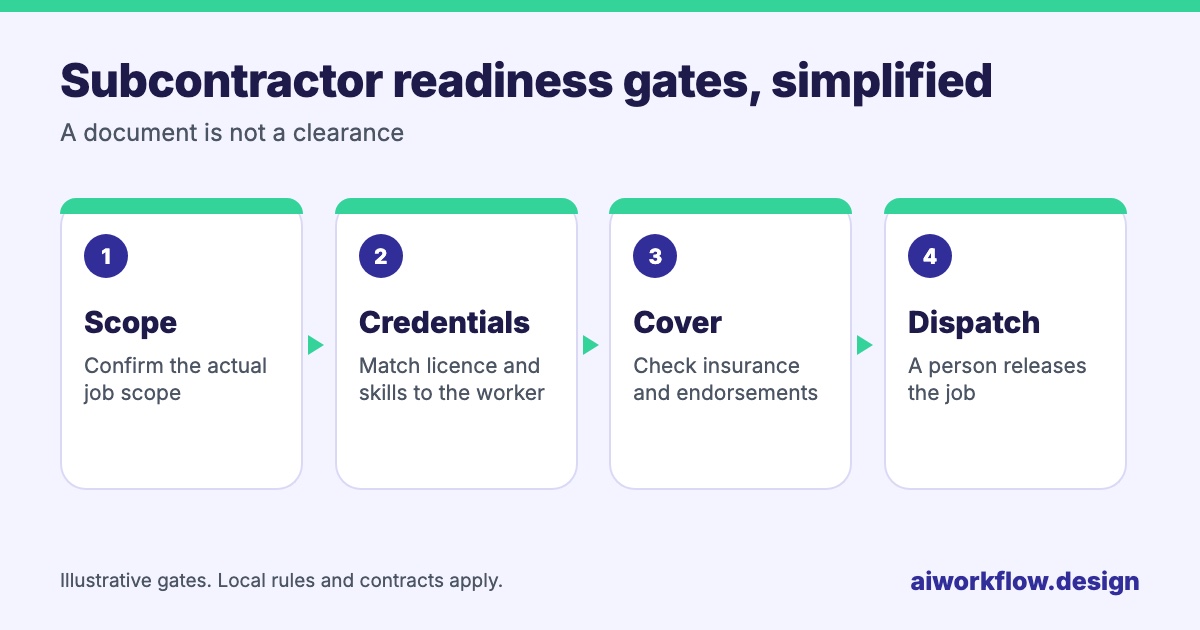
Confirm the actual scope of work
A general appliance call might turn into refrigerant handling or electrical isolation once the technician arrives. Define the known task and specify that any scope change requiring new authorisation triggers a fresh review. Do not use the original ticket title as a substitute for the actual work planned.
Match qualifications to the worker and location
Check the technician who will attend, not just the subcontractor logo. Make licence status, permitted scope, relevant dates and location visible to the authorised verifier. Where official registers are available, record the verification reference and date. Restrict the source document and sensitive personal information appropriately.
Review contractual insurance and endorsements
Track expiry dates and document receipt, but route policy interpretation and adequacy to the client or specialist designated to review insurance. If a policy expires before the service window ends, the record needs an actionable renewal or confirmation, not a green label based on the initial dispatch date.
Confirm site induction and access
Ask whether the technician has completed any required building orientation, visitor procedures, identification checks and after-hours access approvals. A returning contractor’s old badge may have been deactivated after a site change; do not treat prior entry as current clearance.
Assign risk and permit-to-work decisions
For work involving confined spaces, hot work, electrical isolation, work at height or other hazardous activities, route permit and safe-system questions to those legally and operationally accountable. The dispatch process can confirm that the required review exists; it should not create a permit or accept safety controls on their behalf.
Establish a reachable supervisor and contingency
The dispatcher needs a named technical contact who can confirm unexpected changes and a fallback contractor if the preferred worker cannot be cleared. A customer notification plan matters when appointment timing is affected by compliance checks.
Publish the formal dispatch result
Only the authorised dispatch manager or integrated rules validated by the organisation should change Ready to dispatch to Released. A received form, an unanswered reminder or a contractor’s verbal assurance must not automatically flip the release field.
Design renewal alerts so they do not conceal uncertainty
A useful renewal workflow might ask a subcontractor coordinator to confirm who owns a replacement certificate 30 days before expiry, send a second reminder nearer the date and escalate if the authorised reviewer has no valid evidence. Those intervals are an example of an internal service level, not a universal legal requirement.
Record if a credential is required to remain valid throughout the job, not merely on the day the dispatch is created. For a scheduled maintenance visit weeks away, the dispatch date and service date are different. Use both when evaluating expiry exposure.
A renewal submitted after expiry should restart review; it should not backdate an approval. If a contractor is dispatched urgently, the organisation’s lawful alternative or exception process—not the chatbot—must decide what, if anything, is permissible.
Example: a technician substitution at the last moment
Suppose the originally assigned technician has the required site induction, but the subcontractor substitutes another worker on the morning of the job. The company credentials may still be current; the individual training and site access are not established. Record the substitution as a change in the job-level record, recheck the individual requirements and inform the dispatcher of any hold.
If the customer needs immediate restoration, a manager can explore an alternative qualified technician, a safely limited visit or a rescheduled appointment according to the job and local rules. The system must not silently copy the first worker’s approvals to the second.
Use administrative calls without delegating safety decisions
A check-in agent can ask the subcontractor administrator, “Has the updated certificate been sent?”, “Which technician is assigned?” or “Has the customer confirmed the escort arrangement?” The reply can be written to the appropriate board as supplier-reported, with time and source attached.
AI Workflow Design’s check-in products can support approved status calls, while a custom workflow build can be scoped for integrations and routing. Neither is a credential issuing authority, official licence register or competent person for a risk assessment. Call consent, contact preferences, security access and data minimisation must be designed into the workflow.
Track readiness quality, not just on-time arrivals
Review the share of released jobs with all required evidence, number of same-day substitutions, credentials expiring during scheduled work, customer delays attributable to incomplete onboarding and exceptions found after dispatch. Distinguish blocked because not compliant from blocked because verification is pending; the corrective actions are different.
The aim is not to eliminate every hold. A hold that prevents an unverified technician from entering a controlled site may be exactly what the process is supposed to achieve. Build the fastest path to a legitimate decision, not the fastest path to a green dashboard.
Closing principle: readiness is contextual
A vendor profile is a useful starting point. Dispatch authorisation belongs to the particular job and its current risks, people and location. When company documents, technician qualifications, site permissions and a human release decision are tracked independently, the dispatcher can act quickly without confusing administrative progress with permission to work.
Next step
Want these follow-ups handled consistently? Explore Autoza AI for monday.com or talk to AI Workflow Design about scheduled, permissioned status follow-ups that leave approvals with the right people.
Frequently asked questions
What documents belong in a subcontractor credential checklist?
Common categories include relevant business agreements, insurance evidence, legally required trade licences, technician qualifications, site inductions and job-specific permits. Exact requirements vary with task and jurisdiction.
Does a current COI automatically make a subcontractor ready for dispatch?
No. It is one document subject to review; trade qualifications, site entry, the actual scope and safety planning may also be required.
How often should subcontractor credentials be checked?
Review at onboarding, when evidence changes or expires, when the assigned person or job scope changes, and whenever the client or applicable rules require re-verification.
Can an AI tool verify a technician is safe to perform electrical work?
No. It can collect status and route evidence. Legal licence validity, technical competency, hazard controls and work authorisation need the appropriate official or qualified reviewer.
What happens when a credential expires before a scheduled job?
Put the affected release on hold, obtain updated evidence, send it for proper verification and explore an authorised replacement or reschedule if needed.
Related reading
- Customer Job Sign-Off: Handle Disputed Completion Without Auto-Closing
- Rooftop HVAC Visits: Confirm Access and Safety Prerequisites Before Dispatch
- Second-Visit Jobs: Confirm Parts and Access Before Dispatching a Technician
- Shift Handoffs for Dispatch Teams: Stop Losing Open Service Jobs
- Warranty Service Follow-Up: Record the Right Evidence Before Closing a Job