
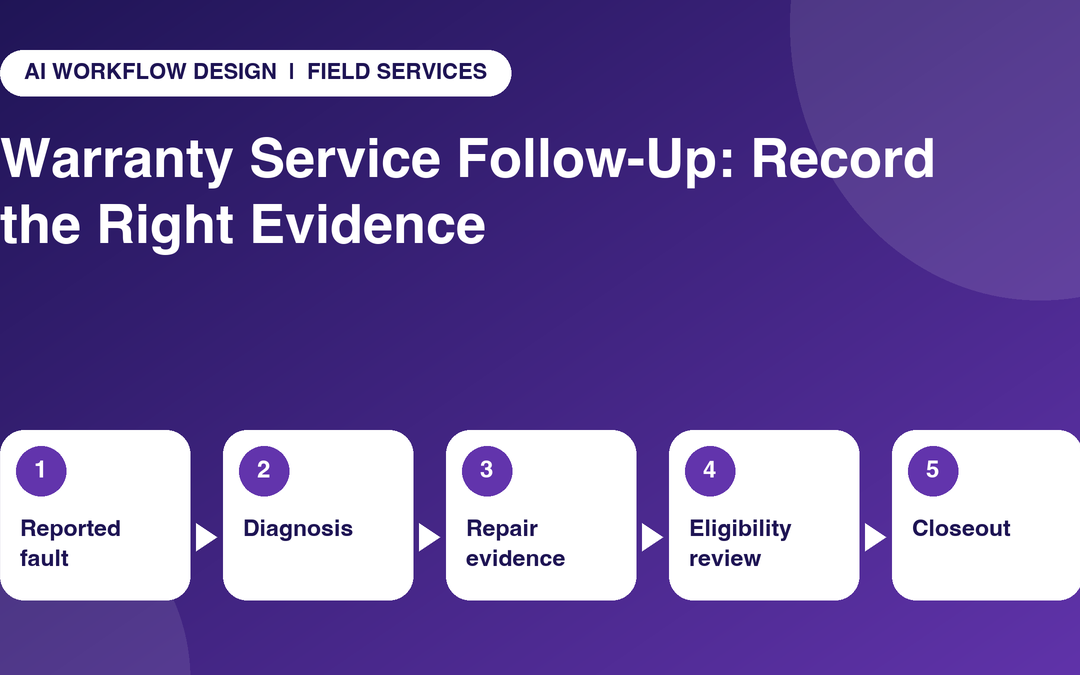
Quick answer: A practical evidence-first warranty service follow-up process, from the reported fault to technician documentation and authorised claim closure.
Field service warranty job follow-up is often derailed by a simple mismatch: the field technician says the work is done, while the office still needs a diagnosis, part record, before-and-after evidence or customer acknowledgement before it can review the claim. Closing the job too early may make it harder to investigate a disputed repair or confirm whether the work falls within the relevant warranty terms.
The answer is not to collect longer phone calls. It is to make the required evidence clear before dispatch, use short check-ins to locate missing items and allow the authorised warranty or service reviewer to decide eligibility and closure. An AI caller can capture reported progress; it cannot interpret warranty contracts or certify technical repairs.
Separate the reported fault, diagnosis, repair and warranty decision
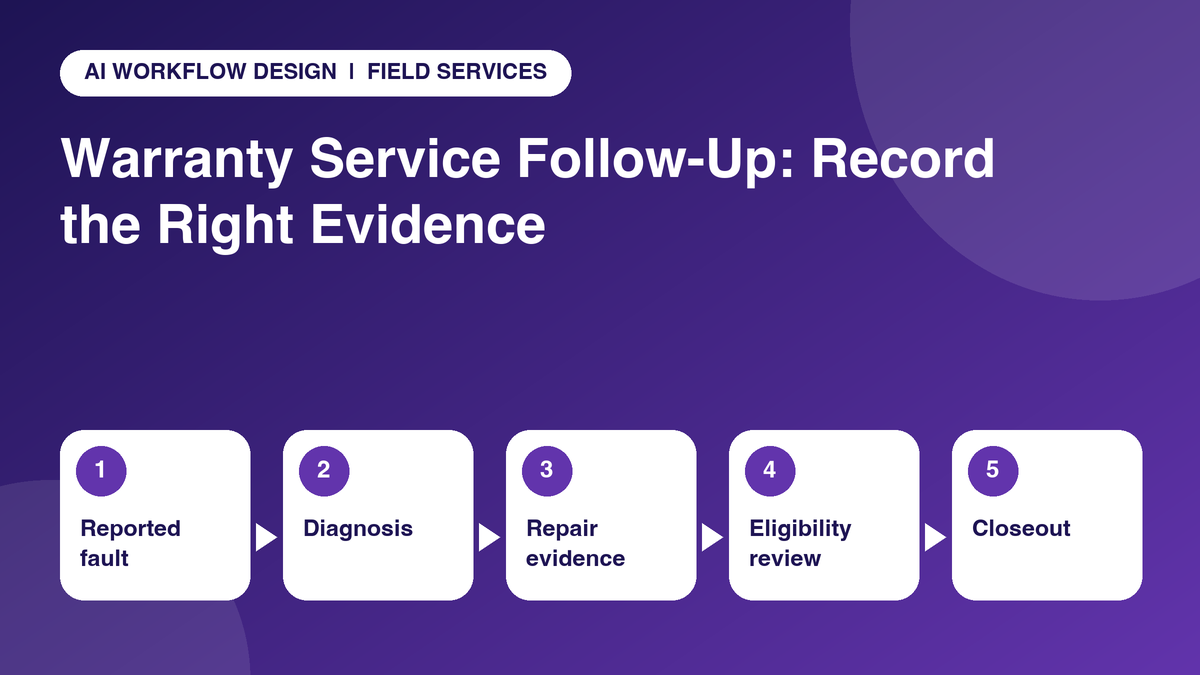
Create four distinct records. First, what the customer reports and when. Second, what the technician observed during diagnosis. Third, what repair or replacement was performed, including part and equipment identity. Fourth, the warranty eligibility and commercial decision by the authorised person. This prevents a completed field activity from being mistaken for an accepted warranty claim.
For example, a customer may describe an intermittent fault, while the technician observes normal operation during the visit and recommends further monitoring. The correct record is not “fault fixed” simply because an appointment occurred. Capture the reported symptom, diagnostic outcome and next approved action without inventing a root cause.
Prepare an evidence checklist suited to the equipment
Before dispatch, specify the required asset identifier, installation or purchase context if relevant, condition photographs, failed part details, measurement or test records, parts replaced, labour description and customer acknowledgement rules. The exact standard should come from the manufacturer, contract and service policy. Do not ask for images of restricted locations unless the site has authorised collection and secure storage.
ServiceTitan’s field forms guidance recommends maintenance and warranty-specific forms and explains how photos and signatures can support job documentation. Its job closeout guidance also separates field work, required forms and office review. These practices support a simple rule: evidence belongs in the work-order system, not solely in a narrative call transcript.
Make the check-in questions evidence-oriented
A scheduled call should ask, “Which assigned warranty job did you attend?” “What action did you complete?” “Which required document or photo is still outstanding?” “Was the customer acknowledgement collected using the approved method?” and “What issue requires supervisor review?” If the worker cannot safely speak, defer to a suitable time or other approved channel.
Do not ask the AI to determine whether a replacement is covered, whether a customer caused damage or whether a disputed invoice should be waived. Those conclusions may depend on formal terms, test evidence and commercial judgement. The caller may record a technician’s observation as reported, but the job should remain under review until the designated person decides.
Use a board that does not collapse all statuses into “closed”
An illustrative monday.com view can use Work order, Asset ID, Reported fault, Visit performed, Diagnosis documented, Repair evidence received, Required signature, Parts used, Warranty review owner, Eligibility decision, Customer update and Closeout date. Some fields should be read-only or restricted, and the initial information should remain auditable rather than overwritten by the latest call summary.
monday.com project boards support task status and ownership. AI Workflow Design’s scheduled-calling product overview and article on technician job progress updates are useful internal context. They do not establish that a voice report alone meets your manufacturer’s or insurer’s required claim documentation.
Handle the common incomplete-claim scenarios explicitly
If the technician replaced a part but uploaded no serial number or required images, the repair action may be marked reported complete while evidence remains pending. If the job needs a customer signature, capture it through the approved signing workflow; a spoken “the customer agreed” may not satisfy the contractual record. If tests show the fault persists, open a diagnostic follow-up rather than closing the issue as resolved.
If the customer disputes the outcome, assign a case owner and preserve the chronology of all visits, explanations, evidence and communications. A call summary may help show what was reported at a moment in time, but it should not change the customer’s rights, the manufacturer’s criteria or a reviewer’s independent determination.
Define an authorised closeout sequence
Use a clear sequence: field work recorded; required documents uploaded; technical reviewer checks any test or safety requirements; warranty reviewer decides eligibility and costs; customer communication approved; work order closed under the organisation’s standard. Some systems distinguish technician appointment completion from office job closure. Keep that separation visible where it exists.
The same logic applies to an unanswered call. Do not infer that the job is complete or overdue because the technician does not respond. Follow the communication policy and assign a human to check the written job record. For safety-related failures, bypass routine retry loops and invoke the responsible technical or emergency process.
A sample evidence exception and its proper resolution
Consider a warranty request for a pump replaced during a commercial service visit. The technician says the pump was changed, but the required old-part photograph and test reading have not yet been uploaded. The office should not reject the claim solely because the call ended, and it should not close the job as fully verified. The status can read “repair reported; evidence outstanding”, with the technician assigned the documentation task and a reviewer assigned the final decision.
If the technician supplies the missing materials, the service manager reviews them under the applicable contract and technical requirements. If the replacement did not resolve the problem, create an approved next diagnostic action. The voice check-in is valuable because it identifies the missing evidence and its owner; the written claim record, technical review and formal communication remain decisive.
Pilot for complete evidence, not faster premature closure
Measure the share of warranty files with all required evidence on first review, average time from visit to documentation completion, rework caused by missing attachments, and number of closures reopened because key facts were absent. Track customer outcomes and disputes, while recognising that claim volume and policy differences affect results.
Use the findings to improve the technician checklist and initial work order instructions. Automated follow-up should make it easier for a reviewer to reach a defensible decision, not pressure the reviewer to accept incomplete repairs.
Practical checklist: steps to put into the next workflow review
- Keep customer symptom separate from technician diagnosis.
- Capture equipment identity and relevant service history.
- Record replacement part, work completed and required tests.
- Attach approved photos, reports and acknowledgements.
- Track evidence pending separately from work reported complete.
- Send coverage and claim decisions to the authorised reviewer.
- Close only after required technical, commercial and customer steps.
Illustrative status-to-decision mapping
The following is a proposed workflow example, not a default configuration or an authorisation to make operational decisions automatically.
| Checkpoint | Person to ask | Reported evidence | Human decision |
|---|---|---|---|
| Technician report | Field technician | Observed condition, work and parts | Technical reviewer checks |
| Claim evidence | Service coordinator | Required forms, photos and signatures | Warranty reviewer checks completeness |
| Closeout decision | Authorised service manager | Coverage, cost and customer outcome | Human closes work order |
Where scheduled AI check-ins may help
For approved monday.com tasks, structured calls can capture relevant progress and flag unresolved actions for a project manager. The Autoza and AI agent overview describes scheduled status calls, board updates and summaries. Set scripts, call windows, consent and disclosure, permitted update fields, retries and human escalation with the implementation owner before a live rollout. Keep original documents and final authorisations in the relevant system of record.
If a call is unanswered, record “no response” rather than inferring non-attendance, rejection or completion. Do not let a generated summary substitute for an official permit, signed creative proof, technical test, warranty decision or customer agreement. For mobile teams, a suitable non-call update channel should remain available when someone is driving or working in unsafe conditions.
Next step: review one real workflow
Choose a real but non-sensitive project, identify the follow-up questions that currently delay a decision, and review them with the people who own the task and the approval. Explore AI Workflow Design’s products or browse its existing automation articles to see how scheduled calls can complement current systems without replacing experienced event and service operations teams.
Frequently asked questions
What evidence should a warranty repair record include?
Use the manufacturer and service policy requirements. Common elements include asset identification, the reported fault, diagnosis, parts and labour details, applicable test results, approved photos and customer acknowledgement.
Can AI decide whether a repair qualifies for warranty coverage?
No. Eligibility depends on contractual terms, evidence and authorised commercial or technical assessment. AI follow-up can collect an update or flag missing documents, not decide entitlement.
When should a warranty service ticket be closed?
Only after the required service documentation, testing, customer communication and authorised review are complete under the company’s policy.
Is a technician’s verbal confirmation enough to prove the repair?
Usually not where a written diagnosis, test, photo or signature is required. Record the report as a status, then review the prescribed evidence.
How do follow-up calls help when a warranty file is incomplete?
A short call can identify exactly which attachment or action is missing, who owns it and when the reviewer can expect an update. It should not substitute for the evidence itself.
Related reading
- Mapping Technician Call Answers to monday.com Job Status Columns
- How to Capture Job Progress Updates From Technicians Still in the Field
- Missed Technician Calls: When to Retry and When to Escalate
- Second-Visit Jobs: Confirm Parts and Access Before Dispatching a Technician
- Preventive Service Appointments: A Contractor Check-In Workflow
- Warranty Callback Scheduling: Confirm Coverage Before Dispatch