
A commercial tenant fit-out rarely depends on the contractor alone. The landlord may control building access and alteration consent; the tenant may own brand, layout and operational requirements; the design team owns technical information; and the contractor schedules physical work. Tenant fit out project coordination works when each party’s obligations, decisions and handoffs are visible before the next trade mobilises. Progress calls can help teams identify missing actions, but they cannot grant a landlord’s consent, change a lease or certify building work.
This guide is designed for development managers, landlord representatives and tenant project teams coordinating offices, retail premises or other commercial spaces. Contract terms, building regulations, fire arrangements and alteration rights vary by jurisdiction and property, so the first step is to read the relevant lease, licence, design brief and building rules.
Identify which party owns each kind of decision
The landlord may control base-building systems, access procedures, loading areas, permitted work hours and consent for alterations. The tenant typically controls its brief, interior specification, operational approvals and nominated vendors. The contractor controls its work programme and submits technical information within the contract. Designers, building control bodies and independent inspectors have separate responsibilities that a project tracker must not blur.
Make a short responsibility matrix for approvals, access, scope changes, design queries, safety documents, base-building connections, test evidence, handover and reinstatement obligations. Name both the person preparing each item and the person authorised to accept it. ‘Landlord to review’ is not enough when the landlord’s building manager and legal approver have different roles.
Lock the fit-out scope before relying on a programme
A fit-out plan is fragile when the working drawings, services loads, existing-condition survey and landlord rules are still changing. Before the contractor starts, check that the tenant’s final brief has an identified version; drawings have been issued for the correct purpose; base-building constraints are recorded; the approval route is understood; and every design exception has an owner.
The approval process may include a licence for alterations, statutory permissions and separate building-management permits. Tenant alterations and landlord consent can carry specific legal conditions, and other leases and jurisdictions will differ. Use the actual property documents rather than assuming all fit-outs follow the same approval sequence.
Create a handoff checklist that follows the work
A usable checklist covers access to the premises, contractor induction, protection of common areas, approved delivery routes, temporary services, drawings, materials, noisy work windows, fire safety coordination, interfaces with lifts and building systems, inspections, and practical handover requirements. For each item, record what will prove it is complete, who checks the proof and whether the next trade may proceed.
For example, ceiling closure should not be scheduled solely because an installer says cable work is done. A competent reviewer may need to verify concealed services, inspection records or fire-stopping requirements. Equally, a tenant’s request for an extra meeting-room outlet is a proposed change until the appropriate cost, design and landlord approvals have been obtained. The same sequencing logic applies in a punch-list follow-up before practical completion.
Organise fit-out work around approval gates
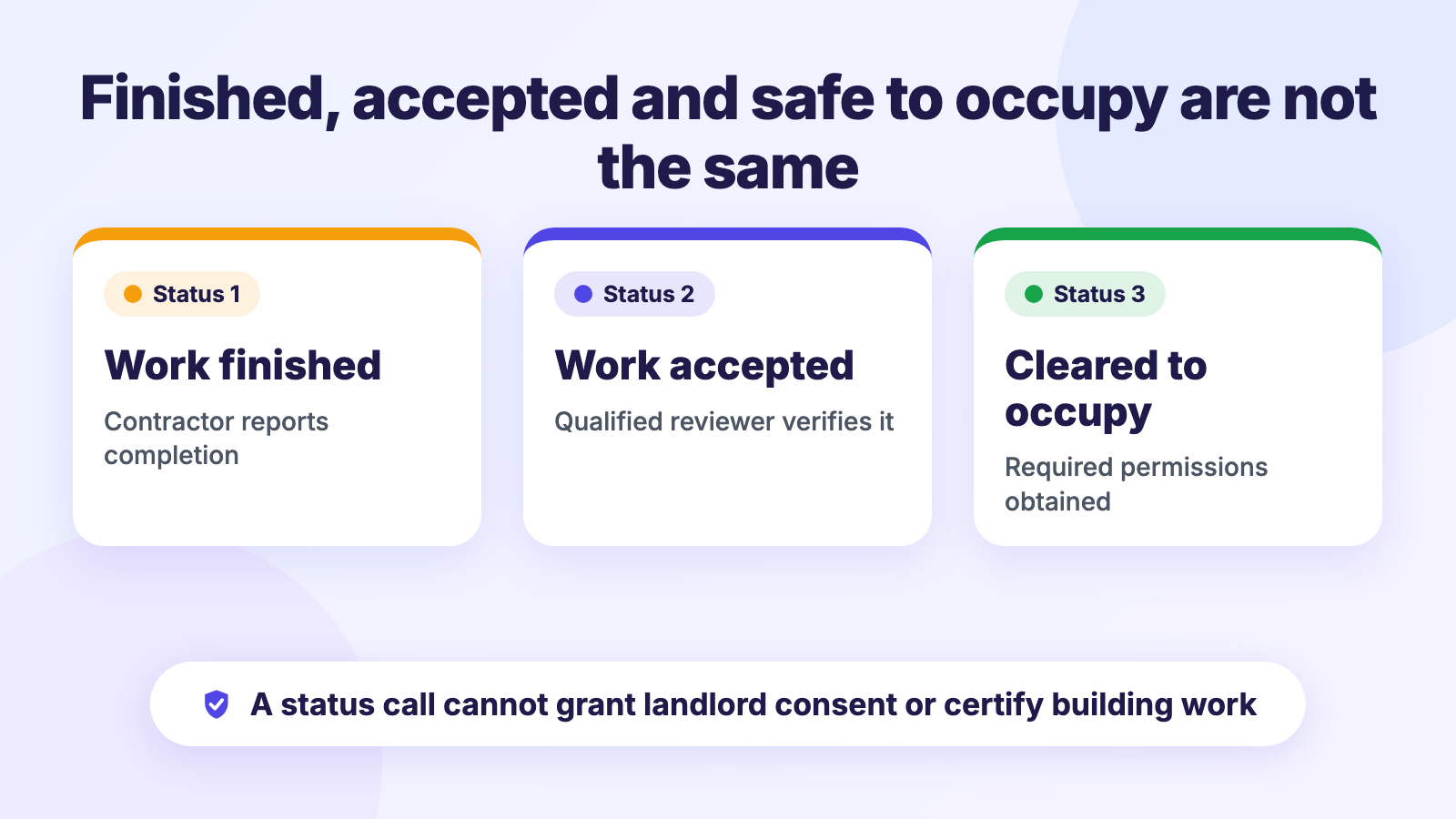
A hypothetical monday.com board could have items for design package, landlord alterations submission, contractor mobilisation, base-building interfaces, inspections, defects and handover. Each item could record owner, planned date, reported status, verified gate, document reference and dependency. Separate ‘submitted’ from ‘approved’, ‘work finished’ from ‘accepted’, and ‘space available’ from ‘safe to occupy’. This is a recommended project structure, not a claim about built-in Autoza templates.
A practical gate sequence is scope and survey confirmed, design reviewed, alterations consent and statutory permissions established, access arrangements agreed, critical works inspected, defects addressed, building systems handed over, and required occupancy or opening permissions obtained. Some gates may run in parallel, but their decision authorities stay distinct.
Use shorter calls for routine coordination
A scheduled follow-up call might ask the tenant coordinator whether the approved finishes schedule has been issued or the building manager whether the delivery-slot request was acknowledged. Good questions are specific: ‘Which drawing version is the contractor using?’ ‘Has the landlord issued written consent for the affected work?’ ‘Is tomorrow’s loading-bay booking confirmed?’ ‘What evidence will the next trade need?’ and ‘Who can resolve the blocker?’
Avoid collecting confidential lease terms, access codes, alarm details, personal tenant information or sensitive base-building drawings through general-purpose voice logs. Autoza AI for monday.com offers scheduled calling and board updates, but sensitive prompts and field mappings should only be used after a product, security and privacy review. To decide who should receive these calls, see internal teams vs external contractors.
Treat changes as proposals until authorised
An illustrative retail tenant asks to add illuminated signage late in the programme. The contractor reports that installation is possible on Friday, but the landlord’s facade rules and electrical design have not been reviewed. Record ‘tenant request received’ and assign the design and consent check. Do not change the official work status to ‘approved for installation’ or treat a phone answer as variation acceptance.
The same discipline applies to revised hours of work, new penetrations, service upgrades and changes affecting fire safety. Escalate these through the written change-control process. Keep a current version of the approved design accessible to those who need it; withdraw obsolete instructions rather than letting two crews work from different plans.
Plan handover earlier than the final week
Handover often involves test certificates, operation manuals, training, warranties, access cards, keys, defects lists and base-building interface documentation. Some of these go to the landlord, others to the tenant’s facilities team, and some to statutory authorities. Create a delivery owner and acceptance criterion for each, including who receives confidential systems information through secure channels.
A completion call can ask whether the documents were submitted, whether outstanding defects are categorised and when a qualified person expects to verify correction. It cannot make an occupancy determination or confirm compliance merely because a contractor says the room is ready. Keep the responsible professional’s final evidence separate from informal project updates.
Review what actually caused delays
After handover, assess the number of late landlord responses, design iterations after mobilisation, missed delivery bookings, unapproved scope changes and defects reopened after initial reporting. These measures highlight coordination problems without implying that every delay was caused by a particular contractor. Share recurring lessons in the next tenant brief and building rulebook.
The broader AI Workflow Design blog covers related project-management follow-up techniques, including permit and inspection follow-up. If your team already uses monday.com, consider a narrow pilot for routine document and readiness checks rather than attempting to automate consent decisions.
A practical coordination rule
Every fit-out action should have a question, an owner, evidence, an approver where required, and a next-check date. The status ‘someone said it is done’ is not an approval. For help mapping low-risk check-ins, explore Autoza AI or request a workflow review.
Frequently asked questions
Who can approve commercial tenant fit-out works?
Approval depends on the lease, alterations agreement, local requirements and the nature of the work. The landlord or building manager may approve certain access and alteration matters; design professionals and statutory bodies control their own technical and regulatory decisions. A contractor status call grants none of these permissions.
What should happen when a tenant requests a late design change?
Log the requested revision against the approved baseline, identify commercial and programme impacts, and send it through the established design, landlord and tenant approval route. Issue the new instructions to site only after authorised acceptance. Do not treat an emailed idea or a phone call as a signed variation.
How do you prevent landlord and tenant tasks from being confused?
Give every item a preparer, decision owner, evidence requirement and next action. Record whether the landlord controls access, the tenant controls a specification, or the contractor is simply reporting progress. Separate reported completion from formal acceptance.
What information should an AI fit-out follow-up call avoid?
Do not collect access codes, alarm credentials, unnecessary personal data, privileged lease terms or sensitive building security documents. Ask instead for a document reference, progress stage, blocker and authorised next owner. Follow approved privacy and calling practices.
What should be collected before fit-out handover?
Depending on the property and contract, the package may include test certificates, training records, as-built information, manuals, warranties, access arrangements, outstanding defects and landlord or tenant acceptance. Verify requirements against the actual project documents and any statutory conditions.
Related reading
- Construction Draw Requests: Follow Up on Development Evidence and Signatures
- Land Development Utilities: A Follow-Up Plan for Water, Power and Access
- Before Practical Completion: A Punch-List Follow-Up Calling Plan
- Permit and Inspection Follow-Up for Real Estate Development Projects
- How Developers Can Get Contractor Milestone Updates Without Extra Meetings
- Autoza AI for monday.com: scheduled status calls
- Workflow automation services
- Industries we support