
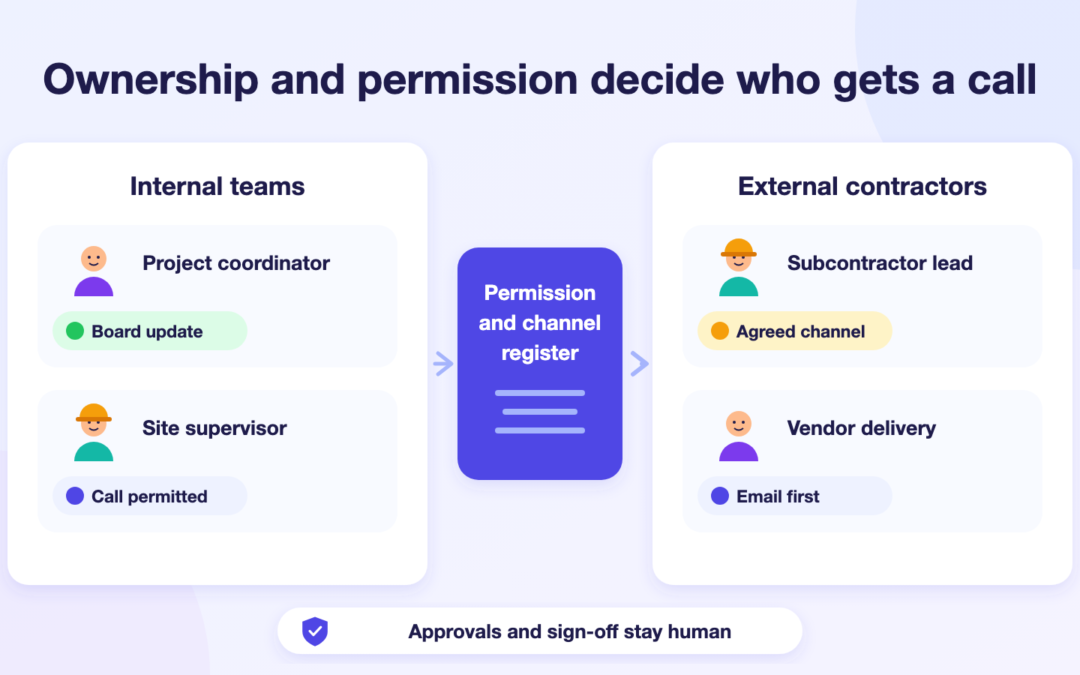
A useful development project stakeholder follow-up policy begins with a simple distinction: someone may be connected to a construction project without being the right person to receive an automated status call. Internal project managers, site supervisors, specialist contractors, architects, suppliers and client representatives have different responsibilities, information rights and contact expectations. Calling all of them on the same schedule creates noise and can expose information they do not need.
A sensible calling plan identifies who owns the task, what they are authorised to report, what decision their answer supports and which communication method they have agreed to use. The outcome should be a clear contact policy with alternatives and human escalation, not a longer list of people to ring.

First identify who owns the next action
Do not confuse ‘stakeholder’ with ‘task owner’. A finance director may need a weekly summary but not a call about scaffold delivery. A subcontractor’s foreperson may be able to report installation progress but not speak for the client on changes to scope. A principal designer or building-control contact may control a formal decision that should remain within official correspondence and approval channels.
Start with the next project milestone and list the outstanding actions. Each action should have an accountable owner, evidence due, review deadline and decision maker. Calls should target the person able to provide the missing operational information. For the broader project approach, see contractor milestone updates without extra meetings.
Compare internal and external communication rights
Internal staff may already use approved systems, employment policies and company devices. External suppliers and subcontractors may be independent organisations with their own approved processes, supervisors and data handling terms. These relationships affect who can be contacted, what a call may ask and where the answer may be stored. Never infer consent from a person’s presence on a project board.
| Stakeholder group | Appropriate routine subject | Better human-controlled decisions |
|---|---|---|
| Internal project coordinator | Pending task owner, due date, supporting documents | Formal change approval, contract commitments |
| Site supervisor | Reported progress, site access and trade sequencing | Safety release, site stop/go decisions |
| Specialist subcontractor lead | Assigned work package, blockers, expected handoff | Variations, liability or acceptance sign-off |
| Vendor delivery contact | Shipment status, delivery slot, missing goods | Contract penalties, disputed terms |
| Architect / consultant | Outstanding drawing or query response | Statutory certification or professional sign-off |
| Client or investor representative | Agreed milestone report by approved channel | Commercial negotiations and scope direction |
This is a suggested role matrix. Real contracts and procurement rules can allocate authority differently, so project-specific documents must prevail.
Give every proposed call a permitted purpose
A good external-contractor call might ask: “For the level-two plant-room installation, has your assigned work package reached the handoff stage? If not, what prevents the next trade from proceeding, and when should the construction manager expect your update?” It should not ask the contractor to reveal another company’s pricing, payroll information or confidential negotiations.
Internal-team calls may cover preparation tasks such as drawing issuance, site logistics or obtaining a status from a third party. Where the answer requires contractual interpretation, retain a human response owner. A reported completion is not automatically accepted work; the developer’s established QA, handover and inspection gates still apply.
Build a permission and channel register
For each relevant person, record organisation, role, task scope, contact channel, agreed contact hours, whether AI calls are permitted, suitable alternate contact, the fields they may update indirectly and the human escalation owner. Review how the organisation obtains a lawful basis for calls, identifies the caller, handles opt-outs and limits recording and retention.
External contractors may prefer a scheduled supervisor call, email, shared portal or direct project-board update. Offer a choice where feasible. A company should not route a sensitive design question into an AI call simply because a supplier’s mobile number is known.
ICO’s employment monitoring guidance provides useful UK principles for transparency and proportionate telephone monitoring. However, calling, recording and data-protection requirements differ across jurisdictions, contract models and the recipients’ circumstances. Obtain advice for each market rather than assuming one global consent rule.
Match urgency to the communication method
An ordinary weekly milestone update can often be collected through an agreed check-in, email or board note. A delivery arriving at the wrong gate might warrant a time-sensitive call to the nominated logistics contact. A suspected structural, fire or electrical hazard must use the established immediate qualified-human safety route. No scheduled AI check-in should substitute for an emergency contact, stop-work procedure or competent safety judgement.
Similarly, if a critical contractor does not answer, record “not reached / status unknown”. Route the issue to the named project manager based on the actual dependency deadline. A missed call is neither proof of contractual non-performance nor permission to reassign or penalise the contractor.
Example: three people, three different kinds of answer
Imagine a mixed-use development where a fit-out subcontractor expects to hand over a corridor on Wednesday. The subcontractor foreperson reports that installation is finished, the internal QA representative says defects remain, and the developer’s project director asks when the next trade can start.
These statements should sit in separate fields: installation reported complete, QA outstanding, and next-trade release awaiting approval. The subcontractor can be contacted about remedy actions; the QA representative owns inspection findings; the authorised manager makes the sequence decision. A single automated ‘completed’ status would lose a critical distinction.
If the client later requests a change to the finishes or programme, that request belongs in the agreed change-control process, even if it was mentioned during a call. Capture a neutral action note without treating the call as a formal instruction or approved variation.
Configure monday.com around task-level permissions
A proposed board might include Project stage, Work package, Internal owner, External contact, Preferred channel, Call permission status, Reported progress, Approved status, Next decision date, Exception type and Human escalation. The objective is to keep information usable for the team without exposing all commercial records to everyone involved.
Autoza AI for monday.com describes scheduled calls, check-in questions, item updates, retry rules and call summaries. These features can support approved administrative status collection. They do not by themselves establish the project’s right to call a third-party contractor or authority to negotiate, approve variations or certify work.
Pilot on a limited set of tasks and confirm that answers are written only to intended fields. Use realistic, non-sensitive examples when testing; do not insert confidential client contracts or personal data to see what the system does. Keep human review available to correct an answer or dispute an inaccurate status.
Evaluate policy quality, not the total number of contacts
After the pilot, review which people were contacted unnecessarily, whether external owners had clear advance notice, how many updates led to a decision, and whether disputes about call records arose. Ask whether project managers still trust the board’s difference between reported and approved completion.
A contact policy is successful when the right person is asked a meaningful question at the right time. Before expanding a rollout, consider the related permit and inspection follow-up guide for formal-authority boundaries and punch-list follow-up plan for contractor closeout tasks. For a scoped demonstration, discuss the workflow with AI Workflow Design.
Frequently asked questions
Should every subcontractor on a development receive an AI status call?
No. Calls should go only to the nominated owners of relevant tasks when the project has an appropriate lawful basis, permissions and agreed contact arrangements. General directory membership is not sufficient.
Can an internal project manager approve work based on a contractor phone response?
A contractor’s report can inform a review, but formal acceptance must follow the project’s authorised inspection, contractual and quality-assurance procedures.
Who should be called about official permit or inspection outcomes?
Use the appointed coordinator and the relevant formal authority channels. A project participant may report that an application was submitted, but cannot substitute for an official regulator decision.
What if an external contractor refuses automated calls?
Respect applicable opt-out and contractual requirements, offer an approved alternative such as a scheduled human call or board update, and avoid treating the refusal itself as a performance failure.
How should a development team handle an unanswered contractor call?
Store the contact outcome separately from project progress, follow an agreed bounded retry policy and ask the responsible project manager to resolve material dependencies before the deadline.
Next step: review one real workflow
See how your project questions, permitted board fields and escalation owners could fit a controlled implementation. Explore Autoza AI for monday.com or request a guided workflow review.
Related reading
- How Developers Can Get Contractor Milestone Updates Without Extra Meetings
- Permit and Inspection Follow-Up for Real Estate Development Projects
- Before Practical Completion: A Punch-List Follow-Up Calling Plan
- Site Inspections Delayed? Build a Dependency-Based Calling Schedule
- Autoza AI for monday.com: scheduled status calls
- Workflow automation services
- Daily Check-in Agent