
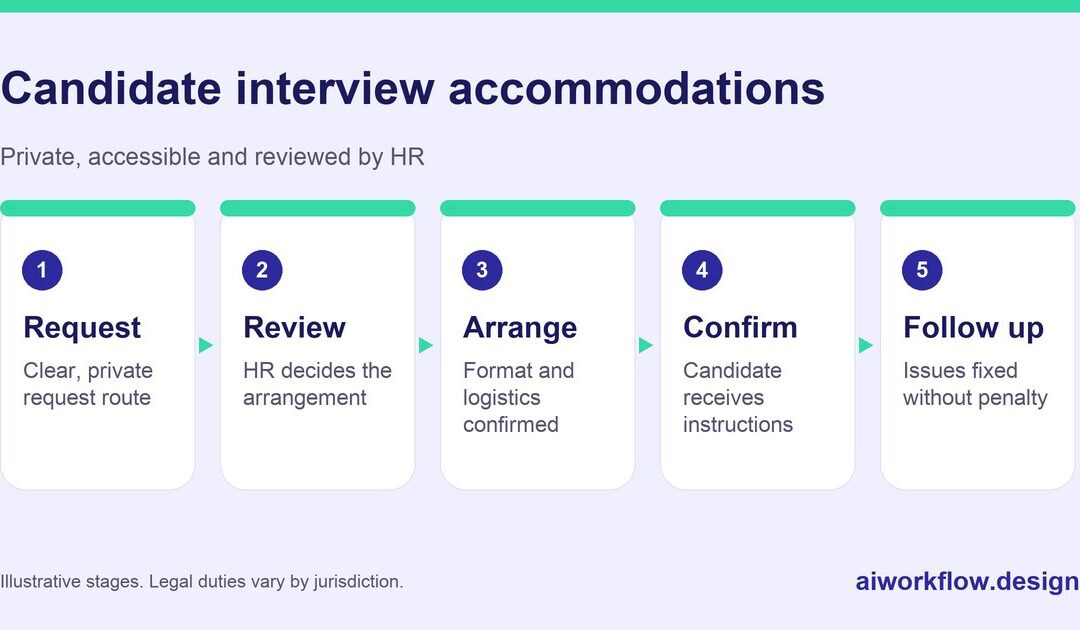
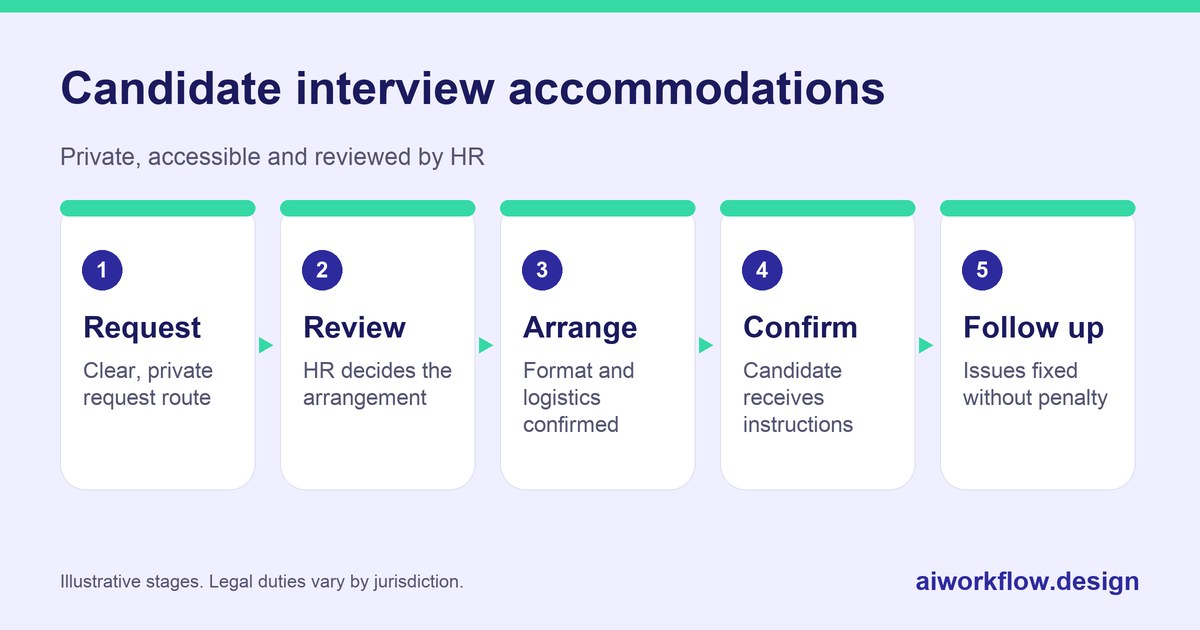
Quick answer: A candidate interview accommodations workflow should let applicants request a fair way to participate, route the request privately to an authorised HR or accommodation specialist, confirm practical arrangements with the interview panel and track whether the interview can proceed. The scheduling board should record the minimum operational detail necessary. It should not record diagnoses, speculate about disability or treat an accommodation request as a negative hiring signal.
Interview logistics can fail in small but consequential ways. A candidate asks about an accessible entrance, but the scheduler confirms only the meeting room. An interviewer sends an online exercise without enough information for the applicant to request an accessible format. A panel moves the interview time without checking that an interpreter or other agreed support remains available. A well-designed process prevents these gaps while protecting confidential information.
Treat access to the interview as a process requirement
Applicants with disabilities may be entitled to reasonable accommodation in the application process, subject to applicable law. The precise obligations depend on jurisdiction, organisation and circumstances; they are not resolved by a generic template. The operational role of the recruiter is to provide a clear request route, refer decisions to the appropriate specialist and make sure confirmed arrangements reach the people responsible for delivery.
Design the initial invitation so applicants know the interview format, location, expected duration, technology and whom to contact if they need an accommodation. Avoid asking every applicant to disclose a medical condition. A simple contact method supports requests without pressuring candidates to share more than needed. If a candidate raises an access need in a reply or phone call, route it promptly rather than asking them to explain sensitive details to the entire panel.
The recruiter should not improvise eligibility decisions or use the request to assess how a candidate might perform on the job. Keep selection criteria and accommodation administration separate.
Describe interview requirements before asking for confirmation
A calendar invite is not an adequate briefing when the interview includes a skills exercise, a site tour, remote proctoring or an unfamiliar platform. Explain whether the meeting is in person or online, how many interviewers will participate, whether a timed assessment is planned and what equipment the candidate is expected to use. Give the candidate a reasonable opportunity to raise logistical barriers through an accessible channel.
For an onsite interview, verify route information, accessible entry, check-in arrangements and the meeting space with the facilities or visitor-services owner. For a remote interview, confirm the video platform, dial-in alternative, captioning availability and compatibility testing route. Do not promise that a platform is accessible merely because it offers a feature; the relevant arrangement should work for the particular interview process.
If the interview date changes, revisit the confirmed accommodation arrangements. A meeting room or support provider that was available on Tuesday may not be available on Thursday.
Route sensitive requests to the right person
Set up a named point of contact in HR, recruitment operations or an accommodation team. When a candidate requests a change, the coordinator can record that an arrangement requires review and provide a secure route to the specialist. The specialist handles necessary confidential information under the employer’s policy. The main scheduling board should generally need only neutral status fields such as “arrangement under review,” “logistics confirmed” or “follow-up needed.”
Avoid entering medical descriptions, accommodation rationales, disability categories, health documents or speculative notes into a general monday.com item. Access to the private case should be limited to people who need it. An interviewer usually needs to know what operational arrangement to support—for example, a revised start time or a particular interview format—not why that arrangement was requested.
If a request could affect the assessment format, have the authorised HR and hiring team review equivalence, timing and applicable obligations rather than making a unilateral scheduler decision. Preserve the rationale in the controlled record, not in a public comment thread.
Build an interview scheduling timeline with dependencies
Start by confirming the approved interview stage and owner, then propose candidate availability, verify panel availability and confirm any support arrangements. Separate “time offered” from “candidate accepted,” and “room booked” from “access arrangement confirmed.” These distinctions prevent the calendar from appearing complete when a crucial dependency remains outstanding.
Use a pre-interview check that asks only what the scheduler can legitimately verify: has the candidate received clear instructions; does the panel have the current invite; are required support providers or technical resources confirmed; is an alternative contact available if the platform fails; and does a specialist need to answer an unresolved logistics question?
Rescheduling should be neutral. Record the agreed new time and which arrangements must be reconfirmed, without labelling a candidate as unreliable simply because they needed a change. In some situations, a schedule adjustment may itself be part of an approved accommodation; recruiters should not convert that fact into a score.
Give interviewers a concise, need-to-know briefing
The panel briefing should identify the interview version, questions or exercises to use, timing plan and agreed operational arrangements. Do not distribute the private correspondence behind an accommodation request. If a candidate uses a different format or has an adjusted time allowance, panel members should follow the authorised instructions and assess the same job-related competencies through the approved method.
If a panel member is unsure how to conduct a modified assessment, direct them to the HR owner before starting. It is better to postpone an evaluation than to improvise a non-equivalent test or ask an applicant to disclose personal information during the interview. Where a candidate reports that an agreed arrangement did not work, record the process failure and ask the appropriate specialist how to remedy it.
The interviewer evaluates evidence of ability against approved job criteria. The recruiter owns scheduling progress. Neither should infer competence, motivation or reliability from the existence of an accommodation request.
Track logistics in monday.com without exposing confidential data
Use a board for Candidate ID, Requisition ID, Interview Stage, Format, Candidate Availability Received, Panel Confirmed, Instructions Sent, Arrangement Review Needed (yes/no), Logistics Confirmed, Assigned Coordinator, Last Contact and Next Action. Do not put diagnosis or personal medical details in status, updates or automation logs. Keep any protected case record in the employer’s authorised HR system.
Where permitted, a scheduled AI check-in could ask a recruiting coordinator whether a room or accessibility resource has been booked, or remind an interviewer to confirm attendance. Autoza or the Daily Check-in Agent must be configured to operate on non-sensitive administrative statuses only. It should not interview candidates about medical conditions, decide whether an accommodation is reasonable or mark an applicant ineligible.
Review integrations for data minimisation, role permissions, retention rules and whether call transcripts can expose information that does not belong in the scheduling board. If a voice conversation unexpectedly includes sensitive details, redirect it to the approved human process.
Handle missed arrangements without blaming the applicant
The candidate arrives and the accessible entrance is unavailable. Use the agreed alternate contact, contact facilities and involve the accommodation owner. Do not mark the candidate late without understanding the access failure. Record corrective action for the site before the next interview.
Captioning fails during a remote interview. Pause the assessment and seek an approved alternative or new booking. The panel should not fill the gap by guessing what the candidate understood.
A support provider cancels. Confirm with the specialist and candidate which alternatives are acceptable, then update the panel and invitation. Do not disclose the underlying reason for the original arrangement.
A manager asks why a candidate requested a change. Share only information needed to deliver the process and direct confidential questions to HR. Curiosity is not a legitimate data-access reason.
Improve accessibility without collecting more data
Measure invitations missing format details, unresolved logistics blockers, reschedules caused by organisational failures, failures of booked resources and time to confirm arrangements. Use aggregated, access-controlled reporting and follow HR guidance on lawful monitoring. Do not use individual accommodation requests as a recruiter performance penalty or a candidate ranking input.
The outcome is a predictable interview process in which candidates can participate, panel members receive appropriate instructions and HR maintains control over sensitive matters. Better coordination supports fairness; it does not replace the employer’s legal or human judgement.
Candidate interview accommodations checklist
- Describe interview format, location, timing and assessment requirements in advance.
- Provide an accessible, private channel to request adjustments.
- Route sensitive details to authorised HR specialists only.
- Keep the scheduling board limited to operational statuses.
- Reconfirm rooms, technology and support providers after rescheduling.
- Brief interviewers on approved arrangements without revealing reasons.
- Record failures and corrective actions rather than scoring the candidate.
- Obtain HR guidance before changing assessment conditions.
Next step
Want these follow-ups handled consistently? Explore Autoza AI for monday.com or talk to AI Workflow Design about scheduled, permissioned status follow-ups that leave approvals and decisions with the right people. For a companion workflow, read Hiring Manager Interview Feedback: Collect Scorecards Without Automated Selection. More guides: browse our recruiting workflow guides or see all industries we support.
Frequently asked questions
How should candidates request interview accommodations?
Provide a clear, private contact route in the invitation and refer sensitive discussions to the employer’s authorised HR or accommodation team.
Should an interviewer be told an applicant’s diagnosis?
Generally, no. Share only the operational arrangements needed to conduct the interview, following applicable law and the employer’s confidentiality policy.
What if an agreed interview accommodation fails?
Pause or adjust the process as directed by the authorised specialist, document the logistics failure and arrange an appropriate remedy without blaming the applicant.
Can AI decide whether an accommodation is reasonable?
No. Automated reminders may coordinate rooms, technology or scheduling status; accommodation decisions require authorised human review.
What should a monday.com interview board store?
Keep administrative fields such as stage, time, format, arrangement review status and coordinator. Store confidential requests in approved HR systems.