

Quick answer: A good recruitment reference check follow-up process begins with the candidate’s documented permission and the recruiting team’s approved reference policy. It then confirms who may contact a referee, what job-related questions are permitted, when an attempt was made and who must review the response. Reminders can coordinate the process; a voice agent must not treat a referee’s opinion as an automated hiring score.
Reference requests often go quiet for ordinary reasons. The referee is on leave, the candidate has asked that a current employer not be contacted, a recruiter used an outdated email address or a manager has not returned a call. These are workflow problems, but pressing a referee for unrestricted personal commentary creates a different kind of problem. The solution is a respectful follow-up schedule that protects the candidate relationship and gives recruiters a reliable next action.
Ask permission before treating a contact as a referee
Begin with the agency’s approved policy and the requirements of the location in which the recruitment takes place. Record which references the candidate has authorised, the allowed contact methods, whether contact with the current employer is restricted, and whether the candidate requested a later contact date. Candidate permission for one vacancy should not automatically be presumed to apply to a new client, a new employment stage or an indefinite contact campaign.
A current-manager reference is particularly sensitive. A candidate may not have disclosed a job search to that employer. An unplanned reference call can harm their current employment even when the recruiter has good intentions. If permission is incomplete or ambiguous, stop the outreach and ask a human recruiter to clarify before proceeding. Never infer consent from a name listed on an old CV or from silence after a reminder.
The AI Workflow Design candidate availability guide describes how to keep interview timing current without treating an unanswered call as a rejection. The same principle applies here: a referee who has not responded is an outstanding contact, not evidence against the candidate.
Split the workflow into permission, scheduling, collection and review
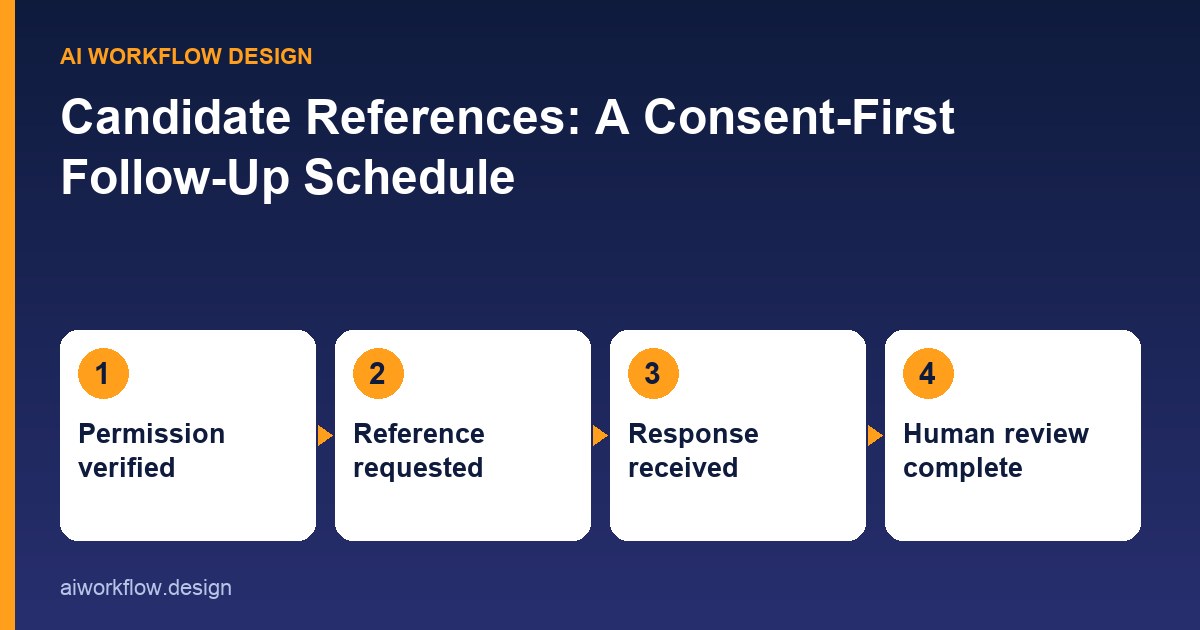
Set four clearly different milestones. Permission verified means an authorised recruiter has checked the permitted contact list. Reference requested means the approved invitation or request reached the identified contact method. Response received means evidence was delivered to the designated secure channel. Human review complete means an authorised reviewer has evaluated the reference under relevant job-related criteria. Never collapse the final two milestones into one status.
Use an illustrative project board with Candidate ID, Requisition ID, Referee role, Permission verified by, Permitted contact channel, Earliest contact date, Invitation sent, Last attempt, Next contact window, Secure-response received, Reviewer and Escalation owner. These are suggested fields, not automatic features of Autoza or a recruiting CRM. Keep phone numbers and sensitive notes in the approved applicant tracking system rather than on an open agency board.
Reference responses can contain subjective statements, irrelevant personal history or disputed assertions. Do not copy free-form answers into an AI calling transcript. Keep actual questionnaires, notes, identity verification and review decisions in an access-controlled HR environment. The operational board needs only a limited task state and secure record reference.
Give candidates visibility without making them chase referees
A candidate should know whether the employer expects professional references, how many may be needed and whether a particular former manager is required under policy. Explain the timing and provide a way to update contact details or raise concerns. Asking a candidate to repeatedly pressure an unresponsive former supervisor can damage trust. The recruiter should own the process and offer a legitimate alternative when policy permits.
A practical cadence is tied to the agreed deadline, not a universal “call every day” rule. After verified permission, send an approved initial request. Allow the stated response window. If no reply arrives, send one courteous follow-up using the permitted channel. Near an actual offer or start-date dependency, a human recruiter can review whether to make another attempt, use an authorised alternative referee or explain the delay to the client. Local rules, individual consent and organisational policy should determine timing and recording.
An illustrative case involves a candidate who authorises two former supervisors but excludes the current employer. The first supervisor submits the secure form; the second is travelling and asks for a call next Tuesday. The correct dashboard shows one received reference and one scheduled follow-up. It should not say “partially failed verification,” and it should not contact the current manager as a shortcut.
Use structured, job-related requests and protect equal opportunity
References should be requested under an approved, consistently applied framework appropriate to the role. For example, an authorised HR reviewer might seek confirmation of dates, duties or past work responsibilities where lawful and relevant. The EEOC’s guidance on selection procedures is a reminder that employment selection practices can create discrimination risk; reference practices are not exempt from fair-treatment obligations.
Do not prompt referees to share disability information, medical history, family circumstances, religious beliefs or other protected or unrelated personal details. A voice agent should not ask someone whether a candidate has a “good personality” and then label the response a suitability score. Even apparently neutral questions can produce unreliable or biased anecdotes. A qualified recruiter or hiring team should review the evidence under the agreed framework and handle concerns discreetly.
If a referee volunteers sensitive information, end the routine collection path and direct it to the designated human contact under policy. Automated sentiment analysis is especially unsuitable as a stand-in for structured reference verification. The agency should decide in advance what information may be retained, whether the referee was appropriately notified and how a candidate can raise inaccuracies when applicable.
Prepare scripts for the people being called
An internal reminder to a recruiter may ask: “Has the candidate’s permission been verified?” “Has the approved reference request been sent?” “Is a permitted contact window recorded?” “Did the response reach the secure system?” “Who owns the next attempt?” The call is intentionally administrative. It does not collect referee commentary or rank candidates.
External referee calls are a separate workflow requiring consent, disclosure, privacy and recording assessment. If authorised, a simple outreach may identify the organisation and recruiter, confirm whether the person is willing to use the official secure reference channel and offer a convenient time to respond. A refusal is a refusal, not a reason for repeated contact. Provide an accessible alternative to an automated voice call where needed.
Candidate preference changes should be acted on promptly. If the candidate withdraws permission for a particular referee before contact, the coordinator must stop the pending request and clarify whether any records already lawfully received require special handling. An automated system should never restart the call sequence solely because an old due date remains on the board.
Manage client expectations and close the loop
A hiring manager often wants to know whether an offer can progress. Give an accurate process update—“One authorised reference received; the second request is awaiting the agreed callback”—rather than forwarding raw comments or drawing an interim conclusion. If reference checks are a contractual condition, have the authorised client or HR owner confirm the actual satisfaction of that condition. Avoid telling candidates that a referee’s delay automatically means the offer is withdrawn.
After human review, the coordinator can record that the administrative stage is complete and archive the proof of communication according to policy. Retain contact attempts only for the approved period. Audit whether references were requested without verified permission, whether current employers were contacted contrary to instruction, and whether excessive reminders caused complaints.
Useful operational measures include first-request response time, proportion of records with documented permission, number of outstanding reviewer tasks and percentage of candidates offered an approved alternative contact route. They do not require recording whether referees sound “positive” or “negative.”
Evaluate Autoza only for the narrow administrative handoff
Autoza AI for monday.com is presented as a scheduled status calling and board-update product. A recruiting operation can explore internal check-ins that ask whether permission and reference-request tasks have been completed. The business must separately validate lawful contact routes, field mappings, storage limits, recording notices and opt-out options before any external calls. Do not assume integration with a reference-check platform has been built or approved.
Start with internal recruiting coordinators and synthetic candidate IDs. Test what happens when someone reports “current employer must not be contacted,” “candidate withdrew permission” or “referee asked to stop.” Each should create a human-controlled stop or review task, not another call. For broader safeguards, see Responsible AI Calls in Staffing. A well-managed reference process is measured by documented permission, timely coordination and fair handling, not aggressive call volume.
Frequently asked questions
What records should a team retain for recruitment reference check follow-up?
Keep a lawful record of candidate permission, the authorised referee contact details in a secure system, request and response timestamps, declined contacts, reviewer ownership and approved decisions. Store the actual reference response and sensitive notes only in the designated access-controlled HR or screening platform.
When should recruitment reference check follow-up be escalated to an authorised human?
Escalate when consent is unclear or withdrawn, a current employer may be contacted, a referee declines, a candidate challenges a record, a sensitive disclosure occurs or the deadline affects an offer. Only authorised HR or recruiting staff should choose alternative referees and assess the evidence.
Can a recruiter contact the current employer listed on a CV?
Not simply because the employer is named. Check the candidate’s explicit permission, the agency’s policy and applicable law. If the candidate requests confidentiality, do not contact the current employer unless an authorised process resolves the issue.
Should a referee give feedback to an automated voice agent?
The safest default is to use a secure, approved reference process and reserve AI calls for administrative scheduling. Collecting detailed evaluative commentary by voice requires separate legal, privacy, consent and fairness assessment; it is not necessary for task-status follow-up.
What if a referee does not respond by the requested date?
Record the request as pending, respect the approved follow-up cadence and give the human recruiter a next action. Non-response is not proof of a negative reference or a reason for an automated candidate rejection.
Related reading
- Responsible AI Calls in Staffing: Consent, Privacy and Escalation
- Staffing Background Checks: Follow Up Without Making Screening Decisions
- Temporary Assignment Extensions: Confirm Client Approval Before Schedule Changes
- Candidate Availability Checks: Confirm Timing Before Sending a Shortlist
- More AI workflow guides