

There is no responsible universal number for field technician check-in frequency. Two brief, scheduled calls may be helpful for an isolated multi-day installation team, while the same schedule could be disruptive for a technician completing short appointments across a city. The question is not how often automation can call. It is which updates genuinely help dispatch make a decision, and whether that benefit justifies interrupting the worker.
A sensible frequency policy starts with task criticality, work patterns, customer expectations, worker consultation and a practical alternative for people who cannot safely take calls. The goal is fewer unnecessary contacts and fewer unowned blockers, not a maximum daily call count.
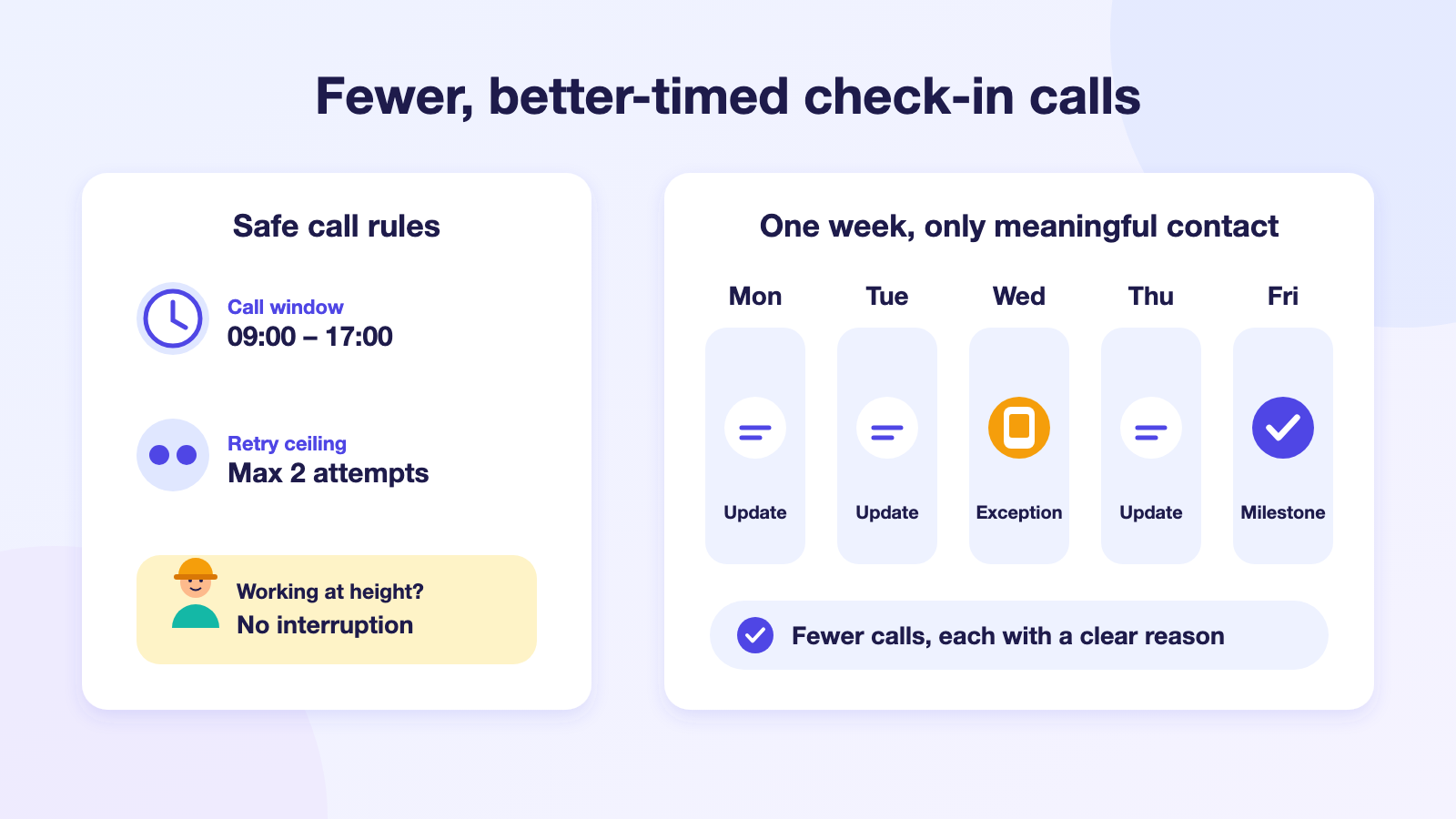
Begin with the decision a call must support
For every proposed call, ask: Who will use the answer? What operational decision depends on it? Could the dispatcher get the same information from a board update or scheduled handover? How late could the answer arrive before causing a problem? If there is no clear decision or deadline, the call is probably optional.
A morning check-in could confirm that an assigned technician has safely reached a planned site and has the correct job reference. A mid-job call might be useful when a replacement part affects a customer’s appointment. An end-of-day call can confirm the next unresolved action. None should be automatic merely because three slots appear in a software menu.
The morning technician check-in guide explains how targeted calls support dispatch at the beginning of a shift. This article covers the harder question: when a contact becomes excessive or counterproductive.
Use a frequency matrix based on the work
Start with a proposed policy that is reviewed with field workers and supervisors rather than an unexamined blanket rule. Example bands below are illustrative operating choices, not legal or safety standards.
| Field situation | Better first communication method | When a call may add value |
|---|---|---|
| Routine visit with no new dependency | Technician’s normal job update | Agreed exception or missing essential handoff |
| Multi-day installation with sequential trades | Planned milestone report | Before another trade’s access or handoff deadline |
| Technician working at height or with live equipment | No interruptive contact during hazardous activity | Later safe check-in or established urgent supervisor route |
| Late-arriving critical replacement part | Parts system / supplier confirmation | Short owner check when dispatch must change appointments |
| Customer asks for a confirmed completion time | Dispatcher reviews existing evidence | Only if forecast cannot be reliably confirmed otherwise |
An answer should be timely, but the calling window must also be safe. The worker may be driving, entering a secure site or speaking to a customer. Provide a return-call or direct board-update option and prohibit punitive conclusions from a missed AI check-in.
Know the difference between routine and exceptional contact
Routine check-ins happen at predictable times for a known purpose. Exceptional calls happen because a significant blocker, dependency or customer commitment changed. Combining them into one uncontrolled loop makes it hard for teams to know why they are being contacted.
For example, a water-system technician may be due to finish two visits before lunch. If the morning check confirms their first site and no problem has been reported, a second early call might add nothing. If the technician flags that the customer has not provided access, a targeted conversation about the access blocker may be justified. The exception should be tied to that job, not to an assumption that every technician needs a higher call frequency.
Protect consent, transparency and working time
Calling employees and contractors can involve privacy, telecommunications, recording and workplace-monitoring requirements that differ by jurisdiction and relationship. Inform recipients who is calling, whether AI is involved, the purpose of the contact, how answers will be used, whether the call is recorded and how they can raise concerns or use an alternative channel. Obtain any legally required consent or other valid basis before calling.
The UK’s Information Commissioner’s Office guidance on telephone monitoring says continuous recording will not ordinarily be proportionate and workers should receive clear information about monitoring. UK rules should not be treated as an exhaustive statement of U.S. law or requirements in other countries; obtain local legal review.
A schedule should respect time zones, rest periods, approved contact hours, off-duty time and local laws. Worker feedback belongs in the pilot review: a check-in policy that appears efficient on a dashboard may create real friction at a customer site.
Set a retry ceiling and distinguish silence from absence
A contact attempt can fail because of noise, dead battery, restricted site access or simply a worker choosing a safe time to respond. None proves a person is absent, non-compliant or failing to work. Preserve No answer / update outstanding as a communication outcome. The technician retry and escalation guide provides a deeper decision framework.
A bounded retry policy defines the initial attempt, the minimum gap, the permitted calling hours, the maximum number of attempts in a period and the point at which a named human takes over. Safety-critical emergencies follow a separate, established emergency response route rather than waiting for an AI retry. Do not keep redialling an unreachable technician when the only effect is disruption.
Design an opt-in pilot that produces evidence
Select a representative set of jobs: a regular maintenance route, a two-day installation and a supplier-dependent repair. Ask supervisors to list decisions that frequently stall because an update is missing. Then select only one or two useful calling moments for each workflow, subject to worker agreement and applicable rules.
During the pilot, collect the proportion of calls that produced a useful new status, duplicate enquiries, missed-call rates, worker concerns, changes to customer commitments and any incorrect board updates. Include a simple question to workers: “Was this call helpful, badly timed or unnecessary?” Review feedback without using individual response rates as a performance score.
Compare those observations with a no-call or lower-call workflow. You may find that one check-in before a high-dependency handoff is more useful than three generic progress calls. The decision should be based on your job types and team experience, not marketing claims about how many minutes automation will save.
What Autoza can and cannot decide
Autoza AI for monday.com describes configurable start-of-day and status calls, smart retries, call summaries, manual Call Now buttons and item updates. These features provide the mechanics for a chosen cadence. They do not determine whether your particular schedule is lawful, acceptable, safe or proportionate. Human managers must approve the policy and the contact list.
Do not use calling frequency to infer individual diligence. More calls can even reduce information quality when a worker is repeatedly asked the same vague question. A useful update is one that points to a changed job state or decision the office needs to make.
A practical rule for daily operations
Adopt three tests before adding any recurring call: (1) a named dispatcher needs this answer, (2) the answer is due before a meaningful decision, and (3) the worker can reasonably and safely respond or use an alternative. If any condition is missing, start with a non-interruptive update instead.
The field-services industry page and Autoza workflow discussion can help teams explore the technical setup. Make the final cadence a jointly understood operational policy, not simply a software configuration.
Frequently asked questions
How many check-in calls per technician per day is reasonable?
There is no universal figure. A schedule should reflect the type of job, the importance of the decision, safe contact windows, applicable rules and feedback from workers. Start small and measure whether each call adds useful information.
Can a missed AI call show that a technician is absent?
No. A missed contact attempt establishes only that the call was not answered. Use a separate, authorised attendance or welfare process if the organisation needs to establish the technician’s situation.
Should dispatch call technicians while they are driving?
No routine status call should distract a worker from driving or hazardous work. Schedule contact for safe windows and provide an agreed method to respond later.
How should automated call retries be limited?
Define approved calling hours, a minimum delay, a maximum number of attempts and a clear human escalation owner. Emergency or safety issues require their own immediate communication path.
What should a field team measure during a calling pilot?
Track actionable updates, unnecessary interruptions, missed calls, incorrect data mappings, changes to handoff delays and worker feedback. Do not treat call response rates alone as a measure of employee performance.
Next step: review one real workflow
See how your project questions, permitted board fields and escalation owners could fit a controlled implementation. Explore Autoza AI for monday.com or request a guided workflow review.
Related reading
- Automated Morning Technician Check-In Calls: A Guide for Dispatch Teams
- Missed Technician Calls: When to Retry and When to Escalate
- How to Capture Job Progress Updates From Technicians Still in the Field
- Mapping Technician Call Answers to monday.com Job Status Columns
- Field services and dispatch industry overview
- Autoza AI for monday.com: scheduled status calls
- Workflow automation services
- Daily Check-in Agent