
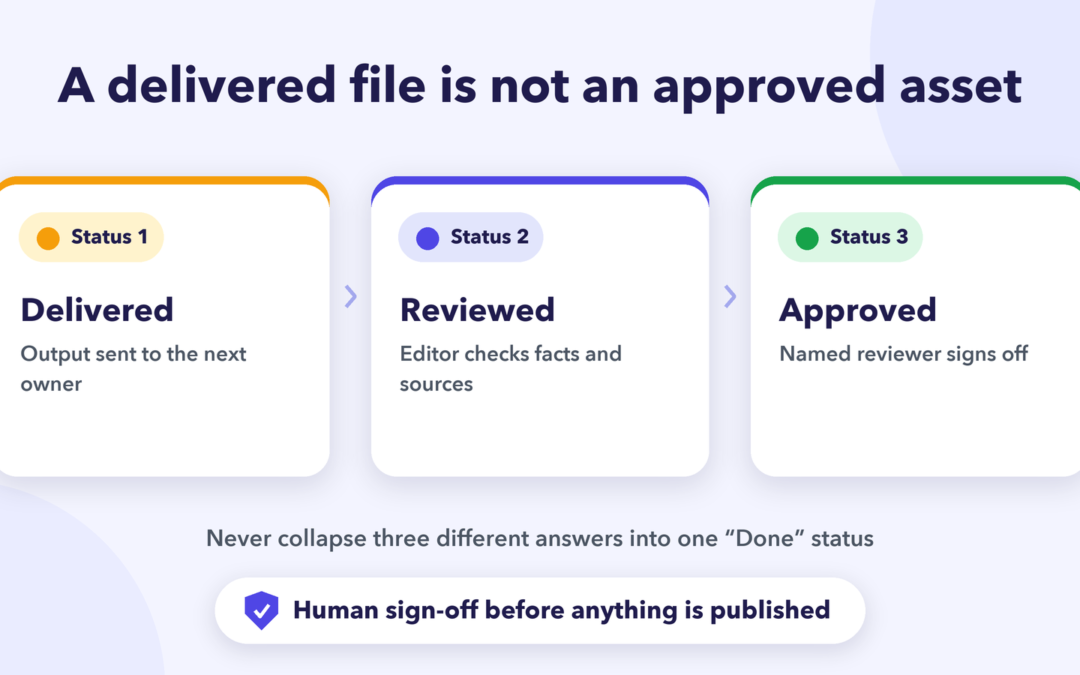
A useful content production handoff checklist makes it clear when work has actually moved from one accountable person to the next. A post that has been drafted is not automatically ready for design. A designed landing page is not ready to publish simply because the file was delivered. Every handoff needs a named owner, a reviewable output, the acceptance checks and any approval that must happen before the next team acts. Scheduled status calls can reveal missing steps, but they should never publish content or grant final approval on their own.
Editorial calendars tell teams when content is planned to go live; workflows explain how the content becomes fit to publish. A practical editorial workflow reference distinguishes briefing, creation, review, approval, publishing and improvement. That distinction matters when writers, designers, SEO specialists, subject-matter experts and clients work in different tools or time zones.
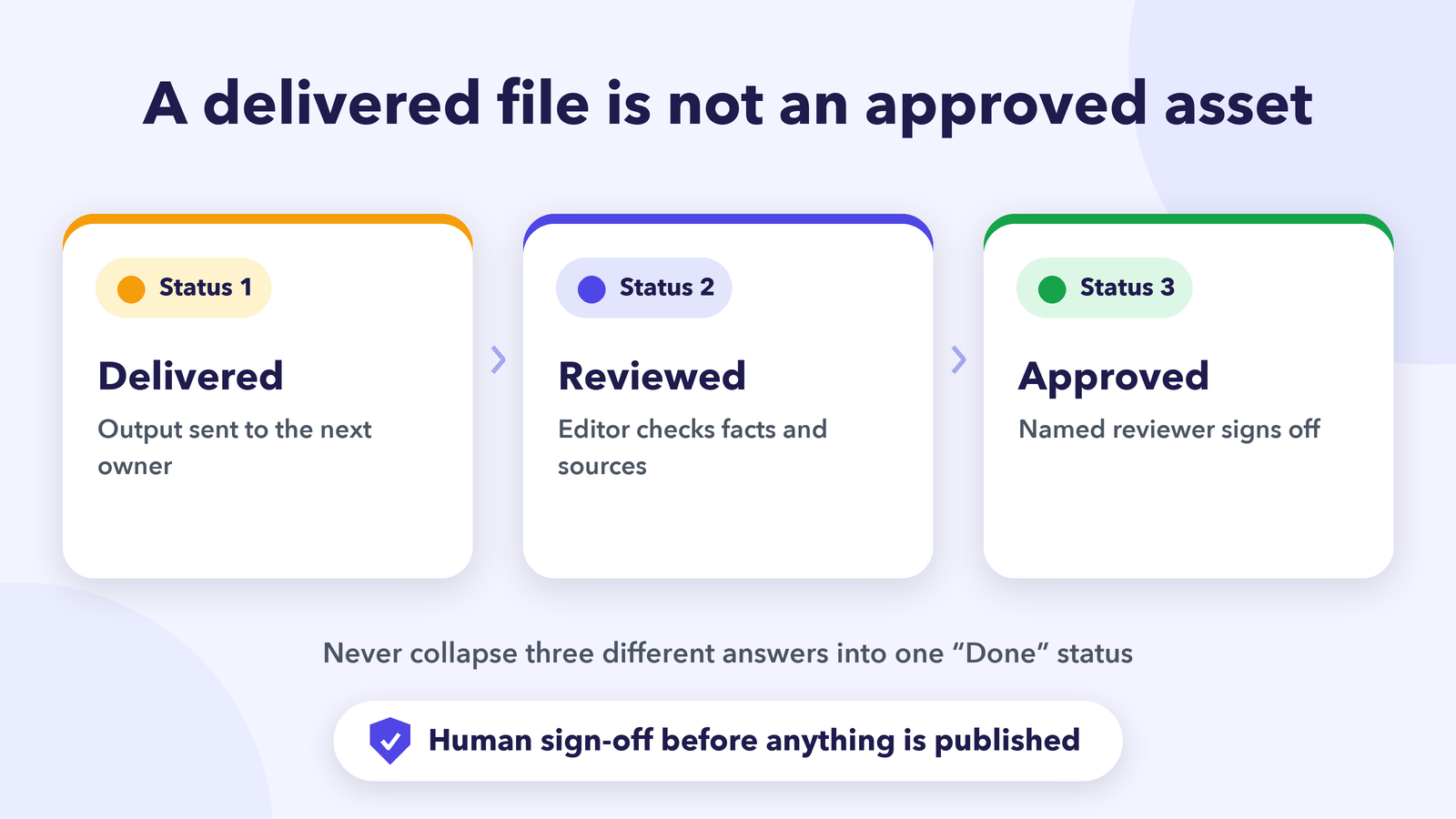
Define the artefact that must pass at every stage
Treat a content assignment as a series of accepted outputs, not an undifferentiated task. The strategist produces a brief with audience, search intent, objective, sources and constraints. The writer produces a draft with claims that can be checked. The editor returns a content-quality decision. Design supplies assets that meet the required specifications. SEO confirms the page title, description, URL and links. The authorised client or subject expert signs off the facts and claims within their remit. The publisher performs final checks and schedules or releases the piece only after all necessary gates have passed.
The sequence may vary. A product announcement may need legal approval before design; an educational article may need expert review after editing. Map the workflow to risk rather than assuming every asset follows exactly the same path. Multi-format deliverables, such as a blog plus email and social versions, should retain separate readiness and approval states.
A handoff is complete when the next owner can work without reconstructing the brief or searching for the latest file. That is the operational standard worth tracking.
Use five gates rather than one “done” column
- Brief accepted: The owner confirms audience, target question, CTA, publication intent and required sources.
- Draft review passed: An editor checks substance, clarity and supporting evidence.
- Production assets ready: Images, creative files, captions, licences and any accessibility requirements are supplied.
- Approvals recorded: Named reviewers sign off relevant claims and public-facing material.
- Publishing QA passed: The publishing owner checks the rendered page, metadata, links, schema, analytics and device layouts.
A gate can be “changes requested”, “awaiting input” or “approved” depending on the evidence. “Sent to client” is a delivery event, not an approval. “SEO checked” should not imply that a technical or legal issue has been resolved by the search specialist.
Keep a final copy of approved text and design references in a controlled location. Informing a colleague verbally that something is ready is helpful communication, but the published version should be traceable to the reviewed artefact.
A task and subitem structure for monday.com
One parent item can represent the publishable asset, with subitems for brief, draft, factual review, copyedit, artwork, SEO, client approval, CMS build, prelaunch check and postpublication QA. Not every subitem needs a call; calls are best reserved for actions that are blocked, time-sensitive or waiting on someone outside the normal software workflow.
Suggested columns include: content ID and format; target page; current gate; owner; evidence link; reviewer; next action; due date; approval status; publication owner; and live URL after release. monday.com allows subitems and related automation configurations, but this example is a recommended setup, not a statement about the default Autoza schema.
Where one piece depends on another, make it explicit: a case-study design task may depend on approved customer quotes; an email announcement may depend on the landing page’s final URL; a regional version may depend on translation and in-market approval. A parent item’s optimistic status must not hide an unresolved approval subitem.
Choose questions based on the stage and recipient
For a writer: “Is the draft ready for editorial review, and where is the version with source links?” For an editor: “Is the piece approved, blocked by factual questions or returned for revision?” For a designer: “Are the final dimensions, alt-text brief and usage permissions available?” For SEO: “Have the title, description, headings, canonical, internal links and indexation settings been checked?” For a client approver: “Have you reviewed the specified version, or is another stakeholder required?”
Each call should name the task and version to avoid accidentally confirming approval of an older draft. Record who responded, what they reported and the next agreed action. If the response contains confidential client information, unpublished results or legal commentary, follow the organisation’s privacy and retention rules rather than broad transcription.
An AI caller should never invent a missing author quote, claim an SEO ranking is guaranteed or infer legal sign-off from silence. A missed call remains “not reached”. A statement such as “looks good to me” should go to the designated reviewer for the documented approval channel if the caller cannot independently verify authority.
Build a publication-readiness test that prevents regressions
The publisher should check the actual page, not only the source document. Confirm the chosen URL and canonical, readable title and metadata, heading structure, original images and descriptions, crawlable internal links, correct CTA destination, mobile rendering, analytics events and visible author or reviewer information where appropriate. Verify that required claims and approvals still match the final version.
Google’s people-first content guidance stresses original value, accurate information and clear sourcing. Treat SEO/AEO/GEO as editorial quality work rather than a guarantee of inclusion in AI answers. A useful direct-answer paragraph, specific examples and clear entity references can help readers and discovery systems, but a green plugin score is not evidence of ranking success.
For structured data, Google’s Article documentation explains how a page can describe its headline and author. Populate only facts that truly appear on the live page. Publish FAQ structured data only if appropriate to the page and site; commercial sites should not expect routine FAQ rich results.
Handle last-minute changes and failed approvals
If an approver changes the wording after design, reopen the appropriate downstream check. A revised claim may need factual review, design correction, SEO recheck and fresh client sign-off. Prevent a “final-final” file from replacing the approved version without a new decision record. If a publishing date must move, notify the campaign owner and adjust related email, social or paid-media tasks deliberately.
Use a risk-based escalation hierarchy: incomplete source or quote returns to the writer; contradictory facts go to the subject expert; legal or regulated claims go to the authorised reviewer; broken tracking or page templates go to the technical owner; public release belongs to the publisher. The agency task-and-subitem guide complements this stage-by-stage model.
Measure clean handoffs rather than content volume alone
Review revision loops caused by missing briefs, time waiting for approvals, number of assets published with QA defects and the proportion of handoffs accepted on first review. Add periodic checks of whether an article continues to answer the buyer’s question and leads naturally to a useful next step. Do not claim improvement percentages without an actual baseline and observed results.
For teams using monday.com, Autoza AI’s check-in information can support an evaluation of scheduled status calling. Pilot with a few non-sensitive approval tasks and confirm the integration’s actual mappings, call permissions and escalation behaviour before making it part of production.
Frequently asked questions
Where do content handoffs most often fail?
Common weak points are an unclear brief, missing source evidence, ambiguous version ownership, unclear approvers and a rushed CMS handoff. Make each stage’s required output and acceptance test explicit so the next owner can act without searching through fragmented conversations.
Which approvals should be manual?
Final editorial, factual, legal, brand, budget and publishing approvals should stay with the appropriately authorised people. Automated calls can collect progress or identify an outstanding decision, but should not be treated as evidence that a regulated claim or campaign has been approved.
How should monday.com subitems be structured?
Use one parent item per publishable asset and separate owned subitems for drafting, review, design, SEO, approval and publication. Track the current version, proof link, blocker and next decision. Use labels and fields that fit the team’s actual process rather than imposing a generic template.
Can an AI call automatically move a piece to “ready to publish”?
Only a workflow specifically configured and authorised for that exact low-risk status should write the field. The final release gate should depend on actual approved evidence and an empowered publisher, not simply a verbal statement or a missed call.
Related reading
- How to Structure Agency Tasks and Subitems for Reliable Follow-Up
- How to Follow Up on Creative Approvals in monday.com Without Endless Emails
- Daily Calls or Weekly Meetings? Choosing an Agency Follow-Up Cadence
- Campaign Launch Delays: 7 Status Questions to Ask Every Task Owner
- Agency Scope Changes: Follow Up on Requests Before Production Restarts
- New Client Onboarding for Agencies: How to Chase Missing Assets and Access
- Autoza AI for monday.com: scheduled status calls
- Workflow automation services
- Daily Check-in Agent