
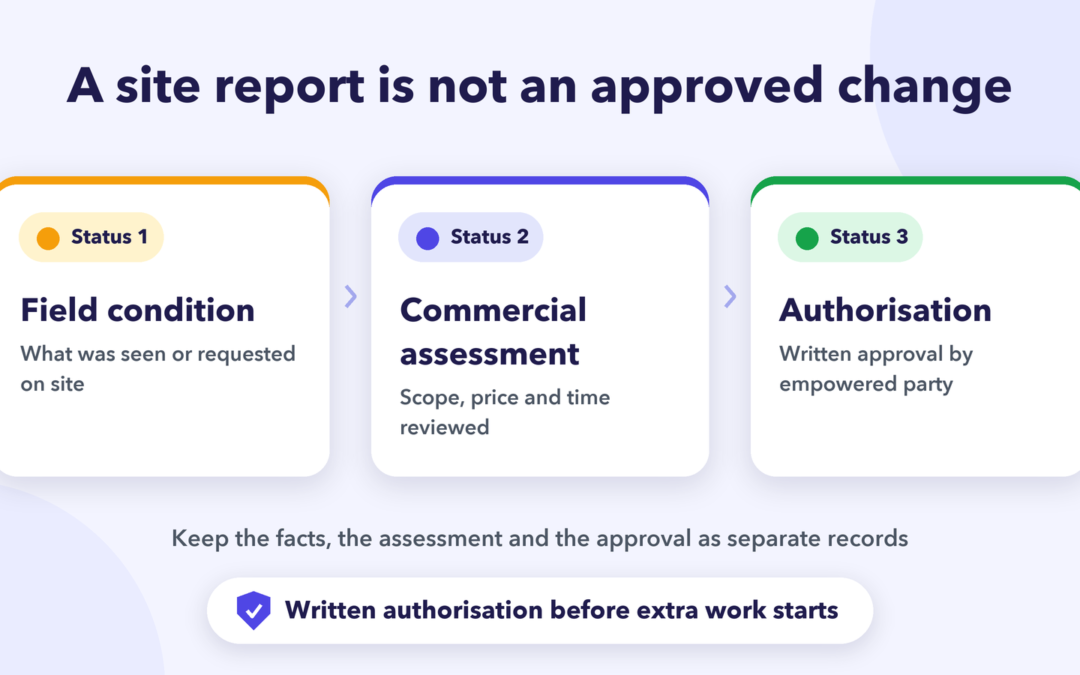
Construction change order status tracking works only when a team distinguishes a reported site change from an authorised change to scope, price or time. A foreman can confirm that an obstruction was discovered or additional labour is being requested. That conversation does not, by itself, authorise additional work, revised payment or a new completion date. A safe follow-up workflow collects facts, preserves contractual approvals and gives the commercial team enough information to respond before a variation becomes a dispute.
The American Institute of Architects explains in its change-order best-practice guidance that changes to the underlying contract require the proper parties’ authority. Where a contract has written-instruction procedures, those procedures govern. Use AI project calls to improve the flow of status information, not to override the people and documents that approve a change.
Define three independent states
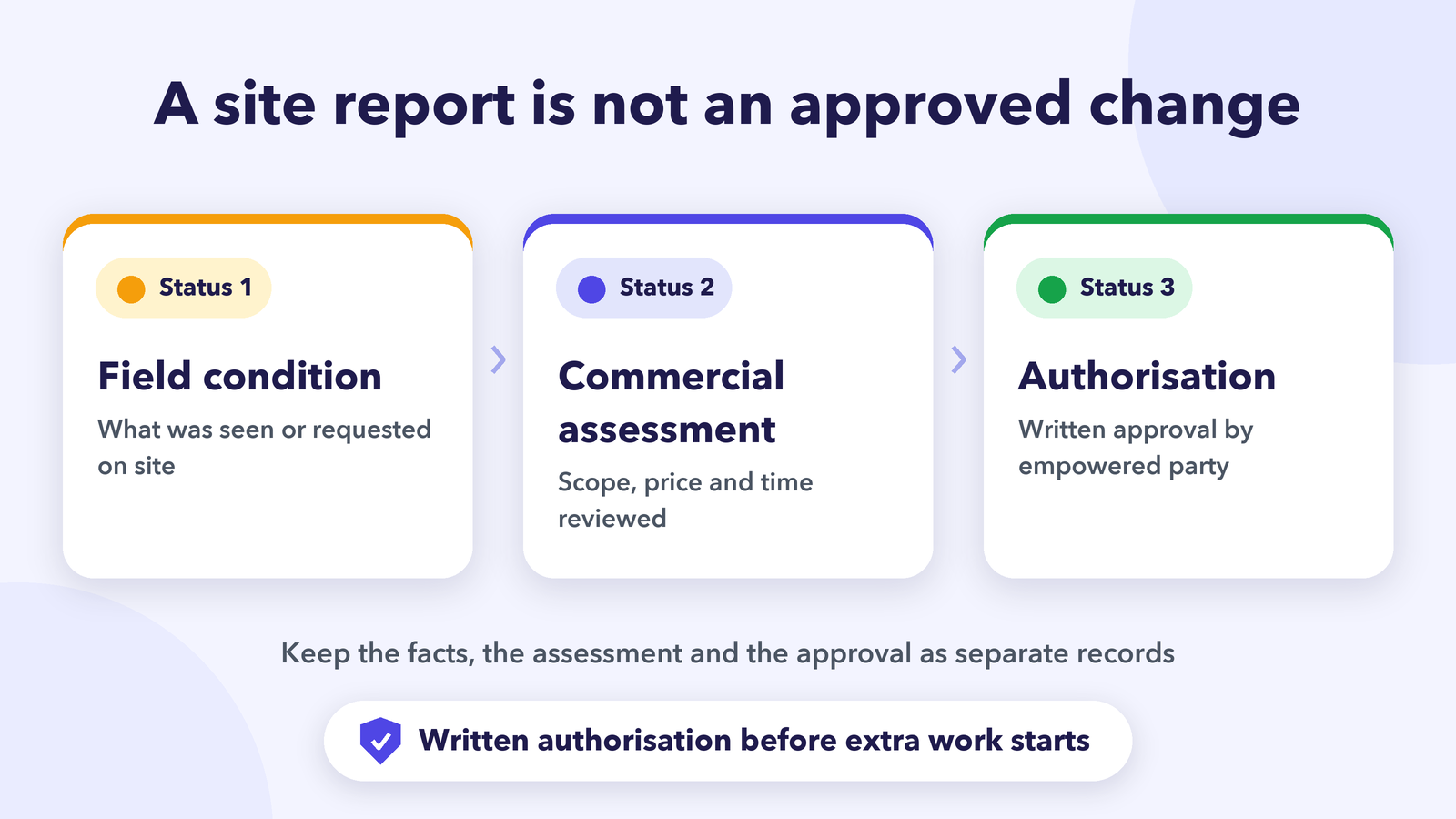
Treat a potential variation as three separate records or fields.
- Field condition: What was seen or requested on site?
- Commercial assessment: What scope, price and time effects have the responsible teams assessed?
- Authorisation: Has an appropriately empowered party approved the change through the contract’s process?
These are different decisions and should never be compressed into one green “complete” status.
For example, a crew might report an unforeseen pipe obstruction. The field record could be “obstruction documented”. The commercial record could be “quotation requested”. The authorisation record could remain “not authorised”. This illustrates the distinction; it is not a claim about a real customer outcome. Only after formal direction should the team update any “approved for execution” marker in accordance with its contract.
A change may also be rejected, withdrawn, returned for clarification or deferred. Preserve those options. A binary yes/no field hides the reason work is not progressing and can create the mistaken appearance that reported urgency equals approval.
Collect verifiable site facts in the first call
The first follow-up should seek enough factual detail for a human review. Ask for the location or drawing reference, the event date, the activity affected, the observed condition, available photographs or daily-report references and the person who raised the issue. Ask whether work has stopped or been redirected and who gave any instruction already acted upon.
Do not ask the caller to assign blame, estimate a binding price or tell a subcontractor to proceed. An AI call should not conduct commercial negotiations. If a foreman mentions an estimated labour impact, tag it “unverified estimate” together with the role that reported it, and direct it to the QS, commercial manager or project manager for assessment. The point is to make information findable, not to turn speech into a contractual instrument.
Where a safety issue is involved, the site team follows its emergency and safety escalation procedure immediately. Routine automated check-ins are not an adequate emergency notification channel.
Build a controlled change register in monday.com
A suggested board may have one parent item per change request and individual subitems for documentation, quotation, programme review, client decision and implementation. monday.com supports subitems, although the available configuration depends on the team’s plan and setup. Keep the formal change register and signed documents as the system of record if that is how the contract is administered.
Recommended fields include:
- Change ID and contract reference: Link to the official instruction, request or variation record.
- Origin and date: Who reported the change and when it occurred.
- Description and evidence: Objective condition and reference to photos or drawings.
- Cost assessment owner: Named person preparing or reviewing the commercial impact.
- Schedule assessment owner: Named person analysing critical-path effects.
- Approval status: Requested, under review, formally authorised, rejected or cancelled; protected from automatic inference.
- Next decision date: The realistic date for authorised review, not an invented response promise.
Use separate permissions for reporting facts and changing approval states. A call-generated summary may update a “reported next action” field if configured and authorised; it should not write to the final commercial approval or contract-value columns.
Design a call sequence by accountable role
A field check-in might ask: “Has the observed condition been photographed and logged?”, “Which activity is affected today?”, and “Has any written instruction been received?” A commercial follow-up can ask: “Has the cost build-up been prepared?”, “Is any supplier quote missing?”, and “Who is expected to review the submission next?” A project-manager follow-up can ask which schedule activity is affected and whether a decision meeting is required.
The phrase “we’ve discussed it with the client” is not equivalent to written authorisation. Capture the statement as reported; request the document identifier and refer the discrepancy to the authorised manager. Likewise, an unanswered approval request is not a tacit approval unless the contract specifically establishes such a mechanism and the appropriate legal or commercial advisers confirm its application.
The construction milestone questions article can help define ordinary site-status questions, while this workflow focuses on the higher-risk boundary around price, scope and time.
Escalate when waiting itself creates risk
A variation that blocks a scheduled predecessor activity deserves faster attention than a minor change that can be reviewed at the next commercial meeting. Configure an escalation owner and an explicit trigger such as “work stopped pending formal direction”, “quoted price validity expires”, or “programme impact needs a decision”. A missed call should stay “not reached”, not “approval refused”.
ConsensusDocs’ change-order procedures guidance emphasises knowing who has authority and using timely, written change procedures. In practice, it is better to alert the correct person once with a complete record than to place five calls to people who cannot authorise the change.
When the decision arrives, the appointed contract administrator should verify the authorised documentation, communicate it through the agreed channel and update the project’s execution instructions. AI may help arrange follow-up but should not perform this verification or release by default.
Measure control, not merely call completion
Assess the percentage of requests with objective supporting evidence, average time waiting for commercial assessment, number of field conditions awaiting authorisation, and cases where work began without a traceable instruction. Track reductions in repeated information requests as well as any erroneous status mappings that the project team corrected.
Pilot with a limited class of non-emergency changes and a named commercial reviewer. Explain the process to participants, set calling-hour and disclosure controls, and confirm with Autoza’s monday.com check-in team what configurable calling and mapped-field functionality is available for the intended workflow.
Frequently asked questions
Can an AI call approve a construction change order?
No. A call can collect reported facts or an update about the approval process, but it should not be treated as contractual authorisation. Follow the project’s change-control provisions and obtain the appropriate written approval from the empowered parties.
What facts should be collected from a foreman?
The affected location and activity, what has changed, when it was observed, evidence references, any current impact on work and who has already been informed. Record estimates and assumptions clearly as unverified; do not ask the foreman to set a final variation price.
When should the commercial manager intervene?
When the potential change could affect cost, scope or completion dates; when a quotation needs approval; or when work is blocked without a clear instruction. The commercial manager can establish the right decision route and the contract’s required notice or documentation.
Should the change status show “approved” after a client phone conversation?
Not on that basis alone. A verbal conversation may indicate that approval is being considered, but the register should reflect approval only when the contractually required authorisation has been issued and verified by the responsible human.
How can a team avoid change-order disputes?
Use a single controlled reference, record factual evidence early, assign assessment and approval owners, identify valid written instructions and maintain a clear history of communicated decisions. Consult contract administrators or legal advisers when authority or notice requirements are unclear.
Related reading
- 7 Questions an AI Construction Check-In Should Ask Before a Milestone
- Phone Calls vs monday.com Notifications for Subcontractor Updates
- Construction Daily Progress Updates: A Better Way to Hear from Field Crews
- Pre-Inspection Follow-Up: Which Construction Tasks Need a Phone Call?
- Long-Lead Materials: A Supplier Follow-Up Plan for Construction Projects
- Construction RFI Delays: A Follow-Up Workflow Before Trades Lose Time
- Autoza AI for monday.com: scheduled status calls
- Workflow automation services
- Daily Check-in Agent