
Construction material delivery follow-up should begin long before a truck is due at the gate. A long-lead item can hold up approvals, fabrication, shipping, unloading, inspection and finally the trade that needs it. Effective supplier calls verify each step, record how confident the promised date really is and escalate decisions early enough for a project manager to act. A date repeated by a supplier is useful evidence of a commitment, but it is not proof that material is manufactured, dispatched or accepted.
Procore’s construction procurement guide describes how selection, submittals, purchasing and logistics form one interdependent process. That is why a purchase order alone does not mean an item is ready for site. The more useful question is: which next milestone is exposed if this particular item slips?
Start with the chain of dependencies
Break each critical item into steps such as specification finalised, submittal accepted, purchase order issued, production slot confirmed, factory inspection completed if required, dispatch booked, customs documentation available where relevant, site delivery arranged and receiving inspection completed. Assign an accountable party and a required date to each step. Omit steps that do not apply rather than turning the register into a generic form nobody trusts.
An air-handling unit, bespoke curtain-wall component and switchgear assembly may have very different lead-time risks. The project needs to know whether the constraint is manufacturing capacity, design review, payment milestone, transport or site readiness. Each constraint requires a different person to resolve it.
A particularly common blind spot is an early procurement task marked “ordered” while its predecessor submittal is still awaiting approval. If the team tracks only shipping, it may discover the real blocker too late. Keep the approved specification and substitute decisions with the authorised technical team.
Separate forecasts, confirmed milestones and evidence
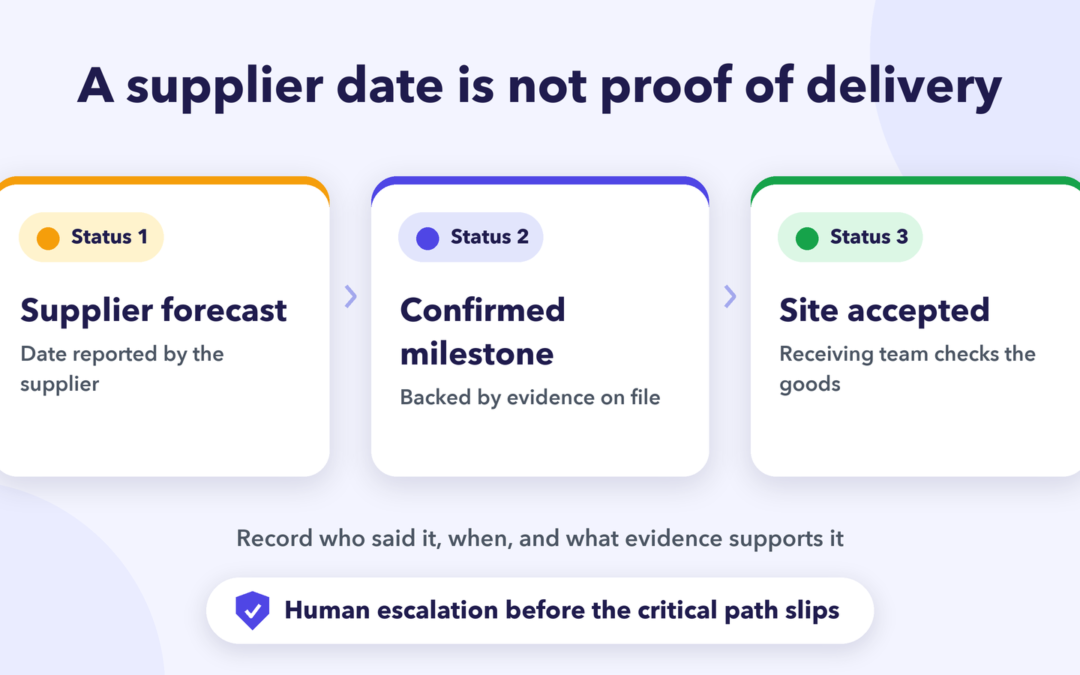
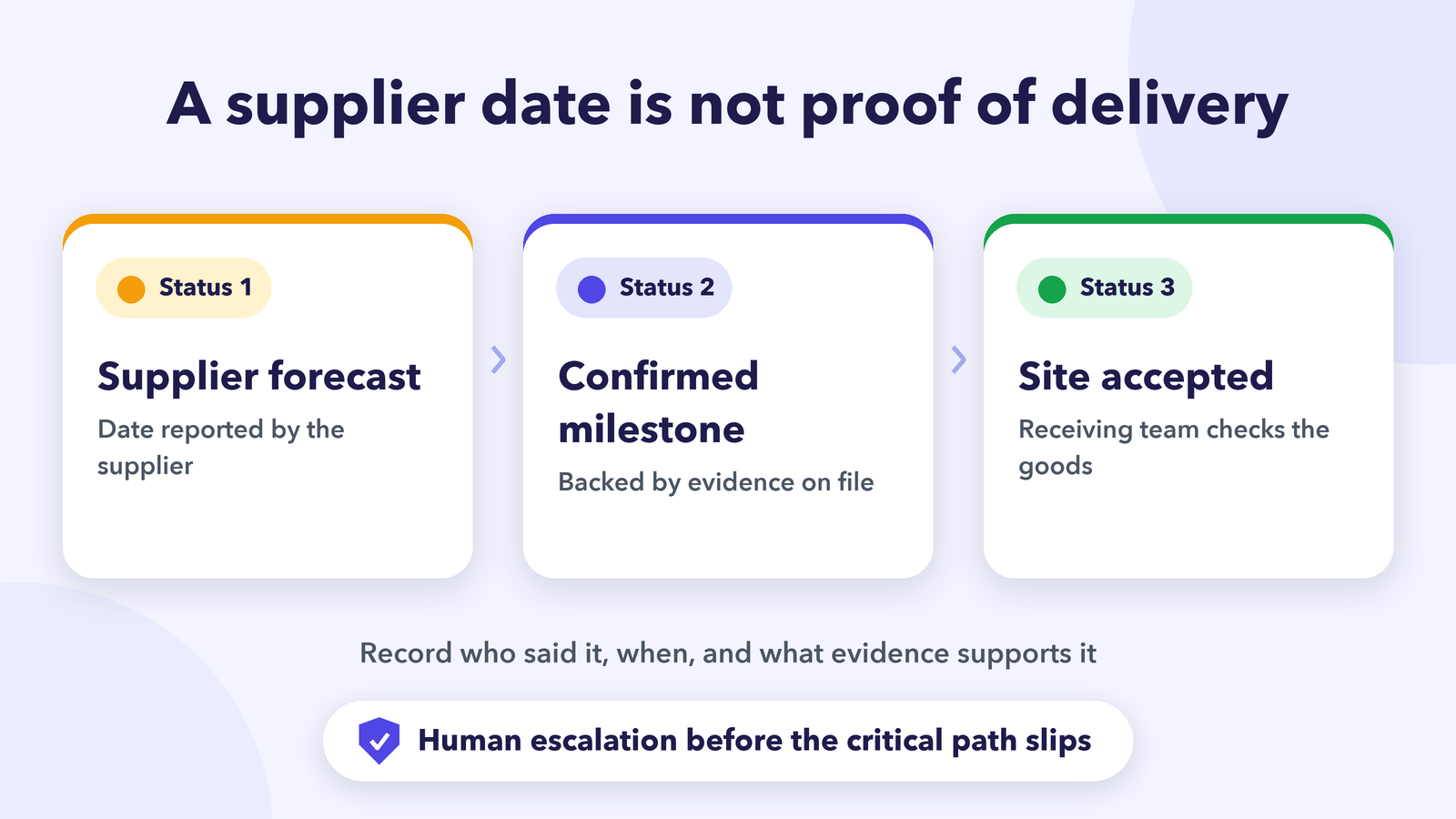
Use three data concepts. Supplier forecast means the date currently reported by the supplier. Confirmed milestone means a dated step supported by appropriate evidence, such as a factory acknowledgement or freight booking. Site accepted means the receiving or quality team has actually checked the delivered goods under the project’s process. These statuses should not be used interchangeably.
A supplier may say an item “should ship Friday”. Record who said it and when, then ask what evidence is available and when the next confirmation can be given. Do not write “dispatched” until the actual dispatch evidence exists. If the item is ready but the site cannot receive it, the project needs a logistics or storage decision rather than another manufacturer reminder.
Avoid collecting commercially sensitive quotes, banking data or confidential supplier details through broad automated scripts unless their use has been specifically approved and secured. The objective is an operational status, not a replacement for procurement governance.
A practical supplier follow-up calendar
Suggested timings should reflect risk, not a mandatory rule. During design and submittal review, contact the document owner near the agreed due date. After purchase order acknowledgement, confirm production milestones at intervals agreed with the supplier. When shipping approaches, increase checks on fabrication completion, inspection release and dispatch readiness. During transit, track the relevant carrier or logistics milestone. Near delivery, coordinate unloading, access, crane availability and receiving inspection with the site team.
A helpful question sequence is: “What milestone has been completed since the last update?”, “What evidence supports that status?”, “What is the next scheduled milestone?”, “Is the forecast arrival date unchanged?”, and “Is there any decision or document needed from us?” For a late reply, the next call should target the unresolved dependency, not repeat the entire checklist.
Treat a missed call as unconfirmed current status. Use pre-agreed retry limits and human escalation where risk is growing. No answer should never automatically create a “supplier failed” finding.
Map each item to the construction programme
A suggested monday.com board could use one parent item per material package and subitems for submittals, purchase order, fabrication, quality release, logistics and receiving. Fields might include package ID, affected activity, manufacturer contact, committed milestone, evidence link, next check date, owner and escalation route.
A dependency between equipment delivery and installation can be represented using monday.com dependencies where supported by the plan. The board is a communication aid; programme resequencing and contractual notices still belong with the authorised construction manager or planner. Proposed column values are workflow recommendations, not known Autoza defaults.
The phone calls versus monday.com notifications guide for subcontractors explains when a person is more likely to give useful context by phone. For high-risk long-lead items, call the party who can explain the variance, while keeping routine confirmation in the supplier’s approved written channel.
Escalate by consequence, not by irritation
Use different paths for three situations.
- Information gap: Supplier has not provided the next milestone or evidence. Ask the procurement coordinator to secure documentation.
- Recoverable delay: The forecast slips but float or a revised sequence may absorb it. Ask the project planner to validate recovery options.
- Critical-path exposure: The item blocks installation or commissioning and threatens a contract milestone. Convene the procurement, design and site decision owners, with commercial review where needed.
Alternative sourcing is a decision process, not a status field. Technical equivalence, warranties, design compliance, price changes and programme implications require the relevant written approvals. Never have an AI caller “approve” substitute products based on a supplier suggestion.
A useful exception register records the cause, responsible person, next action, decision deadline and last verified evidence. This permits the project manager to see whether the material is actually closer to delivery or merely receiving more calls.
Include receiving and acceptance in the plan
Delivery to site is not always completion. Confirm the correct quantities, identification, visible damage, storage needs and required inspection documentation. Where specialist inspection, testing or certification applies, retain that approval with authorised personnel. A delivery note alone should not close the installation predecessor if site acceptance is outstanding.
After the package closes, compare the first reported lead time, actual submittal duration, manufacturing variance and on-site receiving issues. Those differences improve subsequent procurement schedules and supplier selection, without relying on invented performance percentages.
To explore scheduled, permission-controlled progress calls alongside monday.com, use the Autoza AI product page to request a workflow review. Confirm the actual integration scope, call settings and permitted update fields before enabling any live supplier calls.
Frequently asked questions
How often should a project manager confirm delivery dates?
Contact frequency should depend on lead-time uncertainty and schedule impact. Agree milestone updates early, then shorten the interval near fabrication release, dispatch or installation. A routine item with stable evidence needs fewer calls than a critical-path package with an unresolved blocker.
What if a supplier reports a date without evidence?
Record the date as a supplier forecast, note who reported it and request a specific confirming document or milestone. Do not label the item dispatched, delivered or accepted until the relevant evidence is checked by the responsible person.
Who changes the construction programme?
The authorised project planner or manager, following the project’s approval and contract processes. Supplier status calls may reveal a programme risk but should not automatically resequence the baseline or change contractual dates.
Can material follow-up be automated without contacting the whole supply chain?
Yes, as an operational design: focus scheduled calls on named milestone owners, suppress calls when verified written updates are current and use human review for exceptions. The technical ability to configure those rules must be confirmed for the chosen tools before deployment.
Does an on-time delivery mean the procurement task is finished?
Not necessarily. Receiving inspection, correct quantity, documentation, safe storage and any required specialist acceptance may remain open. Link the final procurement status to the project’s receiving and quality processes, rather than the carrier’s arrival alone.
Related reading
- 7 Questions an AI Construction Check-In Should Ask Before a Milestone
- Phone Calls vs monday.com Notifications for Subcontractor Updates
- Pre-Inspection Follow-Up: Which Construction Tasks Need a Phone Call?
- How to Automate Subcontractor Progress Check-In Calls in monday.com
- Change Order Check-Ins: Capture Construction Site Facts Without Approving Extra Work
- Construction RFI Delays: A Follow-Up Workflow Before Trades Lose Time
- Autoza AI for monday.com: scheduled status calls
- Workflow automation services
- Daily Check-in Agent