
A practical agency client onboarding checklist does more than confirm the contract is signed. It makes sure the people delivering the first campaign actually have the assets, permissions, brand context and approval contacts they need. The most costly confusion often occurs when a team has begun planning but cannot publish, measure or obtain a decision. A disciplined follow-up process makes each missing item visible without repeatedly asking the client for the same information or requesting passwords over the phone.
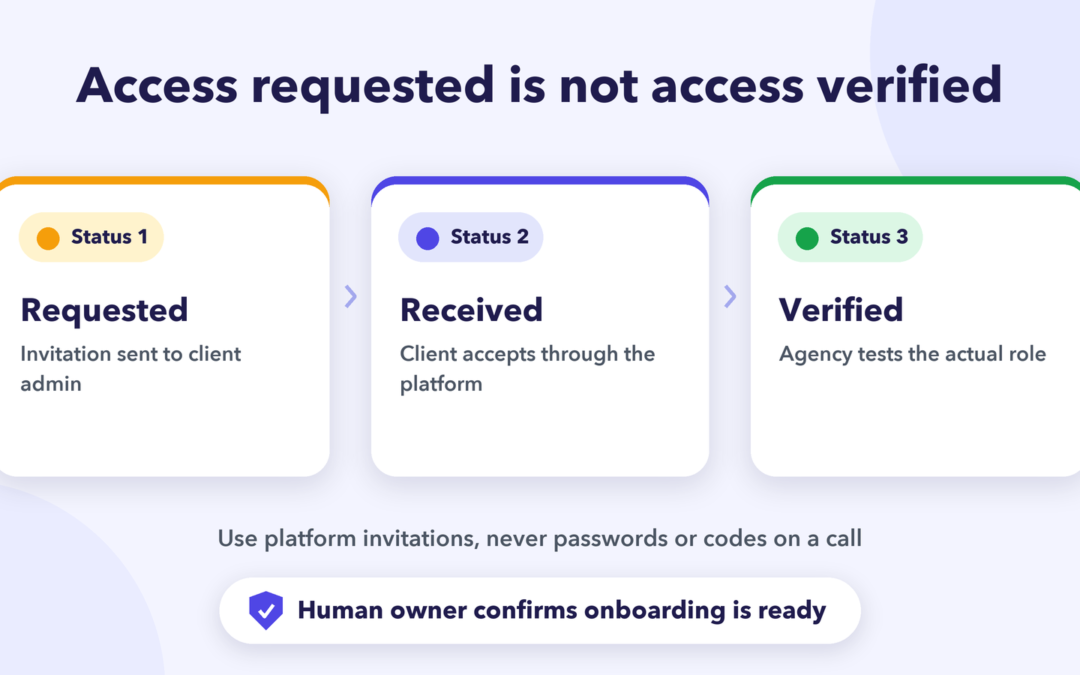
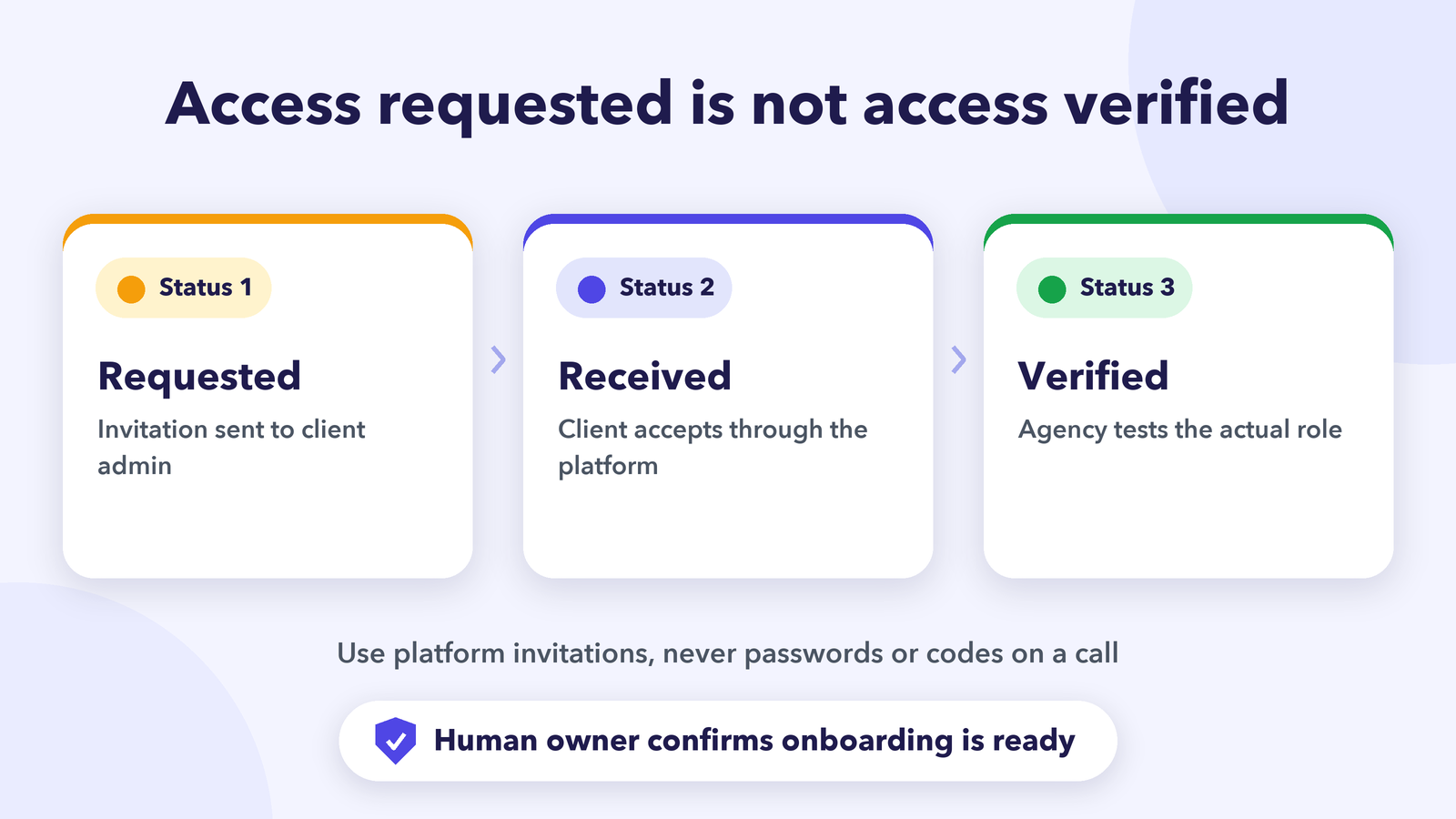
Use one owner for each onboarding dependency, one due date and a test that demonstrates readiness. “Access requested” is not “access granted”, and “invitation accepted” is not always “permission verified”. Distinguishing those states is one of the simplest ways to protect the agency’s first delivery date.
Define the first deliverable before requesting everything
The onboarding list should follow the signed scope. A paid-search launch needs billing and account permissions, conversion goals, landing pages and approved creative. An SEO discovery engagement may initially need read-only analytics and search-console access, the content inventory and an agreed stakeholder for technical changes. A design project needs usable logo files, fonts, visual references and a decision maker. Asking every client for every tool at once adds friction and can create unnecessary security exposure.
Before the kickoff, identify the first deliverable, its acceptance criteria and the tasks that genuinely depend on client input. Mark each requested asset as critical for first delivery, needed for a later phase or optional reference. Only the first category should normally affect the immediate schedule. The project lead may reprioritise independent work while waiting, but must not quietly reduce agreed scope.
Document who can approve objectives, copy, designs, expenditure and publication. The person sending assets may not be the person authorised to sign off the work. If ownership is unclear, make that an explicit onboarding action instead of assuming the most responsive contact can approve everything.
A two-week onboarding sequence with clear handoffs
The following is a recommended working rhythm, not a universal client timetable:
- Day 0–2, commercial handoff: Confirm the signed scope, primary client contact, first delivery, decision owners and the agreed communications channel.
- Day 2–4, asset inventory: Request usable brand files, approved messages, existing content, reference examples and account inventory.
- Day 3–7, access invitations: Ask the client to grant task-specific access through each platform’s native permission process. Test the actual role after acceptance.
- Day 5–10, discovery validation: Check tracking coverage, reporting baselines and gaps in product or customer information; confirm what still blocks the deliverable.
- Day 10–14, ready-to-work review: Transfer open tasks, verified access, unresolved risks and the next decision date to the delivery owner.
These windows are illustrative and should be adapted to the contract, client responsiveness and technical complexity. A platform’s access review or security requirements may require more time than the agency initially expects.
Request permissions without requesting credentials
For Google Ads, the appropriate client-account or manager-account linking process supports access without a shared login; Google’s manager account ownership documentation explains control relationships. Similar owner-granted or partner-access patterns exist in many business platforms. The agency should request the least privileged role that accomplishes the agreed task and verify the account identifier before accepting an invitation.
A safe access task records the platform, client-owned account or property identifier, required role, agency user or business identity, client administrator, date requested, invitation status and test result. Do not place passwords, one-time codes, recovery phrases or secret keys inside call transcripts, monday.com task comments or email summaries.
If the client cannot grant access, the follow-up question is: “Who currently administers the account?” It may be the founder, an internal IT team, a former agency or another legal entity. Escalate ownership questions to a human account lead rather than creating replacement assets that could fragment data or violate ownership agreements.
Suggested monday.com onboarding board
Create one parent item for the new engagement and subitems grouped around brand assets, measurement, platforms, creative, legal approvals and kickoff. monday.com supports subitems and automation patterns, subject to the organisation’s configuration. The fields below are a suggested editorial workflow, not built-in Autoza columns:
- Requirement and deliverable affected: What the team needs and what will be blocked without it.
- Client-side owner / agency-side owner: The person who grants access and the person who verifies usability.
- Permission or file type: Editor access, analytics view, brand guidelines, high-resolution logo or other precise requirement.
- Status: Not requested, requested, received, verifying, verified or blocked.
- Evidence and next action: Invitation accepted, test completed, file reviewed or named escalation.
- Next contact date: An agreed, reasonable follow-up rather than a daily automated nudge.
An item can be “received” and still fail review. A logo file may be too low resolution; an analytics invitation may show the wrong property; a social account may grant publishing rights but not advertising access. Include a verifier’s decision rather than equating a client’s “sent” response with completed onboarding.
Use AI calls for missing status, not sensitive information
A concise check-in could ask: “We are confirming the access request for your existing advertising account. Has the account administrator received the invitation?” Follow with: “Is anyone else responsible for approving it?”, “What is preventing acceptance?” and “When should our account manager contact you directly?” The caller should identify itself appropriately and follow applicable consent and communication rules.
A call should never ask for passwords or authentication codes. It should not approve client budgets or assign new administrators. Record only necessary status information, and route account-ownership disputes or security questions to the named agency lead. An unanswered call is simply an unsuccessful contact attempt, not a client refusal.
The agency task-and-subitem follow-up guide explains how to keep deliverable ownership clearer once the project is live. At onboarding, the key distinction is between collecting a response and verifying that the team can perform its authorised work.
Close onboarding with a real readiness decision
Before declaring the engagement ready, confirm the first milestone can be delivered with current assets, verified permissions and approved creative direction. Transfer unresolved items into the ordinary project backlog with owners and dates. Confirm reporting arrangements, escalation contacts, security expectations and how access will be revoked at the end of the relationship.
Measure time to first usable access, percentage of critical requirements verified, number of repeated requests and days the first deliverable remained blocked. These are diagnostic metrics, not promises of a particular performance improvement. Review a sample of call outcomes to ensure that automatic updates reflect the actual permission state.
Where appropriate, explore Autoza AI’s monday.com follow-up offering for scheduled check-ins against clearly mapped onboarding tasks. Verify the implemented fields, permissions, identity-disclosure controls and calling cadence before enabling it with clients.
Frequently asked questions
What client assets cause onboarding delays?
Frequently the missing items are usable logo and brand files, approved messages, the correct account owner, platform invitations, conversion definitions and the named approver. The critical set varies by the contracted service, so request assets against a defined first deliverable.
Should credentials be collected on an AI call?
No. Use the platform’s official delegated-access or invitation mechanism instead of asking for passwords, security codes or recovery information. Keep sensitive secrets out of transcripts and project boards, and route access disputes to an authorised human.
How do you track owners and due dates?
Assign a client-side provider and agency-side verifier to every required asset, link the affected deliverable and use a due date with a specific next action. Record requested, received and verified as different states so the agency knows what can genuinely proceed.
Can the team start working before every access request is finished?
Often, yes. Scope-independent discovery, brief development and approved planning work can continue. Mark the publishing, reporting or platform-specific tasks that remain blocked and agree any schedule impacts with the client rather than silently changing commitments.
What proves onboarding is complete?
The agreed first deliverable has the inputs, permissions, owner and approvals required to proceed, and remaining non-critical tasks have documented next steps. A human account or operations lead should confirm that readiness state.
Related reading
- How to Structure Agency Tasks and Subitems for Reliable Follow-Up
- Daily Calls or Weekly Meetings? Choosing an Agency Follow-Up Cadence
- When Freelancers Miss Project Reminders: A Smarter Agency Check-In Process
- Campaign Launch Delays: 7 Status Questions to Ask Every Task Owner
- Content Production Handoffs: A Call Plan From Brief to Publish
- Agency Scope Changes: Follow Up on Requests Before Production Restarts
- Autoza AI for monday.com: scheduled status calls
- Workflow automation services
- Daily Check-in Agent