
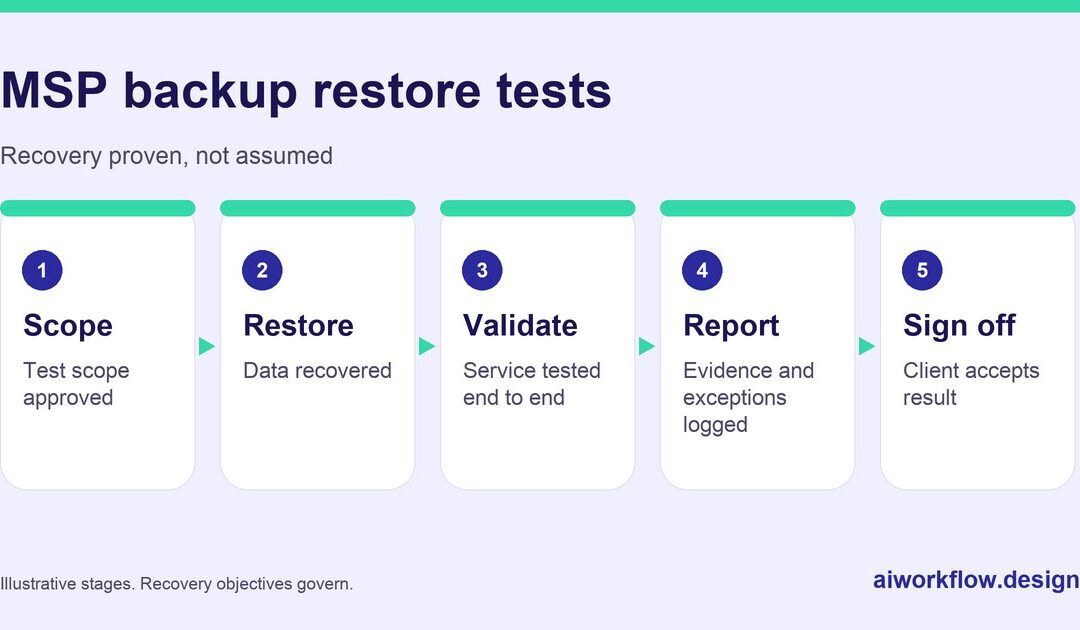
Quick answer: An MSP backup restore test checklist should specify the system or dataset selected, approved test scope, recovery objective, permitted environment, test owner, evidence requirements, observed result, exceptions and client acceptance gate. A successful backup job is not the same as a successful restore. A scheduled status call can check whether a test is booked or a report is ready; it must not certify data recovery, access protected backup contents or approve a production change.
A green icon in a backup console is reassuring, but it answers a narrow question: the scheduled backup task reported success under its configured conditions. It does not prove that the data can be recovered within the client’s required time, that permissions will work after restoration or that the application will function when its dependencies return. Those questions need an actual, appropriately controlled recovery exercise.
Managed service providers have two audiences for this work. Technical staff need precise evidence of what was restored and how the result was tested. Client owners need a clear explanation of what the outcome means for business continuity. A single status label cannot substitute for both. A good restore-test workflow creates a defensible chain from test planning to technical validation and signed acknowledgement of remaining risk.
Start with the recovery outcome, not the backup tool
Define the service that must recover. A file-share restore, database recovery and full business-application recovery may have different dependencies and acceptable downtime. Record the recovery time objective (RTO) and recovery point objective (RPO) where they have actually been established with the client. RTO describes the intended time to recover a service; RPO addresses the tolerable age of recovered data. Neither should be invented by the MSP because a test plan needs a number.
List the system identifier, data classification, backup policy, retention location, encryption/key-management dependencies, recovery method, approved target environment, personnel and test window. Identify third-party services needed to reach the expected operating state. Restoring a database into a sandbox while its identity provider is unavailable may demonstrate database recovery without proving end-user application recovery.
The NIST Contingency Planning Guide, SP 800-34 Rev. 1 is an established reference for testing, recovery strategies and maintaining contingency plans. Use it as general planning guidance, while the client’s contract and risk assessment determine the actual test scope and frequency.
Coverage should be confirmed at onboarding; see managed IT client onboarding checks.
Six gates in an evidence-based restore test
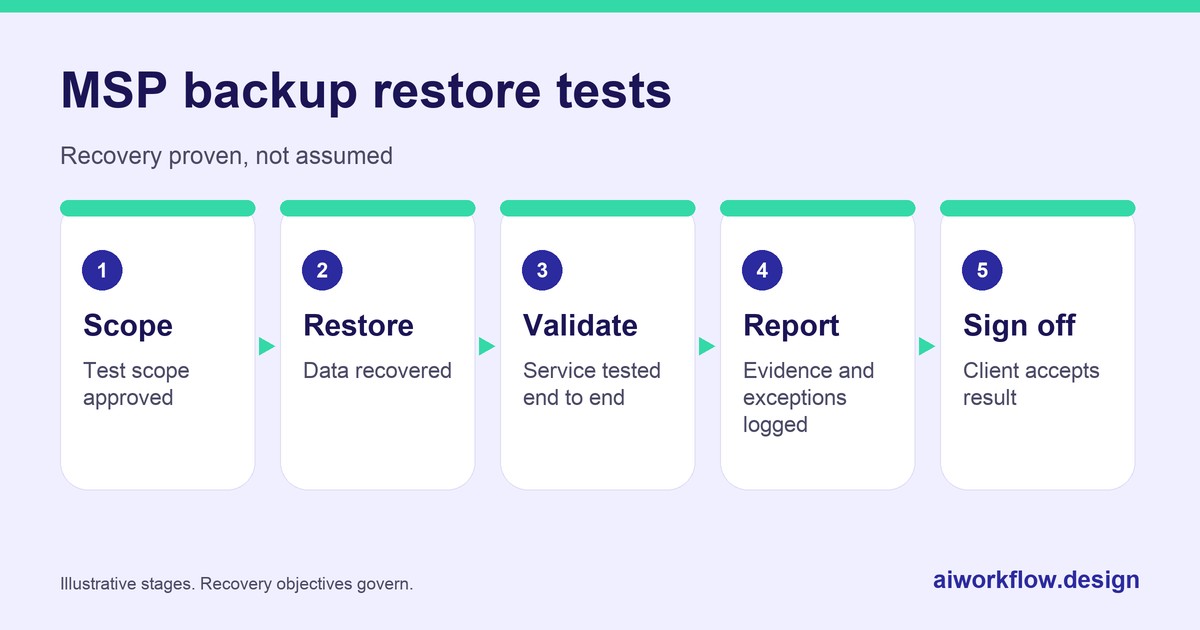
- Scope authorised. Client and MSP agree which assets may be tested, where restored data may reside, how it will be isolated and when temporary copies will be removed. Confirm privacy and access rules before using any production backup.
- Inputs prepared. The technical owner confirms backup availability, required permissions, decryption capability, license or cloud capacity, runbook version and a rollback/cleanup plan.
- Restore executed. The engineer runs the approved method in the permitted environment, recording start and end times, product/version and relevant logs. An unexpected production impact triggers the incident or change process.
- Recovery validated. Verify file integrity, application startup, authentication, service-specific checks and agreed consistency tests. A restored directory that contains files but cannot support the business process is not a fully validated recovery.
- Exceptions reviewed. Assign a technical owner to each failed or untested control. Document the business impact, remediation action and planned retest. Do not relabel “not tested” as “passed.”
- Client acknowledgement recorded. The designated client owner reviews the summary, residual limitations and next actions. Technical success, contractual acceptance and business risk acceptance can be different decisions.
A test can end as Passed, Passed with defined limitations, Failed, Not completed or Canceled, depending on the approved reporting method. Treat the labels as evidence-based outcomes rather than optimistic descriptions. An unsuccessful test is useful if it exposes a real dependency while there is still time to fix it.
Example: the files return, but the service does not
Imagine a hypothetical MSP maintaining a client’s document-management application. A restore completes in 42 minutes, and sampled files pass a checksum comparison. However, users cannot authenticate because the restored environment lacks the configured identity-service connection. Under a file-restoration-only scope, the test may meet certain objectives. Under an application-recovery scope, the service remains unavailable. These are not contradictory findings; they refer to different acceptance criteria.
The engineer records the accessible test evidence, raises a dependency for identity configuration and schedules a retest. The account manager explains to the client which objective passed and which did not. The restore is not called “fully successful” simply because the backup tool displayed a completion message. The 42 minutes is an illustrative scenario, not a performance claim for any product.
A practical monday.com restore-test board
Use one item per planned test, with subitems for technical and client-review gates. Useful columns include Client, System ID, Backup policy, Test type, Data sensitivity, RTO/RPO reference, Authorized tester, Approved window, Test state, Observed restore duration, Exception count, Evidence link, Technical reviewer and Client acknowledgement. Keep credentials, backup data, encryption keys and full security logs in approved systems; the project board should store restricted links and administrative status, not secrets.
Create a view separating Test scheduled, Technical work in progress, Evidence under review, Remediation required and Client review complete. An overdue test needs escalation, but a test that passed only file retrieval while the business application failed must remain visible as a material exception. Assign each remediation item a responsible person, due date, severity and retest reference.
The AI Workflow Design products page describes Autoza AI for monday.com and scheduled status check-ins. In an appropriately configured workflow, a caller may ask whether a client contact has received the test summary or whether a technician has uploaded the report. Such an agent should not attempt an actual restore, request credentials, read recovered client records aloud or issue a security conclusion. Technical validations belong to approved tools and qualified people.
Communication without overstating resilience
The client-facing report should state the tested workload and date, what recovered, the observed timings, which RTO/RPO objectives were evaluated, conditions that could not be simulated, outstanding issues and next test or remediation date. Make clear whether “recovery time” was measured from the first technical restore command or from the simulated service outage; the difference can materially change interpretation.
Where the test uses synthetic or sanitized datasets, label that limitation. A restored sample may establish that a mechanism works without proving that a full production dataset would finish within the same timeframe. Where the test uses a real copy, specify its approved secure handling and cleanup rather than claiming no additional risk. Never turn a limited tabletop exercise into a statement that a full restore has been proven.
Tabletop exercises complement but do not replace restores; see disaster recovery tabletop follow-ups.
How often should MSPs conduct restore tests?
There is no single frequency suitable for every client and system. Determine cadence from agreed recovery objectives, data criticality, technology changes, contractual obligations and any applicable regulatory requirements. A high-impact service may need more frequent verification than a low-risk archive. Significant changes to backup infrastructure, key management, identity systems or application architecture can justify additional targeted tests.
Treat a missed test date as an operational gap, not automatic evidence of failed backups. Record why it was postponed, the exposure and the next approved date. Conversely, a recent successful test should not be used to dismiss newly identified weaknesses in the environment.
Close the loop after a failed or partial restore
Open corrective actions for each meaningful exception, including ownership and a proposed verification method. The MSP technical lead verifies completed repairs and retest results. The account owner makes sure the client receives an understandable summary and any required decision request. Where the client chooses to accept residual risk, capture the authorized acceptance under the governing agreement; do not infer consent from silence. Consider the workflow automation service only for defined administrative integrations, not as a substitute for recovery engineering.
Noisy alerts can also hide restore failures; see MSP alert tuning requests.
Next step
Want these follow-ups handled consistently? Explore Autoza AI for monday.com or talk to AI Workflow Design about scheduled, permissioned status follow-ups that leave approvals and decisions with the right people.
Related guides:
- Disaster Recovery Tabletop Exercises: Track Evidence and Follow-Up Actions
- Managed IT Client Onboarding: Confirm Monitoring and Backup Coverage
- MSP Alert Tuning Requests: Reduce Noise Without Hiding Critical Incidents
More guides: browse our IT services and MSP workflow guides or see all industries we support.
Frequently asked questions
Is a successful backup job proof that recovery works?
No. Backup completion indicates a task reported success. A restore test checks whether selected data or services can actually be recovered and validated against agreed requirements.
What evidence belongs in a backup restore test report?
Record the authorized scope, system, date, test method, observed times, validation results, exceptions, technical reviewer and client acknowledgement. Store sensitive logs and recovered data securely.
Can Autoza or an AI caller perform restore validation?
Routine status-calling tools are not a replacement for recovery software, engineering verification or security approval. They may help coordinate scheduled follow-ups when properly configured.
Does a tabletop exercise count as a restore test?
A tabletop exercise validates aspects of readiness and decision-making. It does not by itself prove that data or an application can be technically restored within agreed objectives.
What should an MSP do after a failed restore test?
Document the failure, assess business impact, assign remediation, communicate limitations and conduct an approved retest. Leave the exception open until a qualified reviewer verifies closure.