
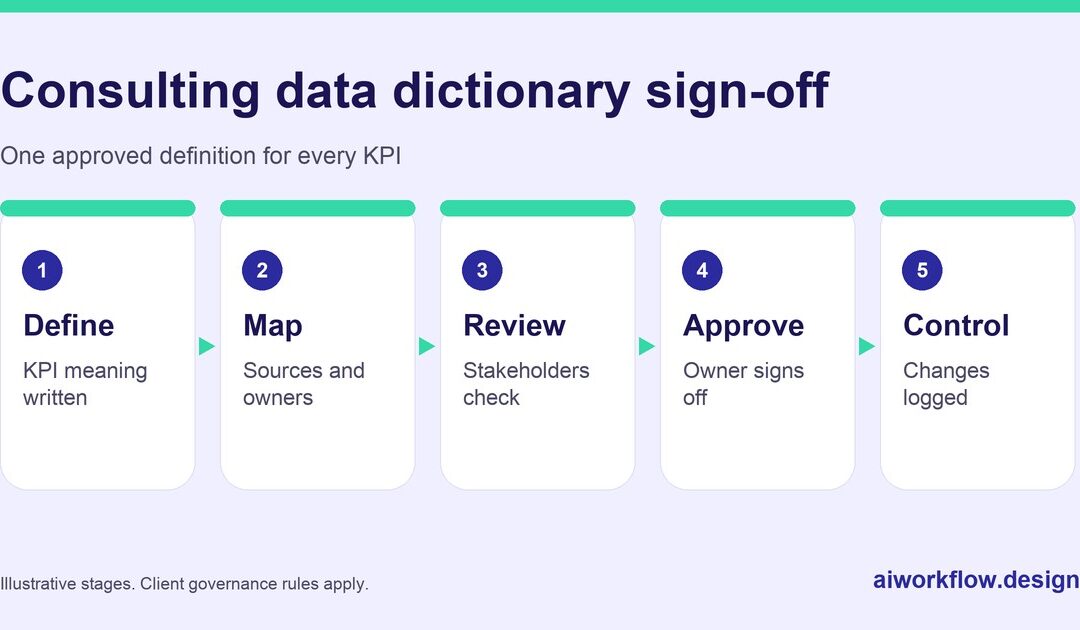
Quick answer: A consulting data dictionary sign-off workflow records the exact business meaning, calculation rule, source, owner, exclusions and approved version of each important metric before it appears in client recommendations or dashboards. It separates definition agreed, data tested and output approved. A scheduled AI check-in can ask whether an owner has reviewed a definition; it should never invent a metric formula, approve a disputed definition or expose confidential client data over a call.
Two teams can present an attractive dashboard and still disagree about the numbers. Sales counts a lead after form submission. Finance counts one after a signed agreement. Operations removes duplicates and test records. The consulting team may be asked to combine all three feeds into a single executive view, but a column labelled “conversion” conceals three different answers. That ambiguity travels into the business case, the implementation plan and eventually the board presentation. The remedy is not another chart; it is an agreed definition that can be traced to an accountable decision.
A consulting data dictionary is a small governance artifact, not a technical encyclopedia. Its job is to make disputed terms visible early, show exactly who can resolve them and provide enough context for analysts to reproduce the agreed result. The following workflow is designed for consultants working with a client in monday.com or another task system. It is a practical coordination pattern, not a claim that a particular AI product performs financial or statistical validation automatically.
What belongs in a decision-ready data dictionary?
For each priority metric, record the business label, plain-English definition, numerator and denominator (where applicable), date logic, inclusion and exclusion rules, source-system fields, responsible business owner, technical steward, current version, decision status and link to supporting evidence. A field such as “active customer” must specify whether activity means a transaction, an account login, an open subscription or something else. Write out the treatment of refunds, canceled orders, archived users and missing records instead of leaving readers to infer it.
Distinguish the authoritative source from a convenient extract. The CRM may contain opportunity stages while the finance ledger holds recognized revenue. Neither becomes the sole source for a combined customer-lifetime-value metric just because it is easier to export. Store a source-of-truth decision and its limitations. If the definition changes, issue a new version and identify the reports, forecasts or recommendations that must be checked again.
Use four separate status fields: Definition proposed, Business definition approved, Technical mapping tested and Report release approved. One green status cannot honestly represent all four. A sponsor may accept a business definition while the analyst has not confirmed that the required raw fields exist or that the data refresh is current.
Assumptions should be logged alongside definitions; see the consulting assumptions register.
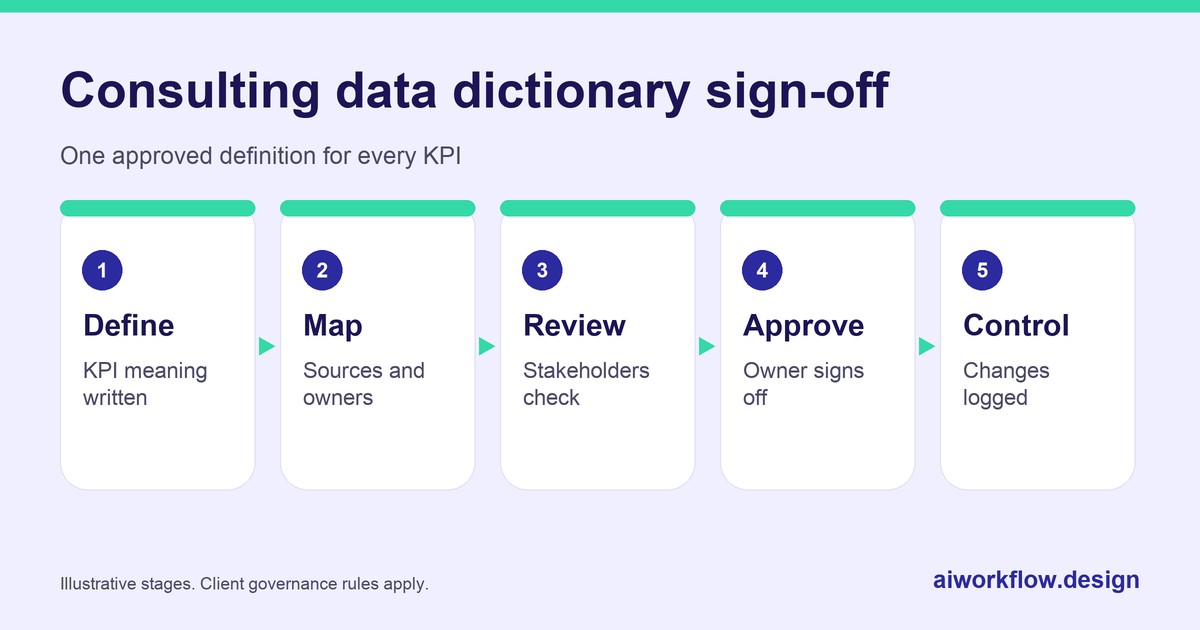
A seven-step client sign-off process
- Identify decision-critical measures. Start from the questions the engagement must answer: retention, utilization, cost per service unit, margin or service-level compliance. Keep a wider inventory for later, but prioritize metrics that influence the client’s actual decision.
- Capture the existing competing definitions. Ask each function for its current formula, report and owner. Record the conflict without declaring one team wrong. Different measures can be valid for different purposes.
- Write the proposed definition and test cases. Include a typical record, an edge case and an excluded case. If “new customer” is based on first paid invoice, a free-trial account should be handled explicitly.
- Assign a human business owner. Technical teams can test whether a query runs, but a commercial definition belongs to the business person authorized to accept it. Name a backup reviewer for absences.
- Validate the source mapping. Analysts test joins, date boundaries, duplicate handling and missing values in an approved secure environment. Attach a QA summary or governed evidence link, not raw personal records to a general calling board.
- Record a durable decision. Capture approver, date, accepted wording, remaining caveats and version. If approval is conditional, identify the condition and the owner who will verify it.
- Publish and monitor changes. Apply the approved version to calculations, update the data dictionary and alert report owners before a subsequent refresh quietly changes the definition.
This order prevents a common mistake: placing a metric in a client deck because a working SQL query exists. Technical feasibility is not business agreement. It also avoids the opposite mistake of treating a signed business definition as proof that the data pipeline is reliable.
Definitions also depend on upstream inputs; see workstream dependency follow-ups.
Example: a conversion rate nobody can agree on
Consider a hypothetical consulting engagement where marketing reports 200 inquiries, sales accepts 140 qualified records and 35 become paid customers. A marketing-to-sales acceptance rate is 140/200, or 70%; a sales-accepted-to-customer rate is 35/140, or 25%. Calling either figure simply “conversion rate” creates a decision risk. The dictionary should specify the stage transition, reporting period, cohort logic and whether later cancellations change historical results. These numbers are illustrative, not performance benchmarks or client data.
Before the next steering discussion, the consulting lead asks marketing and sales to agree on the terms. Finance checks whether paid-customer status means paid invoice or contract signature. An analyst tests the stage history. Only when each gate is complete does the slide owner use the metric in a recommendation. If one owner remains undecided, present the disagreement transparently rather than promoting a provisional calculation to a fact.
Build the approval board in monday.com
Create an item per metric rather than one item per spreadsheet tab. Recommended columns are Metric ID, Definition, Business owner, Data steward, Source system, Version, Approval due, Definition status, Mapping status, Report impact and Evidence link. Use subitems for specific QA tests, such as duplicate detection or reconciliation to a signed financial report. Add a dependency that blocks the report release item until required approvals are recorded.
A useful dashboard does not just count overdue definitions. It shows which high-impact deliverables are waiting on which decision. A definition awaiting review for a dashboard due next month is less urgent than one that blocks a client board pack this afternoon. Escalate based on the agreed delivery plan and business impact, not the number of reminder messages.
For a controlled implementation, monday.com remains the task and decision register; sensitive source data stays in the client’s authorized analytics or document systems. Restrict board access according to project permissions. Update the status only after a verified human response or authorized system event—not because a reminder was sent.
Where AI status calls help—and where they do not
AI Workflow Design’s product overview describes status-calling tools and Autoza AI for monday.com. Such capabilities can be considered for an approved, narrow check-in: “Have you reviewed metric K-14?”, “Is a clarification meeting needed?” or “When can the assigned owner provide a decision?” The response can populate a follow-up task or flag a person to contact, subject to configured integration and permission checks.
Do not ask an AI caller to read client-level sales data, calculate a confidential conversion rate, interpret contractual revenue policy or choose between disputed definitions. A recorded “yes” is not the same as signed approval. Use an explicit approval field and an authorized reviewer, and preserve the decision record outside the calling transcript if the client’s controls require it. For a bespoke integration between approval registers and the reporting system, review the workflow automation service rather than assuming every action is available by default.
Manage changes after the dictionary is signed
Definitions evolve during a transformation. New channels appear, a CRM migration changes stage labels or the client revises its revenue-recognition policy. Open a change record identifying the old and new language, the rationale, the effective date and affected dashboards. Reconcile one representative reporting period under both methods before communicating a trend break. Never overwrite historical definitions without a revision trail; doing so can make a real operational change look like a performance swing.
The key operational test is whether a reviewer can answer, “What did this number mean on the date the decision was made?” If the team cannot, the dictionary is not yet good enough for high-stakes reporting. IBM’s data governance overview discusses business glossaries and shared definitions, supporting the principle that terminology needs stewardship alongside the underlying technology.
Treat post-signature changes like scope changes; see consulting change request tracking.
Practical handoff checklist
Before delivering the final dashboard or advisory report, confirm that every decision-critical metric has an owner, an accepted definition, a tested source mapping and a reference to the version used. Ensure the report identifies unresolved assumptions. Transfer the dictionary to a client-controlled location, establish who will maintain it after the engagement and explain how future definition changes are approved. If approval is still outstanding, mark the affected recommendation as provisional rather than silently presenting it as established fact.
Next step
Want these follow-ups handled consistently? Explore Autoza AI for monday.com or talk to AI Workflow Design about scheduled, permissioned status follow-ups that leave approvals and decisions with the right people.
Related guides:
- Consulting Assumptions Register: Verify Client Evidence Before Recommendations
- Consulting Change Requests: Track Scope, Fees and Client Approval
- Consulting Workstream Dependencies: A Follow-Up Plan That Prevents Milestone Drift
More guides: browse our consulting workflow guides or see all industries we support.
Frequently asked questions
What is a consulting data dictionary sign-off workflow?
It is the process of collecting proposed metric definitions, resolving conflicts, testing source mappings and recording approval by authorized business and technical owners before the metrics are used in client deliverables.
Who should approve a KPI definition?
The client-designated business owner should approve its meaning and decision use. A data steward or analyst separately verifies the source mapping. Report-release authority may belong to a different person.
Can monday.com replace a data catalog?
No. monday.com can track ownership, decisions, deadlines and links. A dedicated catalog, secure document repository or analytics platform may remain the source for detailed metadata and sensitive data assets.
Can an AI agent decide whether two KPI formulas are equivalent?
An agent may help flag a discrepancy for human review, but a routine status-calling workflow should not adjudicate business definitions or certify data quality. Those tasks need the relevant qualified reviewers.
What if a metric remains disputed at the reporting deadline?
Record both interpretations, identify the unresolved decision and label impacted analysis provisional. Escalate to the agreed sponsor rather than choosing the formula that produces the preferred result.