
Quick answer: A consulting change request workflow records what the client wants changed, compares it with the signed statement of work, documents the effects on deliverables, timing, fees, dependencies and risks, and routes the proposal to the person authorised to approve it. Status reminders may help collect missing inputs, but a phone acknowledgement, meeting comment or automated board update is not contractual approval.
Consulting projects rarely follow the exact path imagined at kickoff. A client asks for a new regional analysis while reviewing a strategy deck. A department head wants three more workshops. An executive requests a revised operating model after the team has already approved the workplan. Any of those requests might be sensible. The mistake is to treat the request as an instruction to begin work before the commercial and delivery implications have been agreed.
A useful consulting change request tracker turns these moments into transparent decisions, rather than awkward invoice discussions weeks later. The goal is not to create bureaucracy around every correction. It is to identify genuine changes early, establish who can decide, and preserve the link between the authorised scope and what the team actually delivers.
Start with the baseline, not the conversation
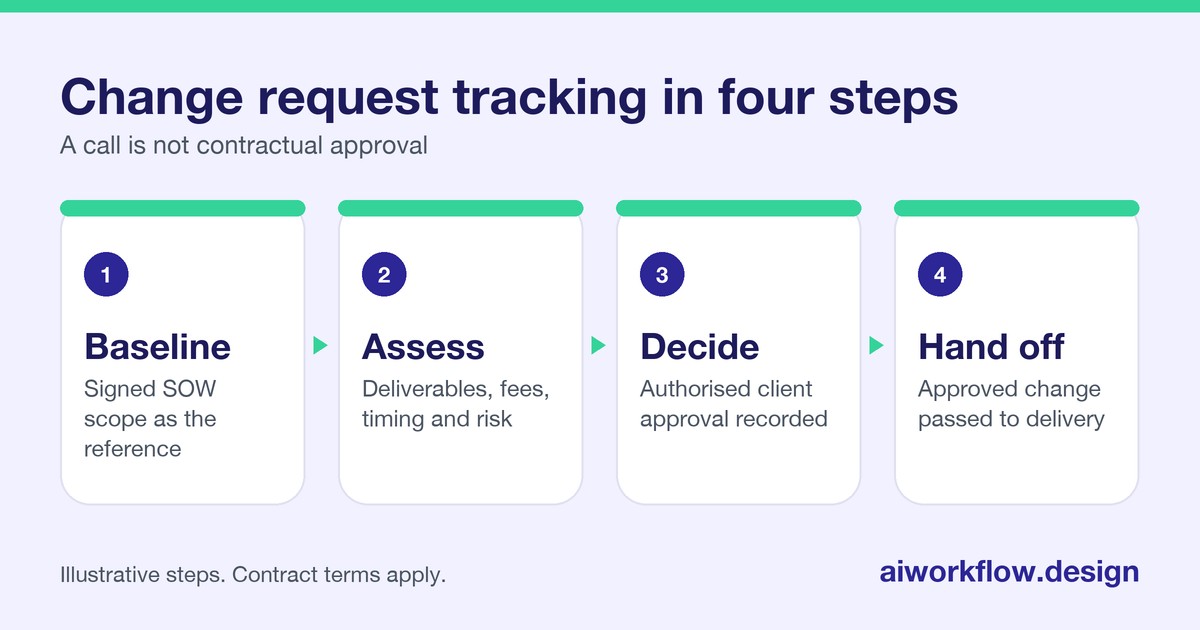
Before reviewing a new request, make the agreed baseline easy to find: signed scope, deliverable descriptions, assumptions, exclusions, timetable, acceptance criteria, fee model and named change authority. A consultant should be able to answer two questions without searching a dozen email threads: “What did we promise?” and “What is now being requested?”
Not every edit is a change. Correcting a misspelling in a deck or addressing an agreed review comment may fall within the original engagement. Adding a new market, extra stakeholder group, additional deliverable or accelerated deadline may alter the baseline. Put an initial classification on the request—within scope, clarification needed, or potential change—then let the engagement lead make the determination under the contract. That classification is a review step, not a billable verdict.
Use a change register that shows the decision trail
Set up one item per proposed change, even when several requests arrive in the same meeting. Capture a concise description, requester, date raised, affected workstream, originating SOW clause or deliverable, evaluation owner, decision authority and requested decision date. Link to the original client message and the current version of the project plan. Preserve older decisions rather than overwriting them when the client changes direction again.
A good register also holds a clearly named proposed impact statement. The delivery team may estimate effort and schedule movement; the commercial owner may assess additional fees; specialists may review privacy, legal, technical or operational consequences. These are inputs to a decision, not approved modifications. Separate “awaiting estimate,” “awaiting client decision,” “approved,” “rejected,” and “deferred” from “work started” so the board cannot quietly imply authorisation.
Evaluate what changes beyond the immediate deliverable
An extra workshop does not simply consume a facilitator’s afternoon. It may require interviews, pre-reading, synthesis, executive review and revisions to dependent work. An accelerated deadline can mean reduced review time, competing resource assignments or a higher risk of rework. An added geography may introduce local market research, translation, policy review and new stakeholders. Assess the complete chain rather than only the visible request.
For each material change, write a short impact note covering scope added or removed, schedule adjustment, delivery capacity, client responsibilities, fee effect, dependencies and acceptance criteria. Explain the alternative of not changing scope, including what would remain covered under the existing engagement. Where exact cost or timing is not yet known, label it as an estimate pending review. Avoid filling empty fields with “no impact” simply to move a card to green.
Build a decision gate that a status call cannot bypass
The decision gate should name a human or authorised governance body, acceptable approval evidence and the effective date. Depending on the engagement, the evidence might be a signed change order, an authorised purchase order, or another form expressly allowed by the contract. The project manager should not infer acceptance from silence, a meeting invitation or “sounds good” from a stakeholder who lacks authority.
Create a distinct implementation gate: only after the required approval is captured should the delivery lead update the baseline and assign new tasks. If the client asks the team to start while paperwork is pending, escalate to the authorised commercial owner rather than converting a pending request to approved. Genuine urgency can be handled through the contractual escalation process; it does not erase it.
A practical monday.com board design
A monday.com change register can contain columns for Change ID, Client, Engagement, SOW reference, Change summary, Requester, Delivery owner, Commercial reviewer, Decision authority, Estimated effort, Commercial status, Impact document link, Target decision date, Approval evidence link and Baseline updated. A separate “status source” field can distinguish reported progress from verified review. Use connected boards if the approved change must create delivery tasks, but keep the source of approval attached to the register item.
Suggested statuses are New → Under review → Impact prepared → Client decision pending → Approved / Rejected / Deferred → Baseline updated. Do not use a single generic “Complete” label for both an evaluated request and implemented work. If the deadline passes, notify the engagement lead and offer the client a new decision window rather than assuming permission to proceed.
Where automated check-ins can help
Administrative follow-ups are a practical use for scheduled AI calls. An approved script might ask an internal analyst whether the revised estimate has been uploaded, whether legal has returned comments, or whether the client sponsor has scheduled a review. The response can be written to a task note with a timestamp and a link to the source. A manager can then see which inputs are missing without personally chasing every owner.
Autoza AI for monday.com is designed for scheduled start-of-day and status-update calls that write mapped answers back to monday.com items. For an unusual consultancy workflow, AI Workflow Design’s custom automation services can be explored after the team defines permissions and escalation rules. Neither approach should be represented as independently negotiating scope, estimating fees, signing a change order or altering a contract. Those decisions remain with the named people and approved systems.
Example: a market expansion requested mid-engagement
Imagine a consulting team engaged to assess customer retention in two US regions. During a steering meeting, a sales executive asks the team to include three additional regions. The analyst logs the request and attaches the meeting note. The engagement manager identifies new data requirements and a revised interview sample. The commercial lead prepares a fee and timeline proposal. The client sponsor reviews it and signs the contractually required amendment. Only then does the engagement manager change the sprint plan.
If the executive withdraws the request before approval, the register records “withdrawn” and preserves the impact assessment for reference. If the sponsor defers it to a later phase, it becomes a future-scope candidate, not an unspoken obligation. The value is a defensible chronology that both sides can understand.
Follow-up timing and escalation
A workable cadence starts at receipt: acknowledge the request and assign an assessment owner on the same working day where possible. Set an internal estimate deadline matched to complexity. A day before the client decision meeting, check that the impact note and correct version have been circulated. On the decision date, capture the outcome and evidence. If no decision is available, record the blocker and its effect on dependent work.
Escalate conflicting instructions, requests to backdate approval, work requiring regulated expertise, and any material cost or schedule effect directly to the engagement leader. Do not turn an automated call into a negotiation channel. Calls to external stakeholders should be agreed in advance, and any recorded information should follow the engagement’s confidentiality rules.
How to know the process is working
Review the time between request and impact assessment, the proportion of changes with an identifiable decision authority, how often project tasks begin before approval, and the number of disputed changes at invoicing or closeout. Also examine the qualitative issues: Are decision notes understandable? Are clients able to see trade-offs? Does the team know which baseline is current? These measures help refine the workflow without promising a specific percentage improvement.
An effective change-control process protects client choice and delivery quality. It keeps the consulting team responsive while ensuring that additional work, altered outcomes and commercial commitments are discussed openly before they become facts on the ground.
Next step
Want these follow-ups handled consistently? Explore Autoza AI for monday.com or talk to AI Workflow Design about scheduled, permissioned status follow-ups that leave approvals with the right people.
Frequently asked questions
What should a consulting change request include?
It should describe the requested change, the part of the approved scope it affects, the business reason, the expected consequences for deliverables, schedule, resources, risk and fees, and the authority that can approve it. Attach supporting evidence and identify which details are estimates.
Can a client approve a change verbally?
Only if the governing contract and authorised process permit that form of approval. A verbal instruction from a participant who lacks signing authority is not automatically an approved change. Record the instruction and confirm the required authorisation.
What is the difference between a review comment and scope creep?
A review comment generally asks the team to meet existing agreed acceptance criteria. Scope creep occurs when work expands beyond the authorised baseline without appropriate assessment and approval. The signed scope and review rules determine the distinction.
Can AI approve an extra consulting deliverable?
No. A check-in tool can collect the status of a proposed change or remind owners to provide documentation. Only the authorised client and delivery representatives can decide contractual or financial terms under the applicable agreement.
Should a rejected change be deleted from the tracker?
No. Retain its decision and supporting context according to the organisation’s retention policy. Historical records explain why the baseline stayed unchanged and help prevent the same rejected request from reappearing as an assumed commitment.
Related reading
- Consulting RACI Gaps: Who Owns a Delayed Client Decision?
- Client Review Rounds: Stop Confusing Comments With Approved Deliverables
- Monthly Consulting Retainers: A Deliverables Review and Renewal Workflow
- Consulting Project Closeout: Follow Up on Ownership Transfer and Knowledge Handover
- Stakeholder Interviews: A Scheduling and Follow-Up Workflow for Consulting Teams