
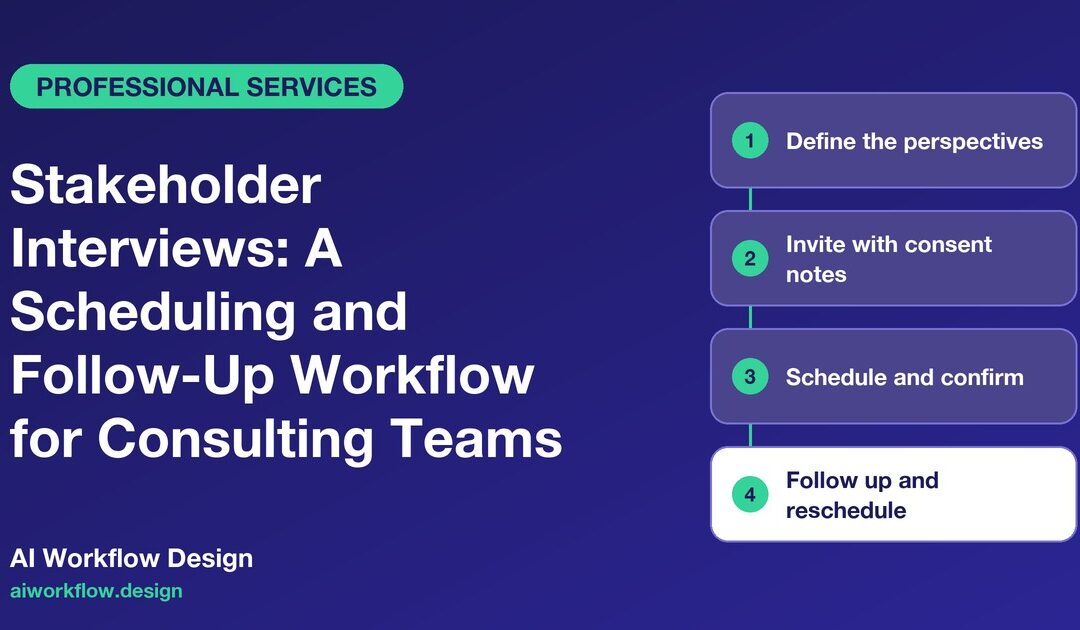
Quick answer: A stakeholder interview scheduling workflow identifies which perspectives the project needs, confirms the appropriate contact and invitation route, reserves an accessible time, records participation and consent requirements, and follows up on missed or rescheduled sessions. It keeps operational coordination separate from research judgments and protects confidential interview responses from general-purpose status boards.
Interviews often look like a small task on a consulting plan: “Speak to 12 stakeholders by Friday.” In practice, the work includes finding the right people, obtaining a sponsor’s introduction, clarifying purpose, accommodating time zones, protecting commercially sensitive discussions, and making sure each interviewer has the right guide. When that preparation is weak, the project loses more than calendar slots. Senior voices dominate, critical frontline perspectives are missed, and analysis begins with gaps that cannot easily be repaired.
A well-designed consulting stakeholder interview tracker helps the project manager see the scheduling dependencies without turning human research into a call-volume exercise. It should measure the breadth of relevant participation and readiness of the discussion, not merely how many invitations were sent.
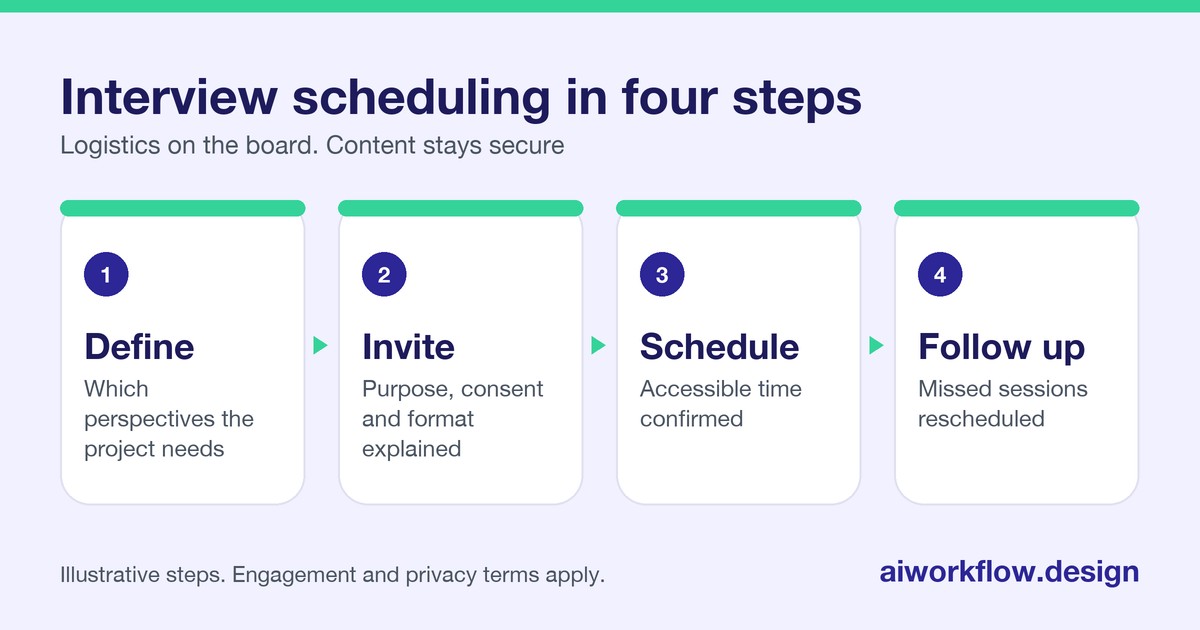
Define whose perspective is needed before inviting anyone
Start with the decision the interviews are intended to inform. A procurement transformation might require the finance sponsor, buyers, supplier-management staff and site requesters. A service-design engagement might need customers, support agents, operations managers and accessibility specialists. The interview map should state the role or perspective sought, the reason that perspective matters, and whether one or several participants are appropriate.
Ask the client sponsor to review the map for missing groups and conflicts of interest. Do not assume that a senior manager can speak for every employee category or that a readily available person is the right representative. Also distinguish mandatory decision makers, useful subject-matter experts and optional context contributors. That distinction helps the team prioritise when a busy stakeholder cannot be scheduled before a milestone.
Separate invitation logistics from interview content
Use two layers of records. The coordination layer can contain stakeholder role, approved business contact, invitation owner, preferred route, time zone, availability status, booked slot, interviewer and preparation link. The substantive layer contains interview notes, recordings, analysis tags and any personal or commercially sensitive information. It belongs in the client’s authorised research repository, not in a status column visible to every contractor or sales colleague.
The simplest operational statuses are Not invited → Invitation sent → Scheduling → Confirmed → Completed / Declined / Reschedule needed. Add a separate flag for “research permission or confidentiality step required” where the engagement requires it. “Completed” should mean the interview actually occurred; it should not imply that the participant endorsed a recommendation or that all governance questions are resolved.
Write an invitation that makes participation informed
A useful invitation explains who is organising the work, why the conversation is happening, the approximate duration, what topics will be covered, who will receive the findings, how to ask questions and whether participation is voluntary or subject to a workplace requirement. Any recording, consent, confidentiality or privacy statement must match the specific project and jurisdiction; don’t copy an unrelated generic consent form into every programme.
For a client-sponsored project, decide whether invitations should come from the sponsor, the consulting team or the participant’s manager. The sender affects trust. A factory employee may answer more freely when the invitation is not framed as a performance review. A customer interview may require an established research-consent process and secure recruitment tooling. If there is uncertainty about collecting personal information or recording, the privacy or legal owner should resolve it before the invitation goes out.
Coordinate availability without harassing participants
Offer a small number of suitable windows or an approved scheduler, respecting shift patterns, local holidays and time zones. For frontline staff, coordinate with operational leaders so an interview does not leave a critical station uncovered. For executives, use the sponsor’s office when appropriate and include the reason their perspective is necessary.
Set an invitation deadline and one or two reasonable follow-ups rather than an endless sequence of automated nudges. A non-response does not mean refusal, agreement or negative sentiment. Mark it as “no response” and ask the engagement owner whether to try a different route, nominate an alternative participant or revise the evidence plan. When someone declines, record the participation outcome without guessing why.
Prepare an interview pack that prevents inconsistent evidence
Before a session, check that the interviewer has the latest discussion guide, project context, role-specific questions, confidentiality requirements and a plan for taking notes. Identify who will observe, whether an interpreter or accessibility accommodation is needed, and how disputed points should be handled. Do not ask a scheduling agent to conduct probing research or generate an authoritative assessment from a brief status call.
A useful interview guide separates opening context, factual process walkthrough, specific examples, constraints, exceptions and closing clarification. Each question should support the project’s decisions. If the discussion moves into sensitive personal or restricted business information outside the agreed purpose, the human interviewer must decide how to respond. A well-organised calendar cannot substitute for interviewer judgment.
Put administrative follow-ups on a monday.com board
For each planned interview, create an item with Role group, Interview ID, Client-approved contact, Invitation owner, Interviewer, Time zone, Booking status, Target week, Calendar confirmation, Preparation checklist, Replacement needed and Evidence location. Use a role identifier or pseudonym when broad board visibility makes names unnecessary. Link to the authorised research repository instead of copying interview notes into the task item.
Automations can alert the coordinator when a session is still unscheduled near its target date or when the preparation pack is incomplete. Display coverage by stakeholder category rather than a misleading single total. A board with ten completed management interviews and no frontline input should expose the imbalance immediately.
Where scheduled check-ins help—and where they do not
A narrowly configured check-in could ask an internal coordinator, “Are all operations interviews booked for this week?” or “Has the interviewer received the approved discussion guide?” The answer might update a monday.com task with the reported status and timestamp. Autoza AI for monday.com supports scheduled calls that record task updates; it is not a replacement for a professional interviewer, qualitative analysis or the consent process. If a team uses a different work tracker, the Daily Check-in Agent may be relevant for straightforward progress reporting.
Do not send unapproved AI calls directly to research participants, collect sensitive interview answers during operational check-ins, or present the tool as able to judge a stakeholder’s truthfulness. External communication should be designed with consent, accessibility and local calling rules in mind. The caller should identify itself and give a clear human contact route where appropriate.
Worked example: a retail operations discovery sprint
Consider a consulting team investigating how store replenishment decisions are made. The scope calls for interviews with headquarters planners, store managers and delivery staff. Planning interviews are easy to book; delivery teams work rotating hours and are missing from the calendar. The board shows high completion overall but a gap in the delivery group. The coordinator requests shift-compatible time windows through an approved site lead and reserves two shorter sessions rather than asking one driver to speak for the entire fleet.
One interviewee requests that a current supervisor not receive their raw comments. The team checks its promised confidentiality arrangements and moves notes to the restricted research workspace. In the status board, the item records only “interview completed” and a neutral evidence pointer. The analysis team can now compare views across groups without the scheduling tool becoming an uncontrolled repository of employee statements.
Handle cancellations and rescheduling as evidence-quality risks
A cancellation should generate an action, not automatically create a replacement participant. Check whether the original person holds a unique perspective and whether rescheduling is worth the delay. If a substitute is selected, record the rationale and the affected stakeholder category. Repeated cancellations from the same group may point to poor timing, insufficient sponsor support or discomfort with the project’s purpose. Raise that observation with the engagement manager rather than mechanically increasing call frequency.
Before closing the interview workstream, have the research lead review coverage, omissions, conflicting evidence and the limits of the sample. A status of “12 of 12 interviews complete” is not proof that conclusions are representative or free from bias. Any generalisation belongs in a carefully reasoned report with limitations stated plainly.
Measures that improve the process
Track invitation-to-booking time, the share of required stakeholder groups represented, preparation gaps discovered before calls, no-shows, cancellations and time spent rescheduling. More importantly, examine whether missing groups caused additional research and whether participants understood the conversation’s purpose. Never rank people by how quickly they accepted an interview request or treat silence as a negative signal.
The result of good coordination is better research readiness: the right voices have a fair opportunity to participate, interviewers arrive prepared, and confidential contributions stay protected. Automation can tidy the calendar and the task board while leaving the substantive conversation to the people qualified to conduct it.
Next step
Want these follow-ups handled consistently? Explore Autoza AI for monday.com or talk to AI Workflow Design about scheduled, permissioned status follow-ups that leave approvals with the right people.
Frequently asked questions
What information belongs in a stakeholder interview tracker?
Keep the interview purpose, role category, approved contact route, invitation owner, booking status, interviewer, timing, preparation status and secure evidence location. Restrict personal details and substantive notes to systems and people authorised to access them.
Can interviews be recorded automatically?
Only where the relevant consent, notification, privacy and organisational requirements are satisfied. Recording rules vary by location and context. Confirm the project-specific requirements before recording and explain them accurately to participants.
How should a consultant follow up with a non-responsive stakeholder?
Use the agreed invitation cadence, respect a refusal and consider an alternate contact route or participant with the client sponsor. A lack of response should not be treated as an adverse judgment about the individual.
Can an AI status caller conduct stakeholder research interviews?
The workflows described here use automation for scheduling and preparation updates, not for interviewing participants or evaluating confidential comments. Any separate AI research method would need its own assessment and approval.
When is an interview workstream ready to close?
When the research lead has reviewed stakeholder-group coverage, documentation, important omissions, consent obligations and analytical limitations. Completing calendar bookings alone is not sufficient.
Related reading
- Subject-Matter Expert Bottlenecks: Prepare Inputs Before Consulting Workshops
- Audit Evidence Requests: A Confidential Follow-Up Workflow for Consultants
- Consulting RACI Gaps: Who Owns a Delayed Client Decision?
- Monthly Consulting Retainers: A Deliverables Review and Renewal Workflow
- Consulting Change Requests: Track Scope, Fees and Client Approval