
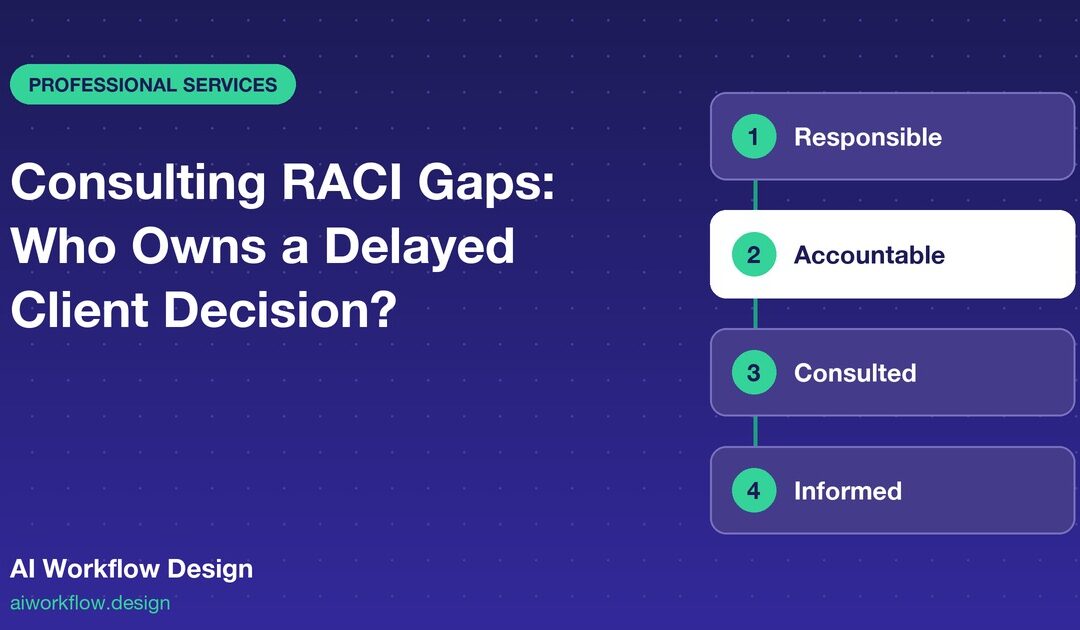
A consulting RACI responsibility matrix identifies who performs the work, who is accountable for the decision, who must be consulted and who needs to be informed. When a client decision stalls, the goal is not to chase every stakeholder equally. It is to identify the real accountable approver, describe the decision needed, surface missing evidence and use an agreed escalation route without confusing a status update with authorisation.

Why a delayed decision is often a role-design problem
A transformation programme may have a steering committee, an executive sponsor, a procurement owner, a workstream lead and two consulting partners. A deliverable can sit for days because each person assumes someone else can approve the scope change. Sending an automated reminder to everyone does not solve the ambiguity; it may increase the noise while the commercial or governance issue remains untouched.
A more useful work item is a decision record: a precise question, alternatives, required evidence, consequences of delay, one accountable decision owner, contributors who must be consulted, deadline and escalation condition. The project manager can then follow up on the missing input rather than repeatedly asking whether a task is ‘done’.
Define R, A, C and I before building reminders
In a RACI matrix, Responsible means the role carrying out the activity, Accountable means the person with ultimate accountability for the result, Consulted supplies input before the decision, and Informed receives relevant updates. The Association for Project Management’s RASCI role guide describes one accountable role for each activity; the Project Management Institute likewise describes responsibility assignment matrices as tools for clarifying work and authority.
A matrix becomes useful only when the roles are based on the client’s real approval structure. A director may sponsor the programme but lack authority to sign a regulated decision or amend the contract. Do not infer authority from job seniority or from who answered a call first. Confirm the decision rights in the agreed governance documents.
Turn a vague blocker into one decision request
Suppose a consulting team needs approval to proceed with a revised reporting model. ‘Reporting workstream delayed’ is too vague. State the choice: ‘Approve Option B’s KPI definitions and effective date, or provide a documented alternative by Thursday.’ Link the current analysis, record the person responsible for preparing the proposal and name the client official authorised to approve the change.
Add the consequence: for example, the planned testing workshop cannot be finalised until definitions are agreed. Be specific about which activities are genuinely blocked rather than claiming the whole engagement is at risk. This permits accurate status reporting without using delay language as a pressure tactic.
A practical consulting decision matrix
For each decision, track ID, workstream, issue, responsible author, accountable approver, consulted parties, people informed, decision authority source, due date, current status, evidence link and downstream dependency. Recommended categories are ‘drafting’, ‘consultation in progress’, ‘ready for decision’, ‘decision requested’, ‘deferred with reason’, ‘approved’, and ‘rejected with direction’. The client organisation should approve the language and authority rules.
A frequent mistake is setting ‘sent for review’ equal to ‘approved’. A second is treating a consultant’s interpretation of a meeting as a formal client instruction. Require the signed decision record, approved meeting minutes or other agreed evidence before any status affecting scope, budget or policy is changed.
Follow-up cadence by decision stage
While analysis is being drafted, follow up with the responsible consultant for missing evidence. During consultation, ask each input owner only for their relevant contribution. Once the request reaches ‘ready for decision’, contact the named accountable approver through the agreed method. If the agreed date passes, ask whether a decision was made, whether clarification is needed or whether the decision has been formally deferred.
Escalate according to the engagement’s governance agreement—for example, after one missed decision meeting or a defined business-day threshold—not because a call failed once. A no-answer result means contact was not established; it is not a rejection, an approval or evidence of poor performance. Keep escalation proportionate and record the real impact.
What an AI caller should ask and never assume
For an appropriate, consented operational check-in, use questions such as: ‘Is the assigned review completed?’ ‘Which information is still missing?’ ‘Who owns the next action?’ ‘Has the decision been formally recorded in the approved system?’ and ‘When should the project manager follow up?’ Keep answers linked to the decision ID and make uncertainty explicit.
Never ask the AI to negotiate a change order, interpret legal authority, infer approval from silence, reveal confidential commercial positions or record sensitive decisions in an unrestricted transcript. If the answer is ‘we agree in principle’, capture exactly that wording and route it to the accountable human for formal documentation.
Use monday.com as an action register, not a new approval authority
Teams using monday.com can create a linked decision register and workstream board. AI Workflow Design’s Autoza AI for monday.com describes scheduled status calls and board updates. A proposed configuration could capture whether review inputs have arrived or the next expected response date. It should never automatically change a contractually significant approval field without a separate authorised process.
Connect status to the evidence repository, and provide a restricted view for confidential deliberations. The site’s editorial and operational blog library contains related follow-up concepts; those should support, not replace, the client’s governance policies. Confirm field mappings and data-access permissions before using recorded calls.
Example escalation when two stakeholders disagree
Consider an illustrative project where the finance lead favours an immediate data migration and the operations lead requests additional validation. Neither answer should be converted into project approval merely because it came from a senior stakeholder. The decision register should show the competing inputs, the agreed accountable sponsor and the decision date. The responsible consultant prepares a concise options paper rather than asking the caller to negotiate between the two positions.
If the sponsor asks for additional modelling, record the revised evidence owner and next meeting. If a delegated decision-maker is required, update the governance record before directing follow-ups to that person. This leaves an explainable trail and reduces the temptation to describe a debated topic as a completed task.
Measure decision flow, not reminder volume
Useful measures include decisions awaiting an accountable owner, time spent in consultation, overdue decision requests, reasons for deferral and dependencies released after formal decisions. Review repeated bottlenecks as governance problems: perhaps the wrong committee meets too infrequently or a decision-rights document is outdated. Changing reminder frequency alone will not fix an unclear mandate.
At closeout, archive the decision record with its formal outcome and link it to affected deliverables. If authority remains contested, the correct status is ‘awaiting governance clarification’. Honest uncertainty is more useful to a consulting PMO than a dashboard that assumes progress where no one has made the decision.
Next step
Want fewer unfocused client chaser calls? Review AI Workflow Design’s monday.com status-call offering and begin with a human-approved decision register.
Frequently asked questions
What does the A mean in a consulting RACI matrix?
A means Accountable: the role ultimately accountable for the outcome or decision. That role should be confirmed against the client’s actual governance and approval rights.
Can one decision have more than one accountable person?
Good RACI design generally assigns a single accountable role for each activity or decision. If approval is genuinely joint under formal governance, document the specific decision mechanism rather than inventing a sole authority.
When should consulting PMOs escalate a delayed client decision?
Escalate under the engagement’s agreed governance triggers when a needed decision is overdue or its impact is material. First establish the accountable owner, missing input and real downstream effect.
Can a client approval be captured through an AI call?
A call can note that someone reports approval. Formal acceptance must follow the contract and governance process, with the approved evidence recorded by authorised people.
How do you distinguish consultation from approval?
Consulted stakeholders give relevant input; the accountable approver issues the formal decision. Use distinct board statuses and evidence so comments cannot silently become approval.
Related reading
- Steering Committee Prep: Collect Decision Papers Before the Meeting
- Cross-Workstream Dependencies: How Consulting PMOs Should Track Blockers
- Managing Several Consulting Engagements Without Daily Status Chasing
- Project Sign-Off Delays: A Follow-Up Workflow for Consulting Teams
- Benefits Tracking After Consulting Delivery: A 30-60-90 Day Check-In Plan
- Consulting Change Requests: Track Scope, Fees and Client Approval