
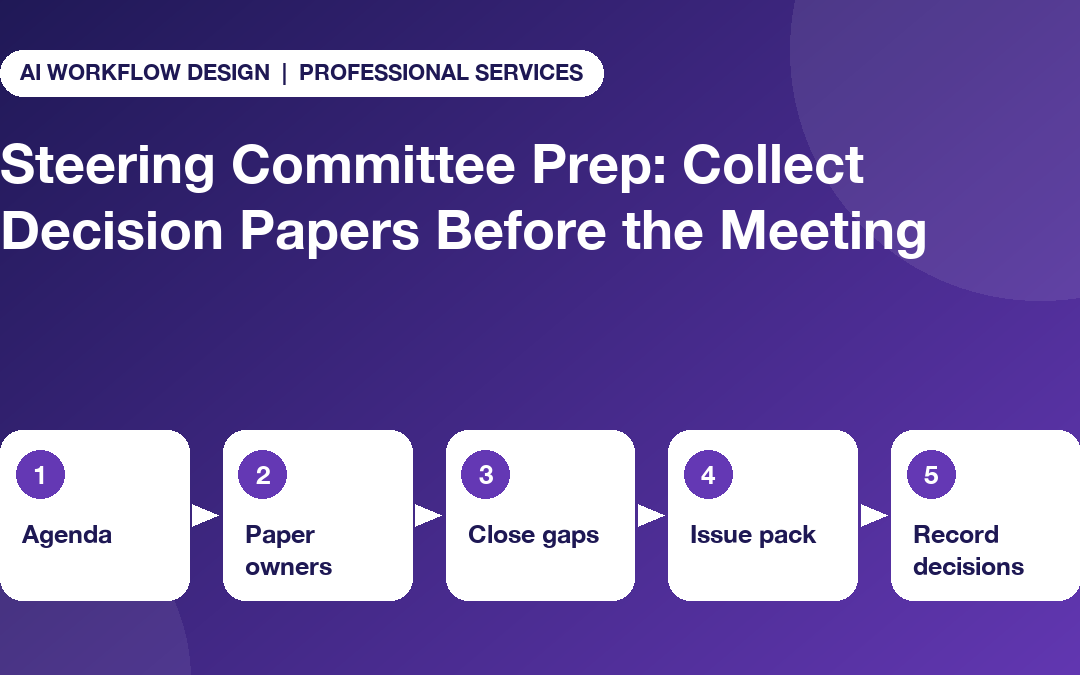
Quick answer: Consulting steering committee action tracking starts before the meeting. Confirm the decision each agenda item needs, assign one owner per decision paper, work back from the pack cut-off, keep draft, assurance, issued and decided as separate milestones, and capture official resolutions only through the committee’s own minutes.
Good consulting steering committee action tracking happens before members enter the meeting. The programme team should have a clear decision request, a credible evidence pack, known alternatives and a named owner for any outstanding input. A steering committee should not spend its limited time discovering that an approval paper is unfinished.
Project follow-up calls can help a PMO confirm whether a paper or review is on track. They cannot approve a proposal, interpret confidential evidence, vote, or substitute for official minutes. The purpose of the preparation workflow is to make human governance decisions more informed and timely.
Start with the decision, not the slide deck
Every proposed agenda item should answer: What decision is required, why now, who has authority, and what happens if the decision is deferred? If the item has no decision or material oversight purpose, it may belong in a written update rather than consuming committee time.
Examples of genuine steering topics include changing a committed programme baseline, resolving an interdepartmental resource conflict, accepting risk beyond delegated tolerance, approving a new project stage or choosing between material alternatives.
Effective sponsorship rests on a documented decision-making process between sponsors and the committee, including how information is prepared, decisions made and outcomes communicated. That is the governance structure the PMO should support.
Create one owner for each decision paper
The paper owner is accountable for the recommendation, supporting evidence, stakeholder consultation and final version. The secretariat or PMO may assemble the pack, but cannot supply a missing business case or choose a sponsor’s preferred option without authorisation.
A reliable paper brief contains the requested resolution, background and options; commercial and delivery implications; risk analysis; relevant assurance positions; dependencies; and any conditions for approval. Keep unnecessary client secrets, personnel information and privileged material out of broadly distributed packs.
Maintain a version-controlled document repository. A status column showing ‘submitted’ is not the same as a paper reviewed and cleared for circulation. An appropriate governance reviewer should assess whether figures and attachments are current, whether affected parties were consulted and whether the recommendation is internally consistent.
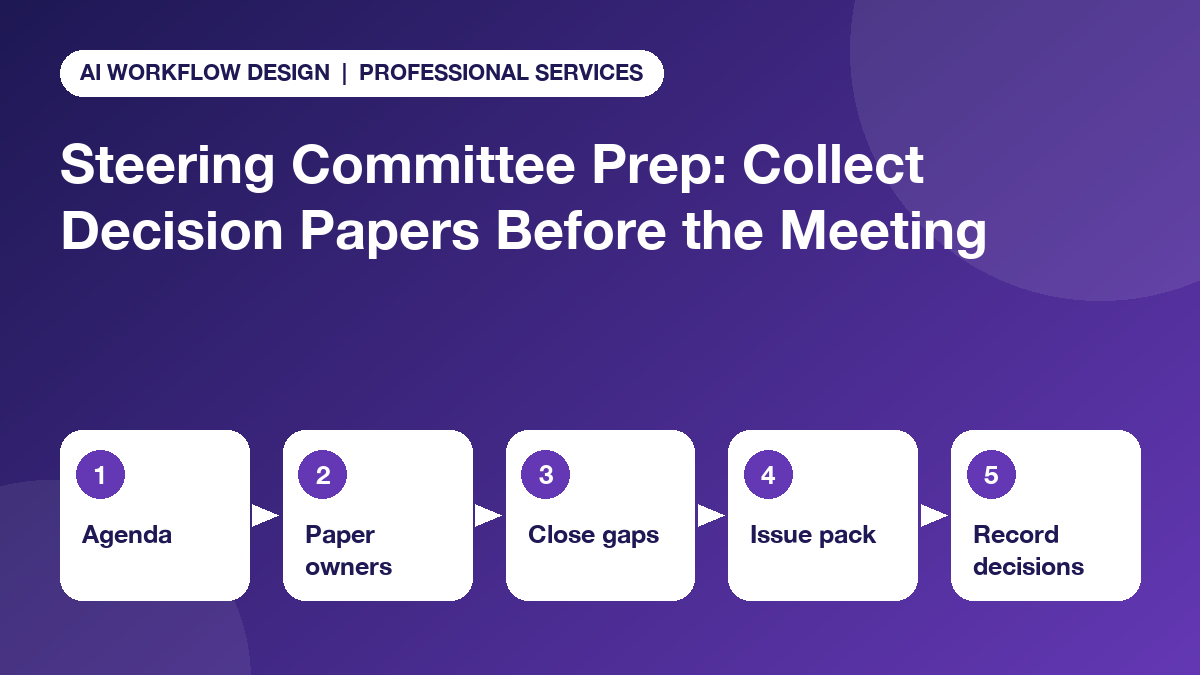
A six-step governance-pack workback
- Confirm the calendar and cut-offs. Work from the committee charter, member reading requirements and the organisation’s established submission process.
- Validate the agenda. The chair or authorised sponsor confirms which proposed issues warrant committee time, distinguishing informational items from decisions.
- Assign paper owners. Each owner accepts responsibility for the recommendation, evidence and clearance path, with named contributors from finance, legal, IT or operations as appropriate.
- Review dependencies. Check missing cost models, assurance reviews, stakeholder consultations and unresolved data. Assign a next action for each gap. For blockers that span teams, use the approach in our guide to cross-workstream dependency tracking.
- Circulate the approved pack. Use the authorised secure repository and record the version and distribution date. Any material late change follows the approved exception procedure.
- Prepare post-meeting capture. Plan who will record resolutions, owners, conditions, actions and follow-up dates for confirmation after the meeting.
This process is intentionally a workback rather than a generic ‘send reminders’ list. Missing evidence must surface early enough for the chair to decide whether a paper is ready to consider.
Status fields the PMO can manage in monday.com
A proposed governance-preparation board can have one item per agenda request, with fields for ‘decision requested’, ‘authority’, ‘paper owner’, ‘assurance contributors’, ‘latest version’, ‘reported writing status’, ‘cleared for issue’, ‘chair approval’, ‘meeting date’ and ‘outcome recorded’.
Separate four milestones: draft complete, assurance complete, pack issued and formal decision recorded. They are performed by different people and should not collapse into a single ‘done’ checkbox.
A RAID log provides useful distinctions between outstanding actions, issues, risks and formally recorded decisions. Use that discipline when connecting a paper-preparation task to a programme decision log.
Ask action owners questions the committee can use
A focused pre-meeting check-in may ask: ‘Is your decision paper ready for the approved review route?’ ‘Which named contributor is still outstanding?’ ‘Does the requested decision or its impact need to change?’ ‘When will the authorised reviewer receive the completed version?’ A failed call remains ‘not reached’, and disputed content routes to the accountable paper owner.
Do not ask people to dictate confidential financial assumptions, client records, legal advice or unapproved commercial positions into a calling transcript. Instead use a short status summary that points to the controlled document location. The boundaries are explained in what should never go into a consulting AI follow-up call.
The published Autoza AI monday.com capabilities include scheduled status calls, summaries and board updates. That supports a limited, agreed check-in workflow; it does not make Autoza a document-assurance, board-voting or governance-approval system.
Handle late papers and unresolved decisions honestly
Suppose a proposed investment decision requires a current benefits forecast, but the finance reviewer will not clear the assumptions until the day before the meeting. The PMO should show the risk to pack readiness, the missing reviewer action and available options. The chair may defer the item, request authorised expedited review or allow a limited discussion without approving the decision.
Do not silently circulate an incomplete paper marked ‘approved’. Likewise, a sponsor’s informal comment during a call should be recorded as feedback, not a passed resolution.
Material scope, funding, resource and go/no-go matters need the right authority, rather than an improvised operational workaround. Delayed approvals are a common cause of stalled programmes; see our workflow for project sign-off delays.
After the meeting, protect the decision trail
Official minutes should identify the resolution, decision authority, date, conditions, action owner and any follow-up deadline. The committee secretary or other authorised reviewer confirms the record according to policy. Reconcile the published decision log with action owners and affected workstreams.
Separate ‘decision recorded’ from ‘decision implemented’. An approval to proceed may depend on legal wording, procurement gates or risk controls that still require documented actions. The next scheduled status check should ask about those actions, not re-ask whether the committee voted.
Our guide to managing several consulting engagements explains how engagement leads can prioritise cross-project questions without filling governance meetings with routine updates.
A final pre-committee readiness test
Before the pack goes out, confirm the agenda authority, exact requested decisions, final reviewed papers, recorded dependencies, agreed alternatives and documented circulation. Ensure that each major open issue has either a resolution plan or an honest explanation of what cannot yet be approved.
The most useful metric is not the number of reminders the PMO sent. It is the proportion of items entering the meeting with a clear decision question, adequate evidence and the appropriate decision-maker present.
Make pre-meeting follow-up more focused
If your consultancy uses monday.com to coordinate paper owners and contributors, review Autoza’s scheduled task-owner calls or request a limited workflow demo. Keep pack approval, formal resolutions and official records under the committee’s established governance. Explore more industry workflows too.
Frequently asked questions
Which topics need a steering committee decision?
Prioritise matters outside delegated team authority, including material changes to scope, cost, priorities, risk tolerance, resources or agreed stage gates. Routine task updates should normally be handled by workstream teams.
Who approves a steering committee decision paper?
The designated paper owner and relevant assurance or sponsor reviewers approve the content for circulation under the organisation’s governance rules. The committee or authorised sponsor makes the substantive decision; a call does not.
What happens when a required paper is late?
Record the missing input, accountable owner, impact on the agenda and fallback options. Ask the chair or governance secretariat whether the item should be deferred, considered with limitations or addressed urgently through an authorised route.
Can an AI summary be treated as official committee minutes?
No. A call summary is a source of reported status, not evidence that a resolution was carried. Official minutes, decision records and approvals must be validated through the committee’s documented process.
How far ahead should the governance pack close?
Set a workback deadline that allows enough time for assurance review and member reading, based on the charter and complexity. There is no universal number of days; include a cut-off for material late changes and identify who approves exceptions.