
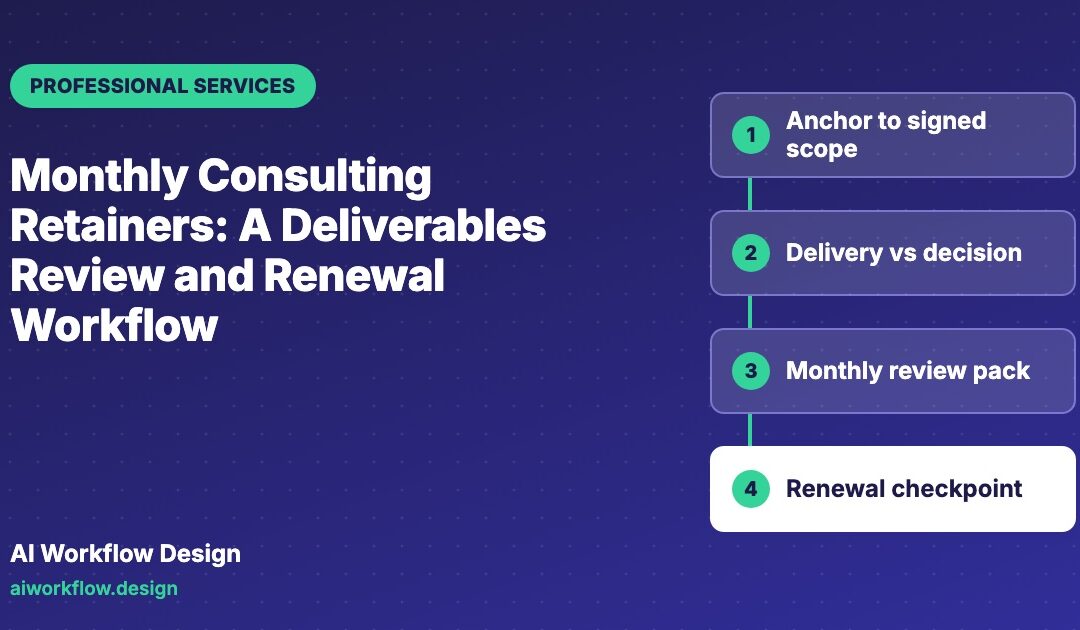
Quick answer: A useful consulting retainer deliverables checklist ties each monthly promise to its statement-of-work (SOW) reference, delivery evidence, client reviewer, acceptance state and carry-forward decision. Run the service review before the next billing or renewal milestone. Administrative reminders can collect missing feedback; only authorised people can accept work, change scope or renew a commercial agreement.
A monthly retainer makes consulting easier to buy but not automatically easier to govern. A client may receive strategy calls, analysis, dashboards and advisory support under one recurring fee. By the end of the month, the consultant believes everything was delivered while the client remembers two decisions that never moved. Both may be describing the same engagement honestly. The problem is that activity, output and acceptance have been blended into one informal status.
The solution is not a longer timesheet. It is a short, evidence-led monthly review that distinguishes commitments from requests, progress from acceptance and proposed changes from authorised scope. This gives account directors an accurate renewal conversation without turning a relationship into an invoice dispute.

Anchor the review to the signed scope, not the month’s email traffic
Start with the active SOW, work order or retainer schedule. List the recurring services, deliverables, meeting cadence, included capacity, exclusions, dependencies and the people permitted to approve changes. A promise in a sales proposal may not match the executed agreement; an idea raised during a workshop is not automatically a new deliverable. Defined work and agreed boundaries should always be kept distinct from later changes.
A practical register has one line per obligation. Record the agreement version, deliverable ID, due period, responsible consultant, evidence location, reviewer, current state, acceptance criterion and next action. Add a separate field for client-supplied inputs so a missing data extract is visible rather than silently absorbed into a consultant’s “late” status. Limit the board to metadata: confidential strategy documents belong in the approved document store with appropriate permissions.
Not every retainer sells a fixed list of outputs. Some sell a number of advisory hours or an agreed level of responsiveness. In that case, track the actual service commitment, such as a monthly steering meeting, capped support window or response obligation. Do not invent a deliverable that the contract never promised.
Use three registers rather than one ambiguous green status
A single “Complete” field is an invitation to disagreement. Separate the work into three records:
- Delivery register: what the team completed or submitted, with the date, deliverable version and supporting link.
- Client decision register: what the designated reviewer accepted, rejected, returned for amendment or has not yet reviewed.
- Change register: what someone proposed adding, removing, accelerating or moving into a later period, including the approved commercial impact if any.
For example, a consultant may submit a forecast model on the 25th. The delivery register can say “submitted”; the decision register still says “client review pending.” A request to add two scenario models is a change request, not proof that the original submission was deficient. Requests that affect an approved baseline should be evaluated and then formally approved, rejected or deferred.
These distinctions matter most at renewal. They prevent a proposal for next month’s scope from rewriting the record of last month’s work.
Build a monthly review calendar around decision dates
A disciplined rhythm gives the client time to respond before invoicing or renewal. Adjust dates to contract terms, geography, holidays and the client’s approval cycle; the sequence below is an operating example rather than a contractual notice period.
| Review point | Consultant action | Client action | Evidence produced |
|---|---|---|---|
| Early month | Confirm priorities and dependencies | Nominate decision owners | Agreed priority register |
| Midmonth | Flag delivery risk and unresolved inputs | Supply data or decide escalation | Blocker and decision log |
| Five working days before month-end | Submit deliverable index and summary | Review specified outputs | Submission record |
| Before service review | Reconcile questions and open changes | Mark accepted, revision needed or pending | Review decisions |
| At renewal checkpoint | Recommend next-period scope | Approve, negotiate or decline | Signed amendment or new instruction |
If an authorised reviewer is unavailable, record the gap. Do not treat an unanswered email or missed meeting as acceptance unless the agreement explicitly provides a valid process and the requisite conditions are met. The commercial owner should verify notice periods and legal requirements, not infer them from a generic checklist.
Design a service review the client can use in fifteen minutes
Send a one-page review pack with four sections: commitments made, evidence submitted, decisions required and recommendations for the next period. Lead with outcomes where measurable, but do not attribute every business improvement to consulting activity. A higher conversion rate, for example, may be influenced by pricing, seasonality and the client’s implementation choices.
For each deliverable, show the agreed criterion and its evidence. “Completed three workshops” is activity; “approved operating model published on May 29 with owner sign-off” is a stronger statement of output. If an outcome depends on the client implementing recommendations, report that dependency separately. Benefits realisation is a managed process, not something implied by project completion.
At the meeting, agree the remaining owner and date for each open action. Finish with a short written decision record. A long presentation with no named decisions is not an effective service review.
Handle carry-forward work without silently expanding the retainer
A client may ask to “just finish that analysis next month.” Before moving the item, determine whether it was in scope, whether the due date depended on a late client input and whether the retainer permits unused capacity to roll forward. The project manager should propose a treatment: complete within the existing obligation, reschedule by written agreement, quote a change, or close as no longer required.
Never use an administrative status update to approve additional hours or change rates. Keep the old plan visible so the audit trail shows what changed and why. Where a continuing service includes service levels rather than fixed outputs, log any service-level exception and its contractual resolution rather than fabricating a “late deliverable.”
Follow up with the right person about the right question
A good administrative call is specific and non-pressuring: “The monthly review pack includes the submitted market analysis and one question on the cost assumptions. Has the designated reviewer had an opportunity to look at that question, or should we schedule a discussion?” A response such as “we need our finance team” should become an owner-and-date action, not an assumed rejection.
Other useful prompts are: “Who is responsible for confirming the data extract?”, “Is the revised workshop date workable?”, and “Do you want the account lead to discuss the proposed scope change?” Avoid asking an AI agent to negotiate prices, make legal representations, commit the client to renewal or interpret silence as consent. If the conversation becomes a complaint about quality, route it to the account lead for a human response.
Where monday.com and Autoza can help
A monday.com board can represent each retainer obligation as an item with owner, due period, reviewer, status, evidence link and next review date. Use separate groups for current-month commitments, client decisions and proposed changes. Views can expose overdue reviews without granting broad access to confidential workpapers.
Autoza AI for monday.com supports scheduled status calls, question prompts, summaries and updates to the relevant board item. A carefully configured pilot could ask a project lead whether the review pack was sent or whether a decision owner has replied. It should write reported administrative status, not approve the engagement. Teams requiring a custom CRM-to-contract workflow can explore AI Workflow Design’s integration services; any additional integration would need agreed implementation and permission checks.
The safest design uses an approval boundary: a call outcome changes “awaiting response” to “reviewer contacted,” while only the appointed contract owner changes “accepted” or “renewed.” That boundary protects both the client and the agency.
Measure friction, not just how many calls were made
A useful monthly dashboard tracks the share of obligations submitted on time, median days awaiting client review, aged unresolved decisions, changes approved versus proposed and carry-forward work by cause. Compare counts over successive months, but interpret them with context. A complex quarter-end engagement might reasonably need more formal reviews than a routine reporting retainer.
Use the metrics to improve the relationship. If a client repeatedly misses review windows, move the review earlier or nominate a backup reviewer. If deliverables regularly need rework, revisit their acceptance criteria. If every month produces unpriced extra work, clarify the SOW before the next renewal.
Final consulting retainer deliverables checklist
- Confirm the live SOW, authorised approvers and actual renewal or notice date.
- Match each recurring commitment to an owner, due date, output and acceptance criterion.
- Capture evidence of submission separately from client approval.
- Track missing inputs, quality questions and proposed changes in separate lanes.
- Prepare the service review pack before the decision deadline.
- Record explicit renewal and scope decisions through the approved contract process.
- Carry forward only work whose treatment has been agreed and documented.
The goal is a calmer client conversation: everyone can see what was promised, what arrived and what still needs a decision. That is a more reliable basis for renewal than an optimistic green dashboard.
Next step
Want these follow-ups handled consistently? Explore Autoza AI for monday.com or talk to AI Workflow Design about scheduled, permissioned status follow-ups that leave approvals with the right people.
Frequently asked questions
What belongs in a consulting retainer deliverables checklist?
Include the signed scope reference, obligation or service level, owner, reporting period, due date, evidence link, client reviewer, acceptance status and follow-up action. Separate proposed changes and client-provided dependencies so the list does not confuse delivery with approval.
Does submitting a deliverable mean the client accepted it?
Not by default. Submission confirms delivery for review; acceptance depends on the agreement and the authorised client’s decision process. Never assume silence constitutes acceptance without a valid contractual basis.
How often should a consulting retainer be reviewed?
A monthly review usually matches a monthly service cycle, with an earlier midmonth risk check and a separate renewal checkpoint. The signed contract determines actual reporting, payment and notice requirements.
Can an AI calling agent negotiate retainer renewal?
A status agent can ask whether the account lead should schedule a renewal discussion or whether a review is pending. Pricing, scope changes, legal terms and renewal consent should remain with authorised people and controlled contract records.
Should unused consulting hours carry over automatically?
Only if the contract or a valid written amendment allows it. Track unused capacity and the reason, but do not convert it into a new obligation through a board status or a routine call.
Related reading
- Subject-Matter Expert Bottlenecks: Prepare Inputs Before Consulting Workshops
- How Consulting Firms Can Automate Follow-Up on Client Deliverables
- Project Sign-Off Delays: A Follow-Up Workflow for Consulting Teams
- Client Review Rounds: Stop Confusing Comments With Approved Deliverables
- Consulting RACI Gaps: Who Owns a Delayed Client Decision?