

A consulting engagement is not finished just because the final presentation has been delivered. A dependable consulting project closeout checklist confirms who will own the work after the consultants leave, which operating documents have been transferred, which residual actions remain open, and who has formally accepted the handover. Without that evidence, the consulting team can declare a project complete while the client’s operations team is left with access gaps, undocumented decisions, and unclear support responsibilities.
Treat closeout as a planned transfer, not a goodbye meeting. Use a transition register with named owners and dated acceptance criteria, and follow up on unanswered administrative actions before the engagement team is disbanded.
What the final deliverable does not tell you
Imagine a consulting firm completing a customer service transformation. The approved design looks comprehensive, but the operating team has not received the latest escalation runbook. Two dashboard administrators are still contractors, one system owner has not accepted the maintenance schedule, and training attendance has not been reconciled. The work may be technically finished yet operationally fragile.
The Project Management Institute’s closing guidance highlights acceptance, lessons learned, contract closure, and transfer to operations. Similarly, the California Project Management Framework’s closing phase describes confirming custody of deliverables and documentation. For consulting teams, that means defining who takes responsibility for each outcome before claiming completion.
Begin the transition register during delivery
Create a closeout board several weeks before the agreed final date, or earlier for complex engagements. Each item should have a business owner, delivery owner, handover artefact, evidence location, due date, and acceptance route. Organise work into four groups: Deliverables, Operational ownership, Access and contracts, and Residual actions. A separate lessons-learned record can capture process improvements without blocking necessary closeout.
Within deliverables, include the agreed final version of each report, model, process map, training guide, and system configuration document. In operational ownership, include accountable line managers, escalation contacts, service support boundaries, and the first review meeting after the handover. For access and contracts, list returns or transfers of credentials and assets, vendor obligations, and support arrangements. For residual actions, identify an owner and accepted plan rather than leaving a generic open-ended risk list.
An illustrative monday.com task structure can use one parent item per transition stream and subitems for individual acknowledgements. For example, “Customer analytics handover” can contain “Operations owner named,” “Runbook link checked,” “Support escalation tested,” and “Acceptance recorded.” Status collection can be assisted, but only an authorised person can confirm that the organisation accepts ownership.
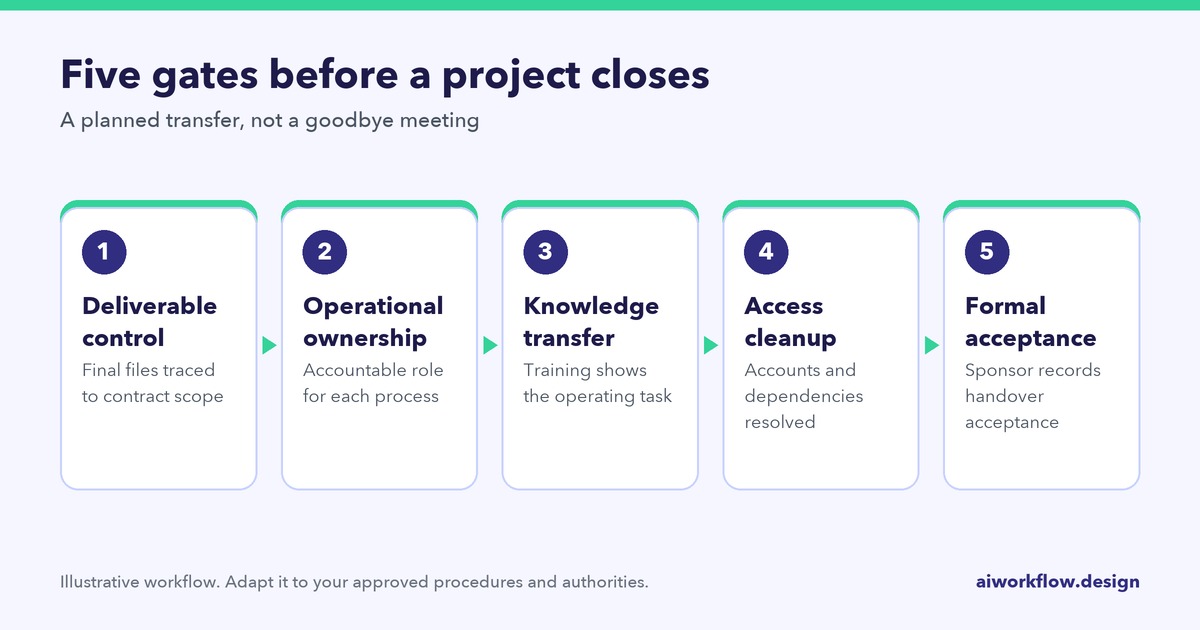
Confirm five transfer gates before the project is closed
Gate 1: deliverable control. Check that the agreed final files can be located, opened, and traced to the contract scope. Where versions changed during approval, confirm that the final package—not an earlier working draft—is being transferred. If a deliverable was removed from scope, record the change decision.
Gate 2: operational ownership. Every recurring process needs an identifiable accountable role, not merely a team inbox. A new reporting workflow might belong to the finance operations director, with technical support assigned to the internal analytics team. Confirm what happens after hours or when the primary owner is absent.
Gate 3: knowledge transfer. Training should demonstrate the operating task, not just prove that a meeting took place. Verify that participants can find procedures, understand exception handling, and know where to seek help. Capture unresolved questions in an action register with deadlines.
Gate 4: access and dependency cleanup. Decide which consultant accounts require revocation, which service accounts will remain, and who owns integration credentials. Access decisions belong to the client’s authorised administrators. Project follow-up calls should never request passwords or API keys.
Gate 5: formal acceptance. The client sponsor or delegated signatory reviews outstanding exceptions and records handover acceptance in the agreed form. If important actions remain open, name the owner, target date, and any temporary support arrangement. “Minor open items” is too vague to support accountability.
Run a purposeful owner-confirmation sequence
Five days before the target closeout meeting, send the transition register to all owners. Use a scheduled call or message to ask a narrow question: “Have you reviewed your assigned handover item?” or “Is the operational runbook accessible?” Record an answer and a follow-up date, but avoid asking participants to recite confidential client records or credentials.
Two days before closeout, review exceptions with the engagement manager. An owner who confirms receipt has not necessarily accepted responsibility. “Received the handbook” and “Accepted ongoing support ownership” should be different fields. If a vendor agreement expires after the consulting team exits, escalate the commercial decision to the contract owner.
During the acceptance meeting, distinguish work accepted, work accepted with exceptions, and work pending a formal decision. Afterwards, publish a concise record of the transition, owner directory, open actions and lessons learned. Confirm that a new support contact will answer questions when the consultancy is no longer on site.
Sample closeout register for a consulting engagement
A practical register might contain: Workstream, Handover artefact, Consulting owner, Client operating owner, Evidence link, Transfer status, Acceptance method, Residual risk, Next action date. Consider an example record: “Reporting | Monthly performance runbook | Delivery lead | Business intelligence manager | Controlled repository link | Training complete, acceptance pending | Sponsor sign-off | Access review open | 9 Nov.” All fields are illustrative and should be adapted to the client’s governance.
Status labels should reflect meaningful distinctions: Not started, In review, Delivered, Accepted with actions, and Formally accepted. Do not map “no response” to “Accepted”. When an owner rejects a handover because documentation is insufficient, return the item for correction and preserve the reason.
Where AI project follow-up calls can help
The Autoza AI product overview describes scheduled status calls, summaries and board updates for monday.com users. For closeout, the safest role for calls is to capture administrative facts: whether training happened, whether a named owner has reviewed a handover package, and whether an action date is realistic. Final acceptance, contractual release, access revocation and support commitment require the responsible humans.
Before using recorded or AI-generated calls, obtain appropriate approvals and explain who is calling and why. Do not collect passwords, client lists or confidential strategy details. Limit mapped fields and make sure ambiguous responses go to a human for review. The AI Workflow Design pricing overview is available when evaluating a controlled pilot.
What to measure after handover
Track the percentage of handover artefacts accepted by named owners, overdue residual actions after 30 days, training gaps, and the number of support issues caused by missing documentation. The first post-closeout operating review is often more revealing than the closing presentation: it shows whether the new process is truly usable without the project team.
A good closeout protects the client’s continuity and the consulting firm’s reputation. It creates an unambiguous moment when responsibility moves, a documented place for remaining actions, and a reliable path to help if something goes wrong after departure.
For a closely related workflow, read Client Review Rounds: Stop Confusing Comments With Approved Deliverables. You can also explore Project Sign-Off Delays: A Follow-Up Workflow for Consulting Teams, or browse more industry workflows.
Frequently asked questions
What must a consulting project closeout checklist include?
Include accepted final deliverables, documented ownership transfer, operational runbooks, knowledge-transfer evidence, residual action owners, access changes, contractual obligations, and the client’s formal acceptance record.
Who accepts operational ownership after a consulting engagement?
An authorised client sponsor or designated operating leader should accept the handover under the engagement’s governance. A project manager can coordinate evidence, but cannot assign acceptance authority simply by changing a task status.
Can a project close with outstanding actions?
Sometimes, if the client formally accepts those exceptions and assigns named owners, dates, and any necessary interim support. High-risk or contractual issues may need resolution before closure according to the agreement.
How should consulting knowledge handover be verified?
Check that the receiving team can access current documents, perform key procedures, identify escalation contacts, and resolve representative exceptions. Attendance at a training meeting alone is weak evidence of readiness.
Can automated status calls complete a project handover?
No. They may collect progress on assigned actions and alert the engagement manager to missing responses. Legal acceptance, security access decisions, and transfer of operational responsibility remain governed human decisions.
Build a better final-week follow-up plan
Explore scheduled AI check-ins for monday.com users if your consulting team spends the closing week chasing administrative confirmations. Start with one authorised, non-sensitive workstream, preserve formal sign-off, and measure the quality of the transfer rather than the number of calls made.
Related reading
- Client Review Rounds: Stop Confusing Comments With Approved Deliverables
- Project Sign-Off Delays: A Follow-Up Workflow for Consulting Teams
- How Consulting Firms Can Automate Follow-Up on Client Deliverables
- Cross-Workstream Dependencies: How Consulting PMOs Should Track Blockers
- Managing Several Consulting Engagements Without Daily Status Chasing