
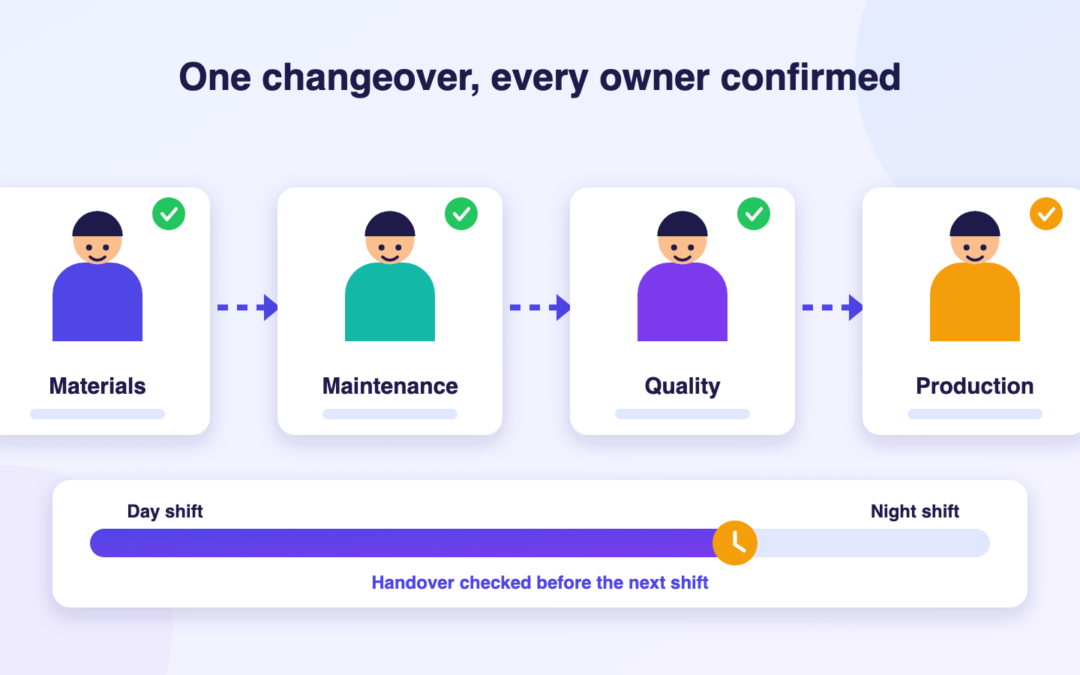
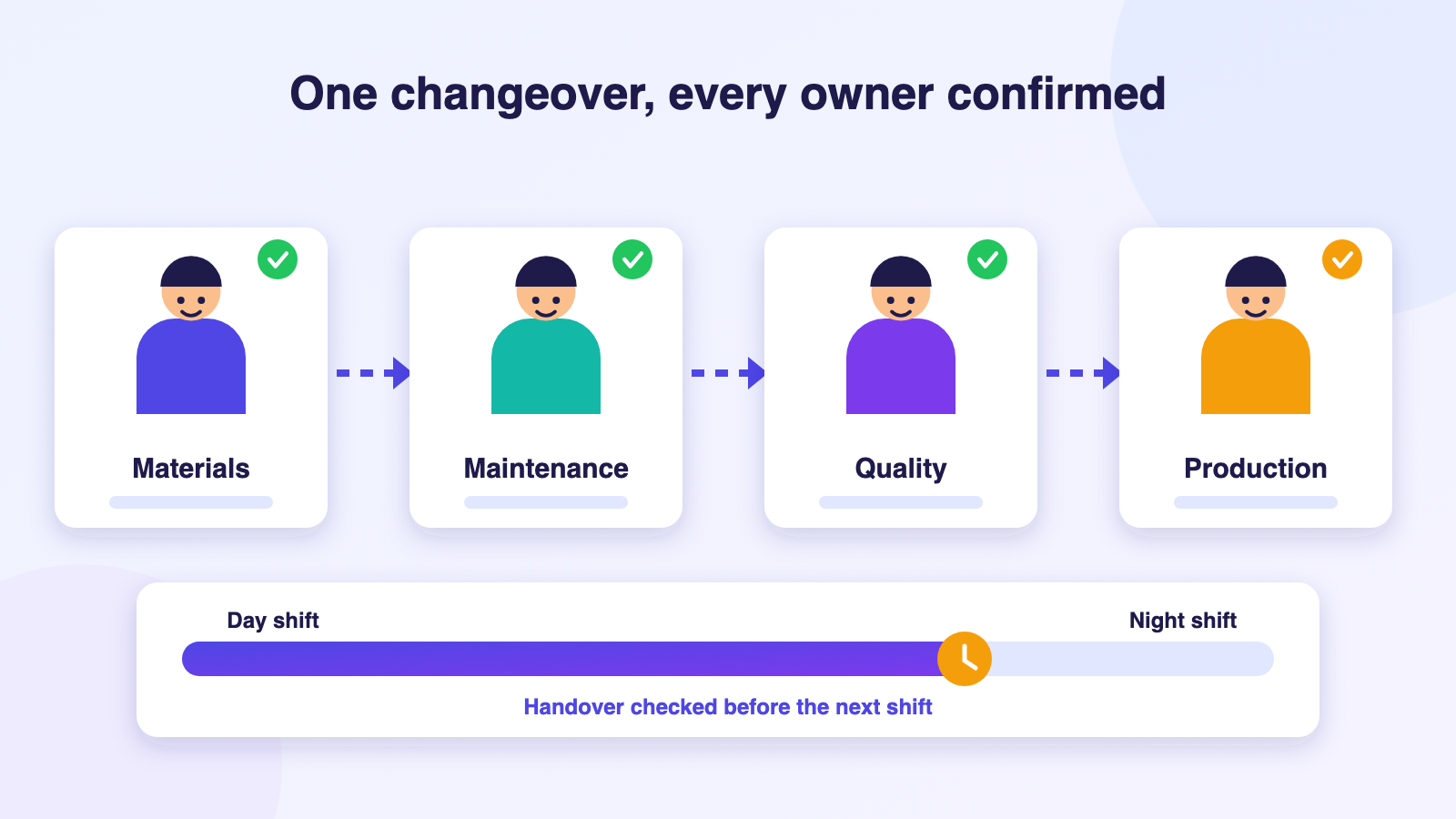
Quick answer: Production changeover follow-up is the process of confirming that each person responsible for a planned product, tooling or line transition has completed the administrative prerequisites for the next shift. A reliable approach names every owner, identifies dependencies, checks status before the handover and escalates anything unverified to the appropriate human. A reported status must never substitute for safety clearance, quality release or the authorised start of production.
A factory can have an excellent changeover checklist and still lose time if purchasing, maintenance, quality and the incoming shift communicate in different places. Short, targeted status calls may help coordinate approved tasks, especially when the people involved do not have easy access to project software. The quality of the handoff matters more than the number of calls made.
What changes during a planned production changeover?
A changeover may involve transferring a production line from one product to another, preparing new packaging materials, setting up approved tooling, arranging cleaning or sanitation, changing operating documentation and verifying that the next crew has the required staffing. Every facility will have its own standard operating procedures and release criteria.
Administrative readiness covers matters such as whether materials are available, who has accepted a task, whether an inspection appointment is booked and whether the incoming supervisor has received the handover information. Operational readiness includes equipment condition, process settings, quality checks, energy control and formal authority to proceed. These must not be collapsed into one green “Ready” label.
The monday.com manufacturing project-management guide discusses cross-functional planning and shared project visibility. For a changeover, those concepts become useful when the handoff between departments is explicit and time-bound.
Create an owner matrix linked to the changeover milestone
| Workstream | Example responsibility | What a routine call may confirm | Protected decision |
|---|---|---|---|
| Materials | Packaging and component availability | Reported stock arrival or open delivery | Material acceptance if inspection required |
| Maintenance | Planned servicing and tooling work | Work scheduled and named supervisor assigned | Equipment isolation and restart authorisation |
| Quality | Inspection plan and sample coordination | Inspector available and records submitted | Product release and quality acceptance |
| Production | Incoming shift and work instructions | Supervisor briefed and staffing reported | Approval to start or resume line |
| Engineering | Approved setup documentation | Current document location confirmed | Technical deviation or process change approval |
Treat these fields as a proposed working structure. The authoritative evidence may be held in manufacturing execution, quality management, maintenance, warehouse or document-control systems. The project board should reference those records rather than copying every technical detail into a voice-call summary.
Schedule check-ins around handoff decisions, not the clock alone
A practical coordination sequence starts the previous shift or previous working day. Ask the material owner whether required components have reached the intended location, ask the engineering document owner whether the approved version is available, and check whether the incoming shift lead knows the planned transition time.
Shortly before the planned changeover, the designated coordinator can confirm outstanding administrative items with the relevant owners. During actual equipment work, avoid interrupting operators, maintenance personnel or authorised safety staff. After the shift handover, a follow-up with the supervisor can record whether the administrative handoff occurred and identify unresolved actions.
The schedule should reflect the plant’s shift patterns, noise, permitted telephone use and safety policies. Never require a person to answer an AI call while driving equipment, performing hazardous work, operating machinery or carrying out energy-isolation procedures. If needed, use a safe break, approved phone station or coordinator rather than contacting the operator directly.
Ask concise questions that reveal dependencies
For a packaging changeover, an approved question set could be: “Are the specified packaging rolls reported at the line-side staging area?”, “Has the new job packet been distributed through the controlled system?”, “Is any team waiting on your action?”, “What is the next expected checkpoint?” and “Which named supervisor should review an unresolved issue?”
Avoid technical instructions and binary conclusions. A reply such as “All tooling is ready except one adjustment” should be recorded as a reported outstanding action, not converted into “tooling approved”. If the operator says the equipment is safe to restart, record that the person reported it, but do not permit the caller to remove a hold, approve restart or update a protected release field.
Keep status labels precise: Not contacted, Response received, Administrative task reported complete, Blocked, Awaiting authorised review and Handover confirmed by supervisor. Treat No answer and Answer unclear as separate outcomes so that unanswered calls do not appear as failed work.
Worked example: an evening shift preparing a new packaging run
Consider a hypothetical food-packaging plant changing from one labelled product to another at the start of the night shift. The planned transition depends on the new packaging rolls, a revised approved work instruction, sanitation sign-off and availability of a quality inspector.
An agreed afternoon check-in finds that the rolls have arrived and the document controller has published the approved instruction. The sanitation coordinator reports that cleaning is still underway and the inspector cannot arrive until later. The board records the two outstanding prerequisites and assigns the shift manager to review the schedule. It does not automatically move the start time or authorise production.
When the next shift arrives, the supervisor uses the plant’s formal shift-handover and release procedure. Only designated personnel can confirm the sanitation outcome, quality requirements and permission to operate. A scheduled call may capture that administrative steps remain open, but a phone result alone can never establish that the line is safe and compliant.
Define the response when one owner gives a conflicting answer
Suppose the warehouse reports that the new label stock has been delivered while production says it is not at the line. Both may be describing different locations. Preserve both statements, identify the reconciliation owner and ask for physical confirmation through the approved inventory process. Do not overwrite the first record with the second simply because it arrived later.
Similarly, “inspection booked” and “inspection passed” are different assertions. The existing quality inspection follow-up guide explains why technical acceptance needs its own authorised review and record. Keep those distinctions in the changeover workflow.
Where AI calls and monday.com can help
The publicly described Autoza AI for monday.com schedules check-in calls, asks configured questions, updates board items and provides call summaries and retries. Those features may be useful for a limited, non-safety-critical owner check-in. They are not an equipment-control system, manufacturing execution system or automatic quality gate. Confirm the available field mappings and escalation behaviour in your actual setup.
Work with plant leadership to identify the approved recipients, quiet periods, calling disclosures and prohibited questions. Map only administrative fields suitable for telephone reporting. Keep lockout/tagout, production release, quality acceptance, testing evidence and machine restart outside the automated update permissions.
Treat shift changes as a safety-governed transfer
In US workplaces where it applies, OSHA’s lockout/tagout standard requires specific continuity measures during shift and personnel changes under hazardous-energy control. A status-call transcript is not a substitute for those procedures or the actions of authorised employees. Other jurisdictions and industries have their own requirements that the plant must follow.
If a caller hears terms such as unexpected energisation, missing isolation, bypassed guard, exposure or uncontrolled process condition, the routine follow-up must not continue as though it were an ordinary delay. The person should be directed to the site’s immediate human-led safety reporting route, and any approved escalation must be initiated without waiting for a routine retry.
Measure handover quality without implying production gains
Track the proportion of changeovers with a named owner for each administrative dependency, how many blockers are discovered before the next shift, the age of unresolved action items and the number of clarifying calls supervisors must still make. Review whether calls were placed at safe times and whether managers trust the resulting notes.
Do not promise reduced downtime, fewer defects or improved safety performance without independently measured evidence. A good initial result is a clearer list of outstanding responsibilities before the next shift, not an automated production-start decision.
Next step: pilot one changeover checklist
Choose a routine changeover with defined owners, write a small set of non-sensitive status questions and test the escalation process before scaling. Explore Autoza’s scheduled board updates or request a plant workflow conversation with the people responsible for production and safety approvals.
Frequently asked questions
What is production changeover follow-up?
It is a structured way to confirm the progress of planned handoff tasks, such as materials preparation, document readiness and owner availability, before a manufacturing line or shift changes work. It is not the technical authorisation to operate equipment.
When should a changeover check-in happen?
Before the planned transition and at agreed safe coordination checkpoints. Avoid interrupting employees performing hazardous or safety-critical work, and use the plant’s approved shift schedule and communications rules.
Can an AI call confirm a factory line is safe to restart?
No. Safety checks, isolation controls, inspections and permission to restart must follow documented site procedures and be completed by authorised people. A verbal status reply cannot replace those controls.
What should be recorded after a missed changeover call?
Record only the missed contact, time and permitted next action. Do not interpret a no-answer as failure to complete an operational task or as evidence that a line is unsafe or ready.
How should conflicting material or quality updates be resolved?
Keep the reported statements separate and assign a named person to verify the authoritative stock, inspection or quality record. Do not allow a general call summary to override controlled evidence or acceptance decisions.
Related reading
- AI Calls in Manufacturing: Where Human Safety Approval Must Stay in Control
- Quality Inspection Follow-Up Calls: What Information Should Be Recorded?
- Equipment Installation Projects: A Status Call Plan for Plant Teams
- How to Follow Up on Manufacturing Project Dependencies Without Daily Chasing
- Autoza AI for monday.com: scheduled status calls
- Workflow automation services
- Daily Check-in Agent