
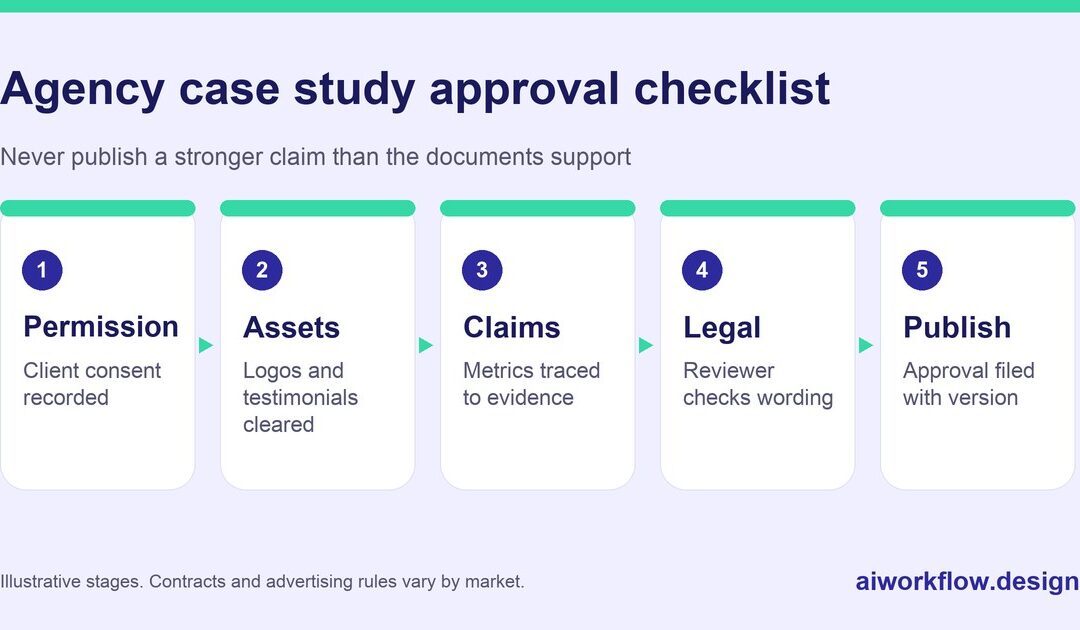
Quick answer: An agency case study approval workflow should confirm the right to name the client, use its logo and creative, share campaign data, describe the work accurately, and publish each performance claim with supporting evidence. Record the approved draft version, authorised reviewers, usage scope and publication channels. A friendly client email or an AI-generated draft is not blanket permission to disclose confidential information or reuse protected assets.
An account manager wants to publish a successful campaign. The copywriter has a striking headline, a designer has added the client’s logo, and a presentation includes a revenue chart from the agency dashboard. The client previously said, “Great job.” That compliment is not necessarily a release for a public testimonial, a trademark licence, approval to share confidential financial results, or confirmation that attribution claims are sound. A separate publication process is needed.
Decide exactly what the case study is asking to prove
A case study can demonstrate a process, creative approach, operational challenge or business outcome. Those are different claims requiring different evidence. “We rebuilt the client’s landing page” may be established by project delivery records. “The redesign doubled sales” needs a defensible measurement definition, time window, comparison, attribution explanation and client approval. “The client recommends our agency” adds an endorsement issue.
Advertising rules generally require truthful, non-misleading and substantiated claims, and testimonials must be genuine, with material relationships disclosed. Applicable law and contractual obligations vary by market, but the editorial principle is universal: do not publish a stronger claim than the documents support.
Create a permission and evidence matrix before drafting
The account owner should locate the services agreement, relevant confidentiality provisions, the client’s approval process and any existing portfolio rights. A permission to mention a client name may not cover its logo, screenshots, staff quotes, customer data or paid-ad creatives. A permission to publish on the agency website may not extend to paid advertising, event presentations or third-party marketplaces.
For each proposed asset, record its owner, source file, planned placement, required permission, permission evidence, any permitted dates or territories, and whether another party owns rights. Third-party stock images, music, creator content and platform screenshots may be subject to separate licence terms. Seek specialist review where terms are unclear rather than relying on a checkbox labelled “all rights cleared.”
Validate campaign metrics at the source
Work from the original platform exports and approved business records rather than a slide that has been copied between decks. Identify the reporting platform, account or property, date range, metric definition, attribution window, currency and data completeness. If numbers are compared, document the baseline period and whether tracking, spend, seasonality or product mix changed.
A percentage alone can be misleading. A higher conversion rate during a much smaller traffic period may not mean more customers; return on ad spend is not the same as profit; and a platform-reported lead may not be an accepted sales opportunity. If a chart cannot explain its denominator, attribution or exclusions, simplify the claim or remove it. Do not invent impressive results to fill a portfolio gap.
The related campaign budget reallocation guide shows why a change in spend and a change in outcomes need separate records. The case study should explain the meaningful business question, not simply display the largest positive platform number.
Handle testimonials and quotations with their own release
If an employee or client contact is quoted, preserve their exact approved words and confirm the person’s authority to speak for the organisation. Do not turn informal praise into quotation marks with text they never used. An edited quote should be sent back for confirmation. Avoid implying an independent endorsement where a material relationship or incentive should be disclosed.
Ask whether the client wants a full name, title, first name, anonymous company description or no quote. A person leaving the organisation can complicate later edits; record the relevant contact and approved usage terms. Treat personal data as a separate privacy issue and apply the organisation’s applicable retention and consent procedures.
Run an editorial review with clear decision stages
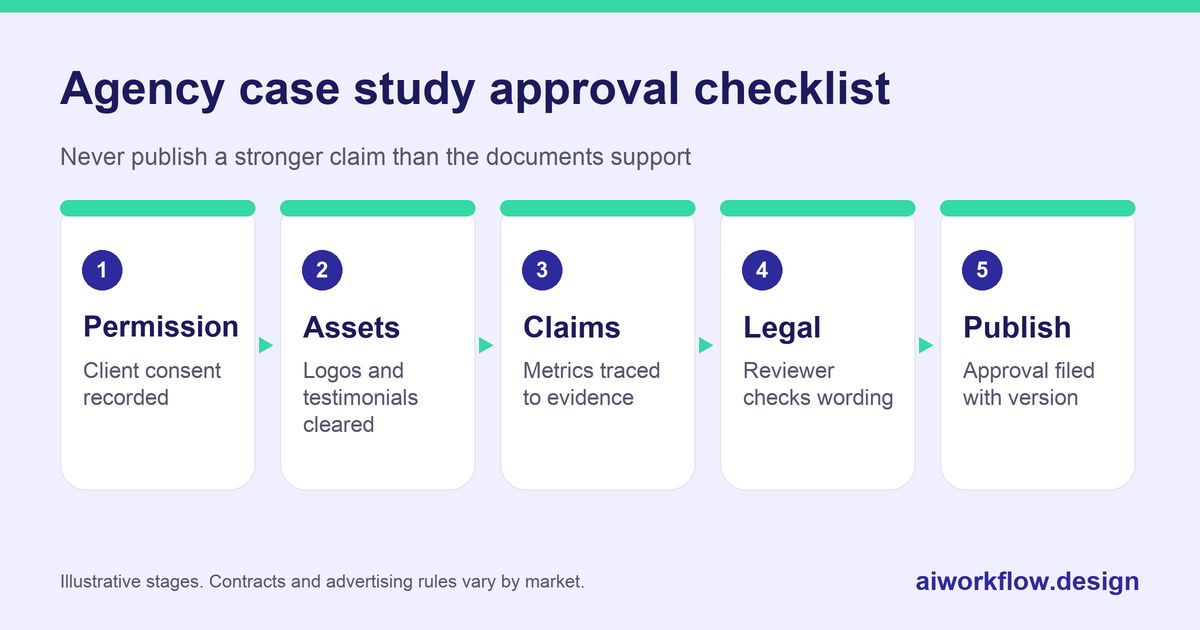
A workable sequence is Case nominated → Contract and permissions checked → Evidence assembled → Draft prepared → Internal legal/brand review → Client review → Revisions logged → Final version approved → Published → Periodic accuracy review. Approval must identify the exact version or asset set. When content changes after sign-off, determine whether the revision is within the approved scope or requires renewed permission.
A draft may receive technical corrections from an analyst, style comments from the marketing lead and legal restrictions from counsel. Those comments are not equivalent. Give each owner a decision lane: measurement validity, commercial sensitivity, trademark or licence usage, privacy, brand tone and final publication authority. If one mandatory review is outstanding, the state remains pending even when other reviewers have finished.
Prepare the client review so approval is easy to give
Send one complete package instead of a chain of partial screenshots. It should contain the exact headline and body copy, proposed quote, logo use, screenshots or visual mockups, metric methodology, channels and intended publication date. Highlight claims that need the client’s direct confirmation. Ask for corrections and a decision from the authorised signatory through an approved channel.
Do not create a default “deemed approved after five days” rule unless the specific contract makes that valid and it has been reviewed. Silence, a meeting acceptance or a vague “looks good” from an uninvolved stakeholder should not trigger publication. Record the approval date, approver role, document version and any conditions.
Build a focused monday.com approval board
Use one item per case study, not one item per email. Useful fields include Client, Project, Case Study Owner, NDA/Contract Check, Client Naming Permission, Logo Rights, Metrics Evidence Link, Claim Reviewer, Quote Approval, Asset Licence Review, Draft Version, Client Reviewer, Approval Scope, Publication Channels, Final Sign-Off, Scheduled Publish Date and Review Due.
Add subitems for each material claim or asset only when those need independent approval. Store confidential source exports in a permission-controlled repository and link to them rather than placing raw customer-level data in a widely shared content board. Track exceptions as “claim requires substantiation,” “permission restricted” or “client requested redaction”—not as generic “blocked.”
Use AI for check-ins, not as a legal or factual approver
A status call could ask an internal reviewer whether the revised metrics table has been reviewed or whether the client-facing approval package was sent. It can remind an authorised account owner that a required logo permission remains outstanding. It must not contact the client with unpublished confidential results unless specifically authorised, interpret legal rights, approve an endorsement or publish the article itself.
AI Workflow Design’s monday.com and check-in products can support bounded administrative tasks. The company also describes workflow automation services that can connect project handoffs. Configure escalation for explicit refusals, confidentiality concerns and disputed claims, and make every approval independently verifiable.
Publish with a controlled final check
Before launch, compare the CMS preview with the signed-off master. Verify that images, logos, captions, quotes, dates, graphs and linked documents match. Check mobile rendering and alt text, but do not add sensitive details to alt text that are deliberately removed from the visible page. Confirm whether the publication scope includes sales decks, social teasers, ads and downloadable PDFs. Save the public URL and publication date to the board.
Schedule a later accuracy review for material claims that may become stale, such as current partnership status or features no longer in service. If a client disputes an assertion, pause associated promotional use, preserve the original approval trail and route the dispute to the appropriate human owner. A process that can correct an error is more credible than one that has no path after “published.”
Next step
Want these follow-ups handled consistently? Explore Autoza AI for monday.com or talk to AI Workflow Design about scheduled, permissioned status follow-ups that leave approvals and decisions with the right people. For a companion workflow, read Email Suppression List QA: A Pre-Send Compliance and Approval Checklist. More guides: browse our marketing agency workflow guides or see all industries we support.
Frequently asked questions
Do agencies need client approval before publishing a case study?
Check the contract, confidentiality terms, trademark and asset rights, data sensitivity and applicable law. A safe workflow obtains specific documented approval for the claims and assets being published rather than assuming prior project praise grants broad permission.
Can an agency publish a client’s logo if it was used in campaign work?
Not automatically. A logo appearing in an approved campaign does not necessarily grant permission to place it in the agency’s own marketing. Review the relevant licence, brand rules and client approval.
How should an agency verify case study performance claims?
Trace every material number to a source export or approved business record, record its dates and definitions, disclose important attribution limitations and have the appropriate analyst and client reviewer sign off the final wording.
Can AI generate a client testimonial from meeting notes?
It can help draft a proposed summary, but it must not present invented or paraphrased words as an actual quote. Obtain the speaker’s explicit approval of the final attributed wording and any required disclosures.
What happens when the client requests changes after approval?
Record the requested change, check whether prior approval still covers the revised material, update the controlled master version, obtain any required new sign-off and verify the live page and downstream promotional assets.