
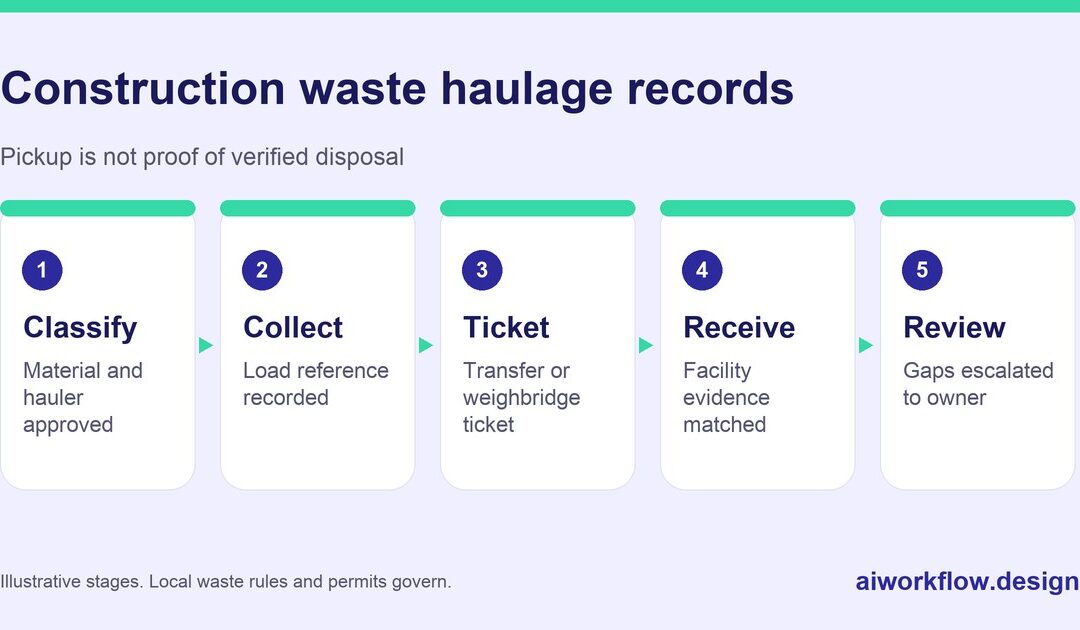
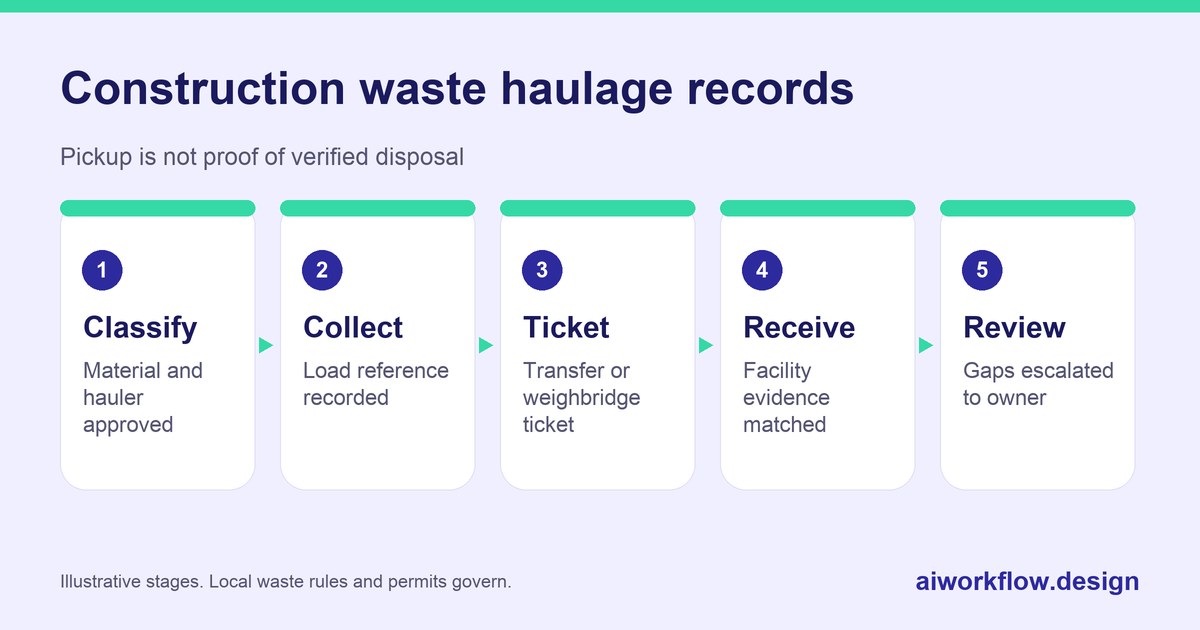
Quick answer: A construction waste haulage records workflow connects each waste movement to the originating site, approved hauler, material category, collection date, load reference, weighbridge or transfer ticket and receiving facility. It flags missing or inconsistent documentation for a responsible reviewer. A driver’s “collected” message does not establish that a load reached an authorised destination, and a general-purpose automation must not determine whether a material is hazardous or whether disposal was legally compliant.
A demolition skip disappears from a project on Tuesday. The site supervisor marks the task complete because the access road is clear. Two weeks later, the commercial team requests waste diversion evidence, but the subcontractor’s collection note has no destination, the facility ticket uses a different vehicle registration and nobody knows whether the load was mixed with general waste. The operational problem is a broken evidence chain, not simply a late document.
Start with the waste stream, not the collection booking
Construction and demolition waste is not a single category. Concrete, brick, timber, metals, plasterboard, packaging and soil can follow different lawful handling routes. Potentially hazardous materials require specialist identification and controls, and local definitions, licences and record-keeping rules vary. Reduction, reuse, recycling and safe management are distinct routes, and that does not mean that every material can be placed into an ordinary recycling skip.
Before dispatch, the environmental or site-management owner should confirm which waste stream applies, whether testing or classification is needed, the nominated container, and who may approve the carrier and destination. Keep any hazardous-waste manifest or controlled document inside the organisation’s designated compliance system. A task board can point to the authoritative record without becoming the legal record itself.
Define the minimum evidence chain
One load should have an identifiable sequence: approved waste instruction, collection request, vehicle or container reference, collection confirmation, transfer or weighbridge ticket, receiving-facility acknowledgement and, when contractually or legally required, a recycling or disposal certificate. Different jurisdictions use different names for these records; the principle is to link the upstream instruction to the downstream receipt.
Use stable IDs rather than free-text phrases such as “skip 3.” Record project and zone, material stream, supplier or subcontractor, authorised hauler, destination, booking reference, planned pickup time, actual departure, weight or quantity with units, facility ticket ID and evidence URL. Keep observed quantity separate from invoiced quantity. A photograph of a loaded container can support the record, but does not replace the receiving facility’s document.
Build a collection-to-reconciliation workflow
Start with Request raised when a site owner identifies the need. In Stream and hauler checked, the appropriate human confirms the handling route and required licences or contract approvals. Collection scheduled means the hauler has agreed a slot, not that the waste is gone. When the vehicle departs, move to Collected—receipt pending, attach the collection note and record the departure time. The load moves to Facility evidence received only when the destination documentation can be matched. Reconciled requires review of material type, quantity, date, facility and contract expectations. Closed is a separate approval by the authorised project or environmental owner.
Create a visible Exception / hold state for missing tickets, quantity conflicts, unmatched vehicle IDs, an unexpected receiving facility or suspected mixing of incompatible waste streams. Do not automatically classify exceptions as minor. Route suspected environmental or safety incidents to the site’s established emergency and regulatory procedures immediately; a scheduled reminder is not an incident-response process.
Investigate discrepancies without rewriting the record
Suppose a collection note records one skip while the receiving ticket lists a weight that appears unusually high for that container. The correct next step is not to change the note to make it match the invoice. Ask the hauler for the corresponding ticket and vehicle movement reference, check whether multiple containers were consolidated, and have the appropriate person determine whether reconciliation is defensible. Keep the original documents and a dated explanation of any correction.
Likewise, a vendor might send a “100% recycled” summary without supporting evidence. Treat that percentage as a vendor claim until the contract owner has checked its basis and the material categories it covers. Do not publish project sustainability figures from unresolved tickets. Where a certification system or local law specifies a reporting method, use that method rather than inventing a diversion calculation.
Make the board useful to the site and finance teams
In monday.com, one item can represent one load or collection event. Suggested columns: Project, Waste Stream, Container/Load ID, Site Owner, Hauler, Planned Collection, Actual Departure, Receiving Facility, Ticket Reference, Weight with Unit, Evidence Link, Review Owner, Exception Reason, Reconciliation Status and Next Follow-Up. Restrict sensitive or regulated evidence in linked document storage if the board’s permissions are broader than the compliance file’s permissions.
Group items by site or reporting period but keep a single identifier across the site diary, hauler portal and finance records. Automation may create a reminder when a scheduled collection has no receiving ticket after the supplier’s agreed reporting period. It should not manufacture a default quantity, approve a waste classification, or close a nonconforming movement because no one answered a call.
Where AI status calls can help
A narrowly scoped check-in can ask the approved hauler contact: “Has collection reference CW-104 been completed?” “Is the receiving ticket available?” “Who will provide it, and when?” If the answer is “ticket unavailable” or “destination changed,” the call should log a neutral exception and assign follow-up to a human. Avoid collecting unrelated driver details or calling contacts without an approved communication basis.
AI Workflow Design’s product overview describes status-call tools that update monday.com workflows; Autoza and the Daily Check-in Agent may be considered for administrative follow-ups after permissions, escalation rules and data minimisation are agreed. A useful AI summary is a lead for verification, not evidence that an environmental requirement was met.
Connect disposal evidence to procurement and final reporting
Waste records also affect subcontractor payment disputes, sustainability reporting, and closeout packages. A hauler invoice should reconcile to contracted rates and supported movements; a site manager should not certify quantities from an invoice alone. For the related inbound process, see the construction material delivery discrepancy checklist. Inbound and outbound material records can share project IDs without being combined into a single approval.
At monthly review, examine unresolved receipts by age, recurrent mismatched destinations, loads missing material categories, vendor response patterns and time from collection to accepted evidence. These process measures expose documentation gaps; they do not independently certify diversion, legal compliance or vendor performance.
A closeout checklist the reviewer can actually sign
Before closing a batch, confirm that each recorded collection has a source instruction, movement record, required destination evidence and a documented disposition for discrepancies. Check whether the reported waste totals are calculated from comparable units and whether any excluded or hazardous streams are disclosed appropriately. Confirm who approved the monthly figures and where the final files are retained. If a ticket is genuinely unobtainable, record the unresolved limitation and follow the contract or statutory escalation route; never replace it with fabricated data.
The objective is not to make the board completely green. It is to provide a defensible chain of custody for routine material movements, visible exceptions and an accountable approval record.
Next step
Want these follow-ups handled consistently? Explore Autoza AI for monday.com or talk to AI Workflow Design about scheduled, permissioned status follow-ups that leave approvals and decisions with the right people. For a companion workflow, read Concrete Test Report Follow-Ups: Track Lab Results Before Engineer Review. More guides: browse our construction workflow guides or see all industries we support.
Frequently asked questions
What should a construction waste tracking log include?
It should identify the project, waste stream, container or load reference, approved hauler, collection date, receiving facility, quantity and unit, ticket or certificate reference, evidence location, reviewer and exception status. Local rules may require additional regulated records.
Is a collection receipt enough to prove recycling?
No. It demonstrates a collection event, not necessarily where the material went or what processing occurred. Review facility documentation and any contractually required diversion evidence before making a recycling claim.
Can an AI agent approve a waste-disposal ticket?
No. AI can request a missing administrative update, record a reference number or alert a reviewer. Waste classification, destination suitability, regulatory compliance and final sign-off remain with qualified and authorised people.
How do you handle a missing weighbridge ticket?
Keep the load in an exception state, preserve collection evidence, ask the hauler for the linked destination document and escalate under the agreed reporting or legal process. Do not invent weight or infer disposal from silence.
How often should construction waste records be reconciled?
Align the cadence with site volume, contractual reporting, regulatory requirements and invoice cycles. High-volume operations may need daily checks; a monthly summary should not be the first time missing destination receipts are discovered.