
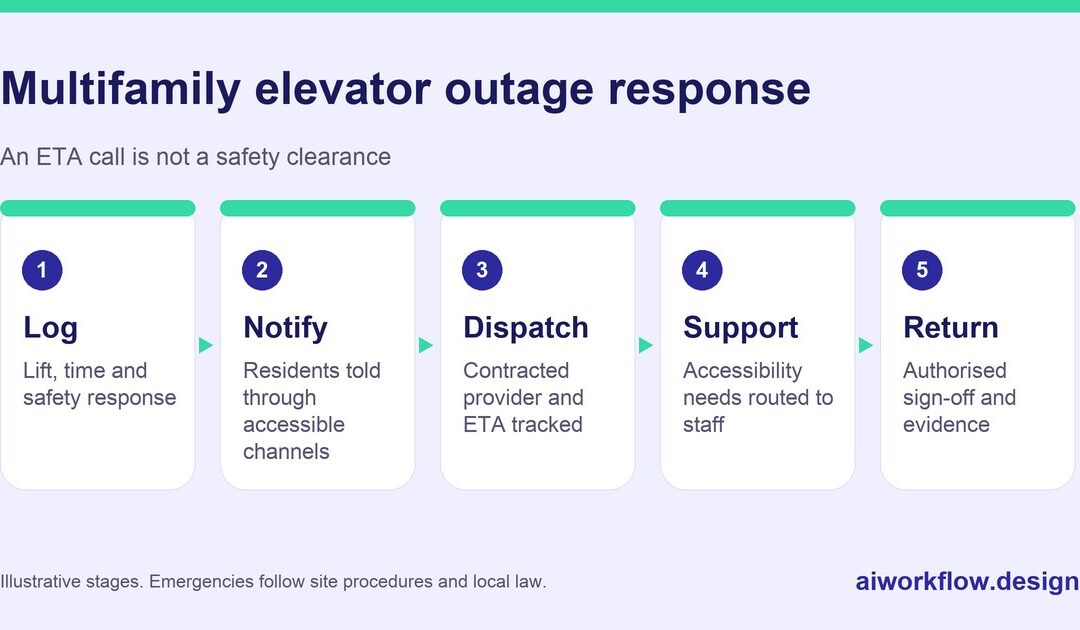
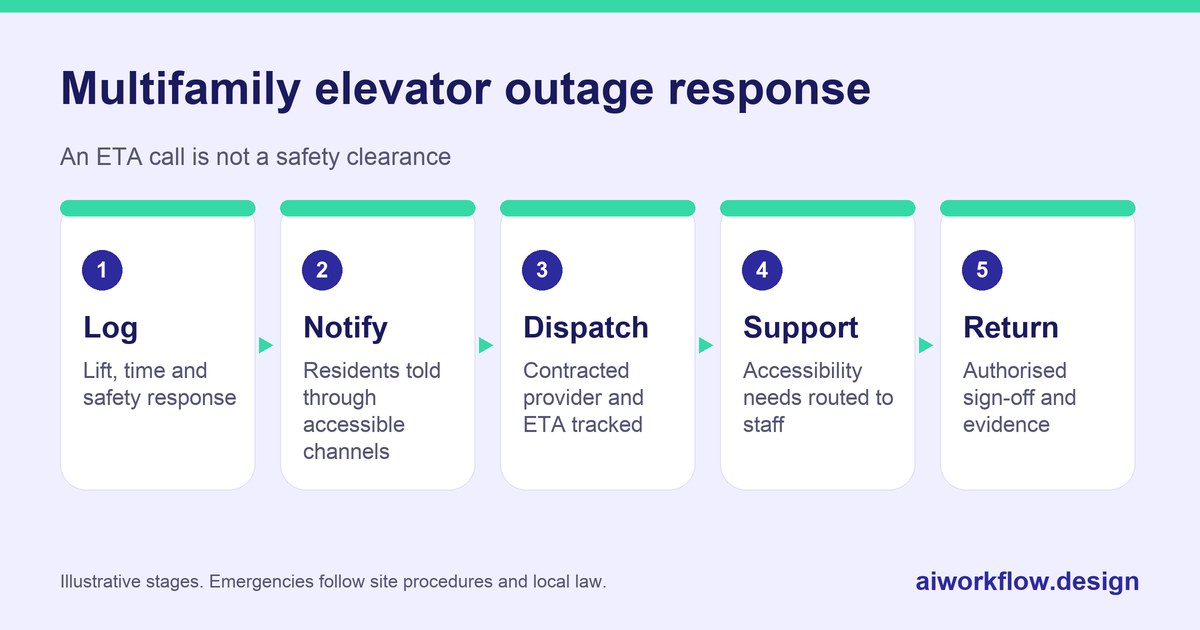
Quick answer: A multifamily elevator outage workflow should log the affected lift, time reported, immediate safety response, contracted service provider, accessibility implications, resident communications, repair evidence and authorised return-to-service decision. Separate an emergency or entrapment from routine service scheduling. An AI status call can chase a technician’s ETA, but it cannot give rescue instructions, certify an elevator as safe or decide a resident’s accommodation needs.
For residents on an upper floor, an elevator that stops working can affect far more than convenience. It may limit their ability to reach work, appointments, deliveries or essential services. For the property team, a vague ticket marked “contractor notified” does not explain when the lift failed, which car is unavailable, whether people were trapped, which residents need urgent assistance or what evidence is required before service resumes.
Start with emergency escalation and equipment identification
The first decision is whether anyone may be trapped or otherwise at immediate risk. Use the building’s emergency protocol and appropriate emergency services or elevator emergency provider—not a general-purpose AI calling workflow. A concierge, manager or resident should not be given improvised rescue instructions or told to enter the shaft or machinery area. Follow the applicable building and elevator safety procedures.
For a non-emergency outage, identify the property, building, elevator number, floors served, time of first report and visible error or symptom reported by qualified staff. Avoid asking residents to diagnose machinery. If another lift is operating, check whether it truly offers an accessible route for all affected floors, rather than assuming “one elevator still works” resolves the issue.
Prompt notice and the needs of residents with disabilities both matter. Rules and duties differ by jurisdiction, ownership type and building; seek appropriate local legal and accessibility guidance.
Use a clear incident owner and a separate technical owner
A building manager normally owns communications and coordination. The qualified elevator contractor owns diagnosis and the technical work. The owner or an authorised compliance professional may have responsibilities under inspections, maintenance contracts and local rules. Housing and resident-services teams coordinate accessibility assistance where appropriate.
Create two parallel tracks. Technical work covers fault assessment, required parts, repair, testing, any relevant inspection and return-to-service authority. Resident impact covers affected floors, communication channels, accessibility concerns, contingency support and follow-up. The tracks share an outage ID and timestamps, but neither can close the other automatically. A contractor’s arrival does not mean the lift is operational; a resident notice does not mean the repair was completed.
Notify residents with accurate, accessible information
A useful first notice states which lift is affected, when management became aware, the approved contact route for urgent assistance, steps residents should avoid and when the next verified update will be issued. State the expected restoration time only when the service provider has given a reliable estimate; identify it as an estimate, not a guarantee. If there is no ETA, say so and provide a specific next communication checkpoint.
Use more than one channel when the property requires it—posted signs, resident portal, email, SMS or direct contact—while respecting accessible communication preferences and privacy. Accessibility features generally must be kept in working order, with limited exceptions for isolated or temporary interruptions. Building teams should not interpret those obligations without considering the actual facts and applicable law.
Handle accessibility requests privately and individually
An elevator outage may create very different barriers for different residents. Do not ask everyone to publicly disclose disability or medical details in a group message. Provide a private contact route for people who need assistance or an accommodation review, restrict access to that information and involve the designated housing or accessibility staff. The response might require changes to normal procedures, practical assistance or other measures assessed case by case.
Do not automatically offer a specific accommodation or assume that a resident can safely use stairs. Equally, do not turn a request into a broad profile in a general maintenance board. Record only the operational status necessary for coordination, such as “resident-services owner contacted—private case open,” with a secure pointer where authorised staff can access the relevant details.
Build a repair and communication timeline
Suggested stages are Outage reported → Immediate risk assessed → Contractor contacted → Attendance confirmed → Fault assessed → Repair or part pending → Technical checks pending → Authorised return to service → Resident closure update → Post-event review. Maintain an explicit emergency escalation route outside this ordinary sequence. An unresolved accommodation request or safety restriction may keep a linked task open after the elevator is technically back in service.
Record the contractor’s estimated attendance and actual arrival separately. The same applies to provisional restoration estimates and actual reinstatement. A vendor update of “part on order” should include the part or repair reference and next confirmation time; it does not mean work is scheduled or an authority has approved operation.
A useful reference for routine inspection preparation is Elevator Inspection Preparation: A Task-Owner Calling Checklist. It addresses a related but distinct process; an unexpected outage requires immediate resident-impact handling rather than only a planned inspection calendar.
Design a monday.com board that avoids false closure
Create one outage item with fields for Property, Building, Elevator ID, Reported At, Safety/Emergency Escalation Triggered, Affected Floors, Property Manager, Service Vendor, Vendor Job ID, Attendance ETA, Actual Arrival, Current Technical Status, Repair Dependency, Next Resident Update, Communication Channels, Resident Services Owner, Technical Release Evidence, Reinstatement Time and Final Review Owner.
Use subitems for vendor attendance, parts, inspection obligations, communication updates and building accessibility measures. Link the vendor’s official service report in controlled document storage. Hide private resident accommodations from a shared facilities board; a general-purpose project tool is not a suitable medical or housing-case repository. A visible status such as “Awaiting technical clearance” is preferable to an ambiguous green “completed.”
Where automated check-ins are appropriate
An AI status call may ask a maintenance coordinator whether the elevator contractor has confirmed attendance, whether the updated ETA was provided or when the next resident notice is due. It can create a reminder for a missing vendor service report. It must not provide rescue advice, interpret error codes, approve restart, tell residents they are safe to ride, or collect detailed health information over an unapproved call.
AI Workflow Design’s product catalogue includes monday.com-connected status calls and an AI receptionist with property-management applications. An implementation needs approved contact lists, escalation routes, recording and privacy controls, and rules that route urgent language to a human or emergency protocol immediately. No-answer is a communication state, not a reason to assume the building is unaffected.
Verify restoration and close the communication loop
Only the qualified, authorised process can establish that the elevator is fit to return to service. Obtain the relevant contractor documentation, inspection or authority evidence where required, actual reinstatement time, and any remaining limitations. Check that access routes, signs and resident notifications have been updated to reflect the verified status.
If the vendor reports “repaired” but the property manager receives continuing fault reports, reopen the technical record under the same outage history rather than deleting the original incident. Preserve previous notices and timelines. Review the communication cadence, accessibility handling, response delays and completeness of the vendor report. These are operational lessons; they are not proof that the equipment complied with every code requirement.
Next step
Want these follow-ups handled consistently? Explore Autoza AI for monday.com or talk to AI Workflow Design about scheduled, permissioned status follow-ups that leave approvals and decisions with the right people. For a companion workflow, read Property Vendor Invoice Disputes: Match Work Orders, Evidence and Approvals. More guides: browse our property management workflow guides or the property management automation page.
Frequently asked questions
What should an elevator outage log include?
Record the building and lift ID, reported time, immediate risk response, service contractor, job reference, attendance and repair updates, resident notice timestamps, accessibility escalation, technical evidence and authorised return-to-service time.
Should residents be told an estimated elevator repair time?
Share an estimate only when sourced to the responsible service provider and explain that it may change. When there is no reliable ETA, give the next planned update and a route for urgent support instead of inventing a restoration time.
What if a resident cannot use stairs during an outage?
Provide a private, accessible way to request help and route the case to the authorised resident-services or accommodation team. The response depends on individual circumstances and applicable housing obligations; do not make assumptions about disability.
Can AI confirm an elevator is safe to use?
No. Technical diagnosis, inspections and return-to-service authorisation belong to qualified contractors and applicable authorities. AI may coordinate administrative updates or reminders within an approved process.
Is a completed contractor work order enough to close the outage?
Not by itself. Verify the required technical release, actual operation, updated building notices and resolution of linked resident-support tasks. Preserve the audit trail if the problem recurs.