
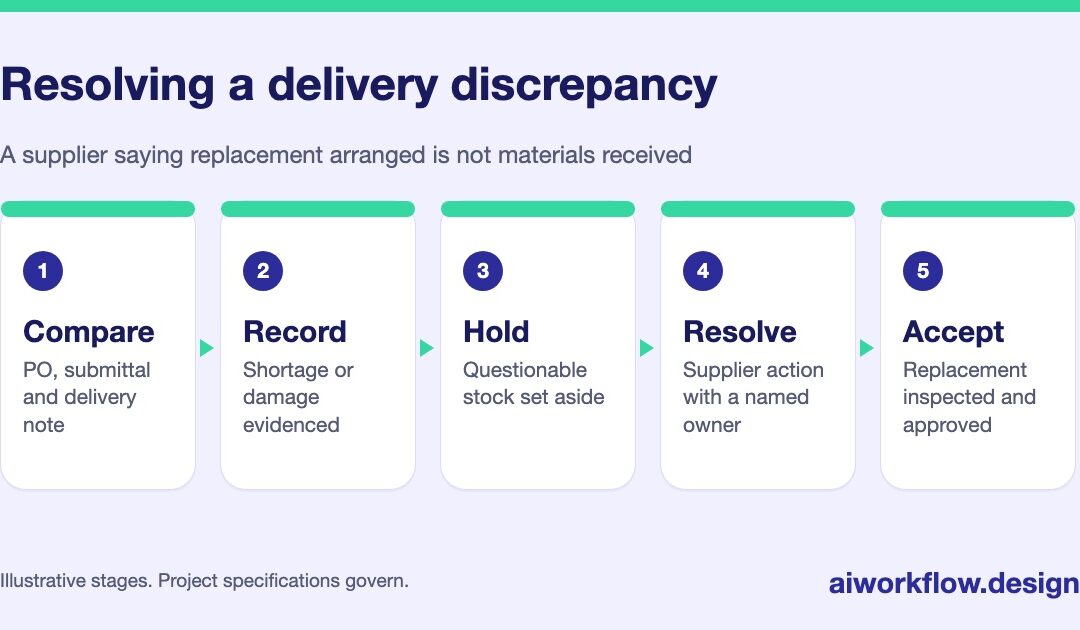
Quick answer: A construction material delivery discrepancy workflow compares the purchase order, approved submittal, delivery note and physically received goods; records shortages, visible damage or specification mismatches; protects questionable stock from use; and assigns a named person to obtain an approved resolution. A supplier saying “replacement arranged” is a useful update, not evidence that the right materials have arrived or passed inspection.
A delivery truck reaches the site before the concrete crew starts. The paperwork says the scheduled quantity is present, yet the storekeeper counts fewer units. Another pallet has torn wrapping. The driver needs to leave, the foreman needs materials, and purchasing wants a quick answer. If everyone writes a separate message, the discrepancy becomes a dispute about what was delivered rather than a fixable operational issue. The cure is not another reminder; it is one record that joins the shipment, affected work package and decision owner.

Begin with four records, not the driver’s verbal assurance
Material receipt is easier to reconcile when the receiving team has access to the order, the latest approved specification or submittal, packing information, and a contemporaneous physical inspection. Those are different sources. A packing slip records the supplier’s claim; a receiving record records what the site found. Neither by itself establishes that a substituted product is acceptable.
Check the purchase order number, line item, product identifier, revision, units of measure, delivery location and planned activity. A short shipment can look like a complete shipment when the purchase order uses boxes but the site counts individual units. Similarly, a dimension change that looks minor on a label may make a product incompatible with approved drawings. Keep the description precise enough that a buyer can follow it without calling five people.
Set a receiving status for each disputed line: quantity short, physically damaged, wrong item or specification, missing documentation, or delivery unverified. Do not combine these into a single “problem” label. The resolution, evidence and accountable reviewer may differ considerably.
Separate goods receipt from technical acceptance
Receiving staff can count, photograph and note visible condition. A site engineer, quality representative or designated inspector may have to determine whether materials meet approved specifications, depending on the contract and trade. The purchaser may negotiate a credit or replacement. The project manager may have to change a sequence. These actions should not be collapsed into one checkbox marked “accepted.”
For visibly damaged material, use the project’s agreed hold, segregation and storage procedure. If the material poses a lifting, stability or handling risk, involve competent site safety personnel rather than asking a routine workflow to decide whether it can be moved or installed. OSHA’s construction material-storage rules are a relevant reference for US sites, but the project’s actual arrangements and local requirements control the work.
Where a substitution is proposed, route it through the applicable design and contractual approval process before the material is installed. For the related document-review step, see construction submittal approval tracking. A supplier’s claim of equivalence does not replace the architect’s, engineer’s or other authorised review.
Build a discrepancy record that can survive a shift change
Give every issue a unique ID associated with its work package and purchase order line. Record the scheduled and actual delivery dates, ordered quantity, counted quantity, location, affected installation date, driver or carrier details where permitted, photos, delivery-note annotations and the name of the receiving witness. Add links to the approved product data and any inspection result. Avoid duplicating sensitive supplier contracts in general-purpose call transcripts.
Record the estimated operational impact separately from commercial liability. A delayed ceiling installation may affect sequencing, but the receiving clerk should not calculate a contractual claim or agree who must pay. Mark the impact as “requires planning review” and route it to the project lead. If several work packages depend on the same material, relate each dependency to the one authoritative discrepancy record; otherwise two teams may separately order replacements.
A useful status sequence is recorded → receiving verified → supplier response requested → resolution proposed → authorised review → replacement or credit pending → physical verification → closed. Include a separate blocked or rejected route. Once an issue is rejected, the record should state the reason and who must act next, not quietly reset its status to open.
Contact the supplier with an actionable request
A vague email asking “Any update?” produces vague replies. Tell the supplier the exact purchase order line, the observed discrepancy, the proof already shared, and the response needed. For a shortage, request a confirmed balance quantity and dispatch reference. For damage, request an agreed return or replacement route. For a wrong specification, request corrected material information for authorised review. Ask for expected dispatch and arrival dates, clearly labelled as estimates until independently verified.
Do not accept a new arrival date without checking the unloading slot, site access conditions, receiving cover and downstream trade dependencies. If a material must arrive before a scheduled inspection or concealed work, the planning owner should assess the change. A clear record prevents a supplier’s optimistic dispatch date becoming an unreviewed site promise.
Use a short escalation path: unanswered request to supplier representative; overdue commitment to purchasing lead; work-package impact to project manager; technical uncertainty to designated reviewer. Escalation should be driven by the work’s criticality, not merely how long the issue has sat on the board.
Set up a monday.com receiving-discrepancy board
Create one board item per disputed order line. Practical fields are: project, purchase order, item and approved revision, discrepancy type, quantity short or affected, receiving owner, supplier contact, technical reviewer, safety hold, original promised delivery, revised estimate, next follow-up, linked evidence, work-package impact and resolution decision. Configure date and status reminders for named owners. monday.com supports notifications based on dates and status changes, but the approval logic must be designed by the organisation.
Store photographs, signed notes and final supplier acknowledgements in approved document systems and link the authoritative record to the board. Use a clear distinction between supplier has replied and goods verified. The first should never automatically trigger the second. Likewise, the workflow must not change a commercial purchase order or waive a defect without a decision from the person authorised to do so.
For teams already using scheduled status calls, AI Workflow Design’s product options describe Autoza AI for monday.com and the Daily Check-in Agent. A narrow use would be to ask the buyer whether the supplier’s revised dispatch date has been received, then write the administrative status to the board. Actual integrations, permissions, call consent and escalation behaviour need to be configured and tested; a voice agent should not approve damaged material.
Resolve the discrepancy and protect the audit trail
Close a shortage only when the agreed quantity has been physically received and checked or an authorised commercial adjustment has been documented. Close damage only when disposition, return, replacement or approved acceptance has been recorded. Close a wrong-product issue only once the technical acceptance or rejection and associated order action are complete. The same person can collect information, but the applicable contract determines who accepts each outcome.
Retain the original delivery note, receiving remarks, inspection or test records, supplier response and evidence of completion together. Do not overwrite earlier dates when a replacement is late; a timeline is useful precisely because it shows the difference between the first commitment and the final delivery. Where a defect could affect installed work, escalate to the project’s formal nonconformance process rather than treating it as a routine delivery delay.
A weekly review should ask: Which missing materials are blocking planned work? Which suppliers repeatedly miss corrected dates? Which discrepancies are waiting for engineering rather than purchasing? And which items show “resolved” without receiving evidence? These questions make the board useful for planning instead of a warehouse complaint log.
Receiving follow-ups are well suited to a scoped workflow automation project: notifications and administrative check-ins can become routine, while acceptance and commercial decisions remain with the project team.
Next step
Want these follow-ups handled consistently? Explore Autoza AI for monday.com or talk to AI Workflow Design about scheduled, permissioned status follow-ups that leave approvals and decisions with the right people. For a companion workflow, read Building Permit Expiry: A Renewal and Inspection Follow-Up Checklist.
Frequently asked questions
What should a construction material discrepancy report include?
The purchase order and line number, approved material description, expected and observed quantities or condition, delivery date, site location, photographic or inspection evidence, affected work, and named owners for the next action. Include an explicit acceptance or hold status.
Can a supplier’s replacement promise close a shortage?
No. Record the promise and revised estimate, but keep the shortage open until the corrected quantity is received and verified or another authorised resolution is documented.
Who can accept a substitute construction material?
The authorised technical and contractual reviewers defined by the project documents. Receiving staff and an automated check-in tool can collect evidence but should not grant equivalence or design approval.
How can monday.com prevent two teams ordering the same replacement?
Link the affected work packages to one discrepancy item with one purchasing owner, a single supplier commitment and visible decision history. Require authorised approval before an additional purchase order is issued.
Should AI calls handle disputed delivery quantities?
They can request routine status from an authorised supplier or purchaser when permitted, but quantity disputes, liability, contract amendments and material acceptance require human review of primary evidence.
Related reading
- Building Permit Expiry: A Renewal and Inspection Follow-Up Checklist
- Construction Submittal Approvals: A Follow-Up Matrix for Shop Drawings and Product Data
- Construction Daily Progress Updates: A Better Way to Hear From Field Crews
- Construction Closeout Packages: Following Up on O&M Manuals and As-Built Drawings