
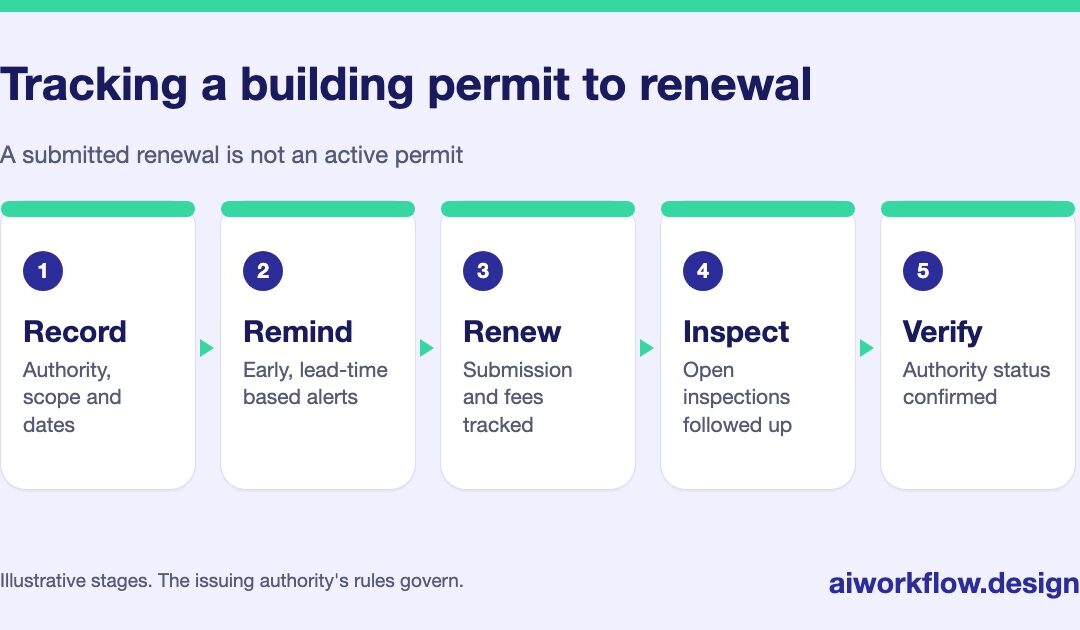
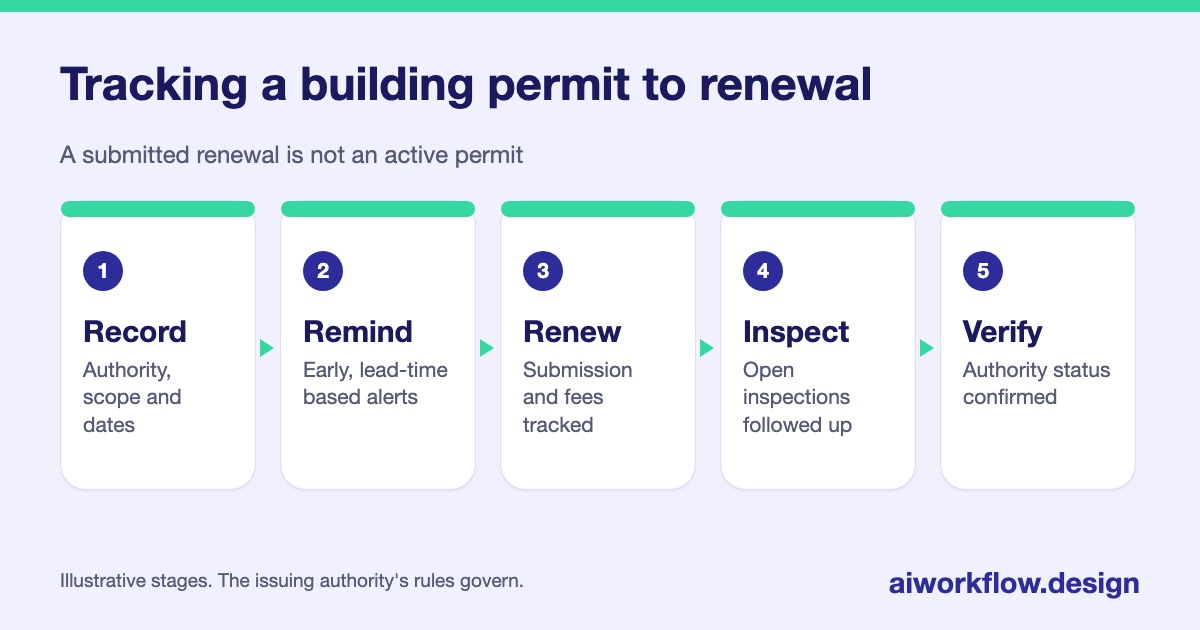
Quick answer: A building permit expiry tracker should record each permit’s issuing authority, work scope, issue and expiry dates, local renewal rules, open inspection requirements, named applicant and verified authority status. It should warn the project team early enough to renew or resolve restrictions. An internal reminder, renewal submission or booked inspection does not by itself mean the permit remains valid or that work may continue.
A contractor can have a fully staffed site and an agreed construction programme yet still face a preventable stoppage because the permit record is stale. The permit number is buried in a file, the inspection is waiting for an outside agency, and the person who submitted the original application has left the project. Someone remembers that permits generally last “about six months.” That assumption is dangerous. Permits differ by jurisdiction, scope, extensions, conditions and activity history.
This checklist focuses on the administrative handoffs that managers can control: identifying the relevant approvals, checking their status with the issuing authority, arranging timely submissions and making sure supervisors receive accurate instructions.
Inventory every authorisation affecting the work
Start with the approved permit documents, not a spreadsheet inherited from the estimating phase. List the issuing body, permit number, permit type, property or project address, authorised scope, named applicant, issue date, expiration conditions, extension or re-establishment process and any associated conditions. Keep trade permits, temporary works permits and right-of-way or street-use approvals distinguishable where the authority handles them separately.
Some approval periods depend on when work starts or stops, whether inspections have been recorded, or the type of activity involved. Some authorities allow renewal before expiry; others distinguish renewal from re-establishing an expired permit. Seattle’s permitting guidance, for example, describes renewal and re-establishment as separate processes. Treat that as a jurisdiction-specific illustration, not a national rule.
If the relevant dates are not visible or the language is unclear, ask the authority or permit professional to confirm. The tracker should include a field marked date verified with authority rather than presenting an estimate as a fixed legal deadline.
Link the permit to actual work and inspection milestones
A permit record becomes valuable when tied to the schedule. Map each permit to the subcontractor or site manager who relies on it, the work activities that cannot proceed without it, and the inspections or supporting certificates required before the next stage. A structural inspection, for example, may be a prerequisite for concealment; a utility approval may be necessary before energisation. These are separate conditions from whether the underlying building permit has expired.
Track inspection requests, appointment confirmations, failed or deferred results, corrective work, and final records. A booking is not a passed inspection. If work was corrected, retain the reference to the authority’s or designated inspector’s formal outcome, rather than replacing the original deficiency with “done.”
For a related field-communication problem, see construction daily progress updates. Site status reporting tells managers what crews did; it does not certify that the regulatory authority has permitted the next activity.
Design reminder dates around lead time, not arbitrary intervals
Ask the permitting specialist how long extension paperwork normally takes, what supporting documents are needed, and whether an earlier submission is required. Build reminders backwards from the verified deadline. Include preparation milestones for updated drawings, fee authorisation, contractor or licence records, inspections and owner signatures where applicable. Different permits may need different lead times.
The useful alert is not just “permit expires soon.” It should read: Permit renewal package incomplete; applicant signature outstanding; activity affected; person responsible; confirmed deadline. That gives the manager a decision to make. A reminder sent to a departed employee is worse than none because it creates false confidence that the issue has been handled.
Classify risk by the consequences of loss of authorisation. A permit supporting active structural work may need escalation before a permit associated with a phase not due for months. The project manager and qualified permitting staff should make those decisions based on law and the approved construction sequence.
Keep a proper distinction between submission, approval and authority status
Use a deliberate lifecycle: not verified → valid and monitored → renewal in preparation → renewal submitted → authority response pending → renewed and verified. Also include expired or restricted, not applicable to current scope, and closed. The board should never assume that “submitted” equals “approved.”
When the authority requests information, capture the exact request reference, response owner, deadline and supporting document. If an inspection must be repeated, record the result and required next action. If the permit expires while the application remains under review, do not infer a grace period. Refer the question to the appropriate local authority or permitting professional and instruct site leadership on the verified status.
New York City’s building department, for example, documents specialised renewal and inspection processes in its DOB NOW guidance. Its approach may not apply in another municipality. Do not copy a city’s workflow or inspection exception into an unrelated project simply because both use the word “permit.”
Set up a monday.com permit-control register
Give each distinct authorisation an item. Suggested columns are permit number; authority; approved scope; address; applicant; work-package owner; verified expiry basis; verified expiry date; inspection dependencies; submission status; document link; external reference number; current restrictions; next action; escalation owner; and last authority confirmation. Tie these items to the programme without putting every inspection note into the same status field.
Use monday.com’s date-based reminder automations to contact the item owner before a verified deadline, and status changes to tell the project manager when a hold has been raised. Build a second escalation if nobody confirms the required evidence. Boards should store links to authoritative permits, inspection portals and correspondence rather than relying on pasted snippets that become outdated.
Create a restricted field for work-authorisation status. Only the person designated by the project should update it after verifying the relevant authority’s records. A site superintendent may need an immediate phone call if the status changes, but a bot should not independently change a stop-work instruction.
Use check-in calls for paperwork progress, never legal conclusions
An administrative call can ask: “Has the permit extension request been submitted?” “Was the confirmation number received?” “Which document is still missing?” “Who is checking the authority portal today?” The answer may be stored as a pending or verified task update, with the source named. A reply such as “the city said it should be fine” belongs in a needs verification state until the accountable person checks the official record.
AI Workflow Design’s Daily Check-in Agent is described as collecting structured status updates from teams into work systems. A permit follow-up is a potential administrative application, provided the call script, authorised contacts, recording or consent arrangements and data access are properly configured. It should never calculate jurisdictional rights to work or override a supervisor’s safety and compliance instruction.
Run a weekly review and a separate pre-expiry escalation
During the weekly coordination meeting, review every active permit due to lapse within the project’s required planning horizon. Confirm whether renewal is needed, who will submit, which inspections are unfinished, whether contracts or insurance need updating, and which trade is at risk if the authority does not respond. Move genuine blockers into the programme’s risk register.
Immediately before a critical deadline, use a separate escalation to the permit lead and project manager. Confirm the authoritative record, not a statement relayed by a colleague. Where activity may be restricted, communicate the verified decision to the affected foremen in language they can act on. Keep a time-stamped copy of the instruction and its acknowledgement under site procedures.
After closeout, archive the final inspection and permit records according to contractual and legal retention obligations. Closed permits may still matter for certificates of occupancy, warranties and later disputes. The aim is a defensible history of what was authorised, when and by whom.
AI Workflow Design’s workflow services can be evaluated for reminders and evidence handoffs, but the permit decision belongs to the authority and the authorised project professionals.
Next step
Want these follow-ups handled consistently? Explore Autoza AI for monday.com or talk to AI Workflow Design about scheduled, permissioned status follow-ups that leave approvals and decisions with the right people. For a companion workflow, read Construction Material Delivery Discrepancies: Track Shortages, Damage and Supplier Replacements.
Frequently asked questions
Do building permits expire after the same period everywhere?
No. Duration, renewal rules and conditions depend on the jurisdiction and permit type. Check the actual issued permit and current authority guidance rather than applying one city’s date to every project.
Does a submitted renewal allow construction to continue?
Not necessarily. The authority’s applicable rules and confirmed permit status control whether work may proceed. A submitted form is not proof of renewed authorisation.
How should inspection failures affect a permit tracker?
Record the failed or deferred inspection separately, assign correction and reinspection owners, and preserve the official outcome. Do not overwrite it with a task marked complete until the required authorisation has been verified.
What is the most important monday.com field for permit tracking?
The verified authority status, alongside its source and verification date. Deadline reminders are helpful, but they cannot replace proof that the permit is active and covers the work.
Can an AI check-in agent tell the site to restart after expiry?
No. It may collect factual updates and alert responsible staff; only authorised humans applying the issuing authority’s rules should communicate permission or restrictions on work.
Related reading
- Construction Material Delivery Discrepancies: Track Shortages, Damage and Supplier Replacements
- Construction Daily Progress Updates: A Better Way to Hear From Field Crews
- Construction Submittal Approvals: A Follow-Up Matrix for Shop Drawings and Product Data
- Construction Closeout Packages: Following Up on O&M Manuals and As-Built Drawings