
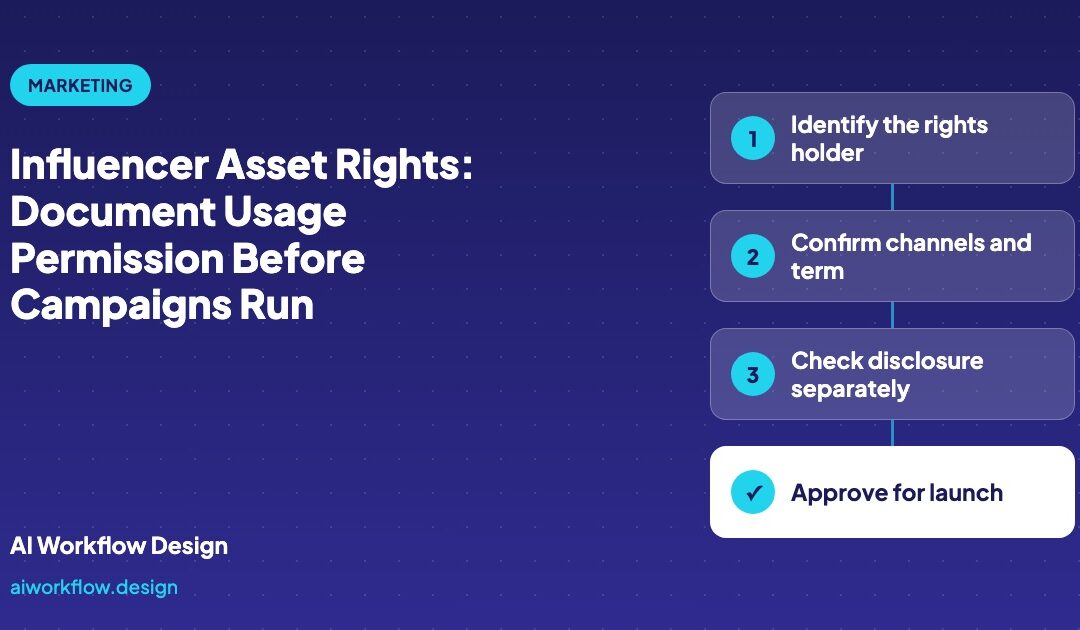
Quick answer: An influencer content usage rights checklist should identify the exact asset, its rights holder, permitted channels, paid-media rights, duration, territory, editing permissions and the approval record before a brand publishes or boosts the content. A creator’s delivery of a video does not automatically give an agency unlimited reuse rights. Usage permission and advertising-disclosure compliance are separate checks.

The asset can arrive on time and still be unusable
A creator sends a polished video, an agency designer crops it into three formats, and paid social is due to launch in the morning. Everyone sees the file. Nobody can find the signed permission for paid advertising or the period during which the brand may run it. The schedule is “green” but the legal and commercial handoff is not.
That is why creative delivery and rights clearance should be different milestones. A creator can have completed their production work while the brand is still waiting for permission to use the work in a specific way. The U.S. Copyright Office’s permission guidance explains how to identify the rights owner and specify the requested use. The UK government’s copyright overview likewise explains licensing and ownership. Actual rights depend on the governing contract and law.
If a campaign is intended to use the creator’s words or likeness in an advertisement, the agency should check the relevant appearance, endorsement and publicity rights separately. Do not presume that a broad “content approved” comment covers every channel or adaptation.
Build a rights record for each asset and channel
One creator agreement may cover many assets, but a rights register should still connect permission to the specific deliverable. A useful register is not a legal contract; it is an operational index that helps a reviewer locate the controlling agreement and any later amendments.
| Rights field | What the team records | Risk when missing |
|---|---|---|
| Creator and rights holder | Contracting party and actual owner where different | Permission from the wrong person |
| Asset ID and version | Specific video, photo, voiceover or edit | Using an unapproved cut |
| Channels and formats | Organic social, website, email, paid ads and derivatives | Assuming organic permission covers paid media |
| Territory and term | Countries and start/end dates | Continuing use after licence expiry |
| Paid amplification | Whitelisting, boosting, creator-handle access if permitted | Unauthorised ad placement |
| Edits and adaptations | Captions, cropping, voice edits and translations | Changing content outside the licence |
| Approval proof | Signed agreement or documented amendment | No reliable source for the launch decision |
| Disclosure obligations | Assigned owner, required language and placement | Misleading endorsement presentation |
Store the signed agreement in the approved legal repository and link to it from project tasks using restricted access. A campaign board should show an evidence reference, not expose a creator’s confidential contract to every contractor.
Permission and disclosure are not the same approval
The FTC’s Disclosures 101 guide addresses clear disclosure of a material relationship between a creator and a brand. It does not grant a brand copyright permission to reuse the creator’s content. Conversely, a broad content licence does not remove obligations to make appropriate advertising disclosures or substantiate claims.
Use two separate checks: first, may the brand use this asset in this manner? Second, does this placement present the relationship and claims appropriately? Depending on the market, additional advertising, privacy, data and consumer-protection rules may apply. Legal or specialist approval should be part of the workflow where required.
For translated edits, check whether the permission includes adaptations and whether local disclosure text needs separate review. Avoid building an automatic rule that treats “licensed in one country” as “licensed everywhere.”
A realistic pre-launch handoff
At briefing: The account lead specifies which rights the brand expects to acquire, including paid media and future cutdowns. The creator or representative confirms who can grant them. If the brief changes later, the team checks whether the contract must change too.
At content receipt: The production coordinator records the asset ID, version and deliverable completeness. A download link alone is not proof of commercial usage rights.
At legal review: The authorised reviewer checks term, territory, channels, exclusivity and modification permissions. Open questions become named blockers, not informal “fine to use” comments.
At campaign QA: The media buyer checks the actual placements, duration and ad account or creator-handle settings against the approved permission. The account lead separately checks disclosures, claims and brand approval.
After launch: The agency monitors rights expiry, ad variations and creator-requested changes. An ad that was approved for a limited period should not quietly continue running when that period ends.
Where scheduled follow-up calls help
Creator campaigns often involve people who do not use the agency’s project board every day. A short scheduled call can identify whether an amendment is pending, who is reviewing it or when the final signed document will be available. It can also help internal teams confirm that the approved file version has arrived.
For teams using monday.com, a proposed workflow is to record a “Rights evidence received?” task, permitted progress status and a follow-up date. AI Workflow Design’s products describe scheduled calls and updates for project teams. They should not be described as automatically verifying licences, legal validity or advertising compliance. Those are professional review decisions.
A suitable question is: “Has the signed paid-usage amendment been uploaded to the approved repository?” An unsuitable one is: “Do we own the video now?” The second invites an unreliable legal conclusion from an operational call.
Escalate the exceptions that genuinely block publication
The most useful rights dashboard is an exception view: missing signatures, unclear edit rights, a term expiring before the planned end of the campaign, a creator who cannot grant third-party music rights, or a paid-ad variation that was never included in the original approval. Each exception needs a human owner and a resolution date.
Do not solve these problems by copying permission language from another creator’s agreement. A rights grant may be personal, channel-specific or conditional. Nor should teams assume the source audio is free to reuse because it appeared in a social platform library; music and third-party footage can be licensed separately and subject to platform restrictions.
A well-documented rights workflow gives creatives a clearer brief, media buyers a safer release process and clients an auditable record of what they actually purchased. It also reduces late-stage rework because permission is requested before expensive edits are produced.
Before briefing a creator, align the campaign workflow and budget with the available AI Workflow Design products and the company’s approach to integrations. The operational benefit is visibility into pending actions, not automated ownership of someone else’s intellectual property.
Frequently asked questions
Does payment for influencer content automatically transfer copyright?
No general rule should be assumed. Ownership and the rights to use or adapt an asset depend on the applicable law and written agreement. Obtain and retain explicit permission covering the planned uses.
Is permission for an organic post enough for paid advertising?
Not necessarily. Organic publication and paid amplification can carry different rights. Check the agreement for paid-media channels, account access, duration, territory and adaptations before launch.
What is the difference between creator usage rights and FTC disclosure?
Usage rights address permission to use creative material. FTC endorsement guidance addresses when and how a material brand relationship should be disclosed to audiences. One does not replace the other.
Can an AI check-in call clear an influencer asset for use?
It can collect status about whether a signed record exists or an approval is pending. It should not decide who owns the work, interpret the licence or waive a missing approval.
How should an agency track rights expiry?
Record an end date for each relevant permission, assign a renewal owner, review active placements before expiry and stop or amend any use that is no longer covered. Keep the controlling signed records accessible to the reviewers.
Next step: add a rights gate to every creator campaign
Start with your next creator campaign and require separate completion of delivery, usage permission, disclosure review and media QA. If staff and partners are slow to report what is outstanding, explore AI Workflow Design’s scheduled check-in options as a way to gather status—not as a replacement for legal approval.
Related reading
- Agency CRM Lead Routing Handoffs: Follow Up on Sales Acceptance
- Website Relaunch Content Freeze: Track Copy, Redirects and Sign-Off
- Multi-Market Campaign Assets: Tracking Translation and Local Approval
- Paid Media Launch QA: Who Confirms Tracking, Creative and Budget Controls?
- Content Production Handoffs: A Call Plan From Brief to Publish
- Explore workflows by industry
- Autoza AI for monday.com