
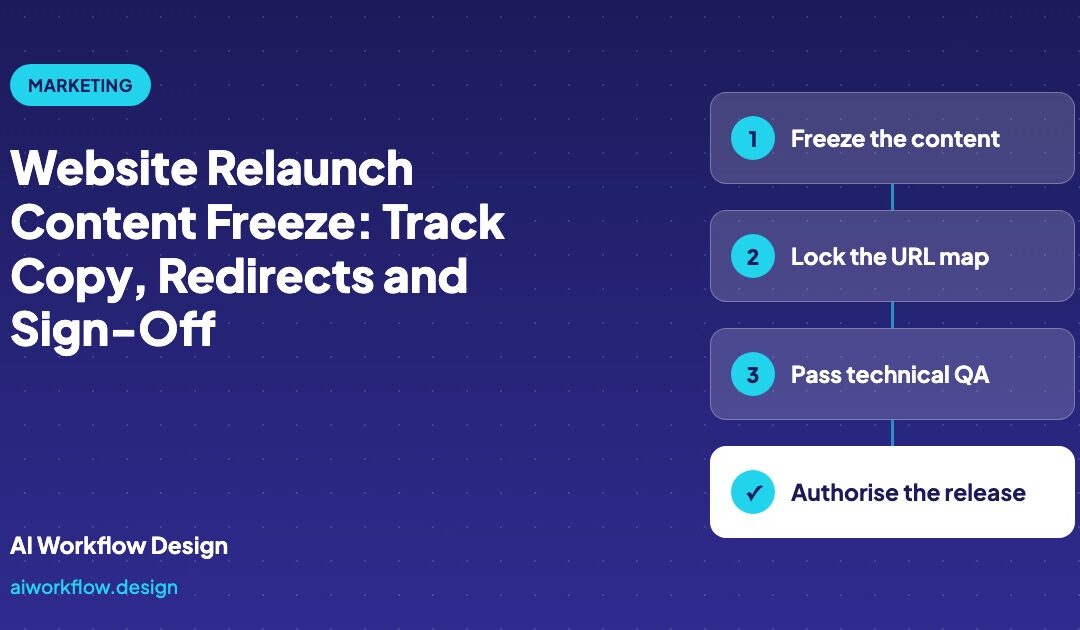
Quick answer: A website relaunch content freeze checklist should identify the approved copy and assets, their final owners, the locked URL map, the redirect plan, SEO controls, functional QA and the person authorised to approve launch. A freeze is a governed change window—not a promise that nothing can ever change. Scheduled check-ins can surface missing approvals, but publishing and redirect activation should remain under human release control.
Why a “finished” website is not necessarily launch-ready
A homepage can look perfect on staging while the migration still fails in search and conversion. An old service URL may redirect to a generic page, a quote form may post to the wrong endpoint, a mobile image may use unapproved wording, or a team member may edit the final hero after everyone signed off. The problem is not a lack of effort; it is that ownership of the last version is unclear.
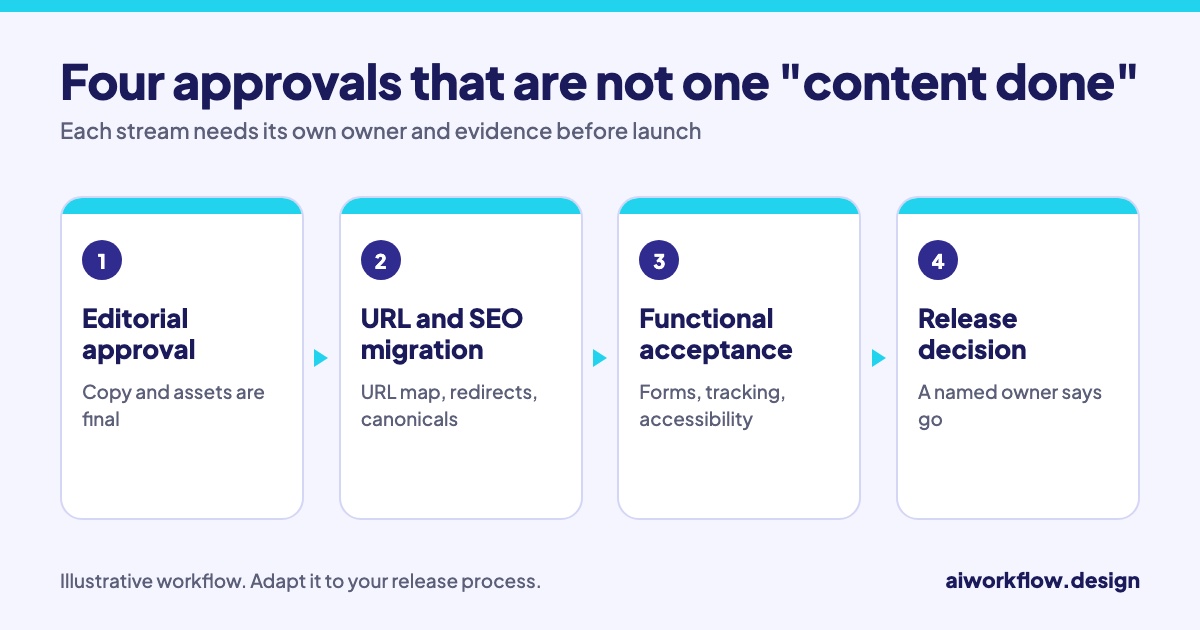
A successful relaunch separates four things that are often collapsed into “content done”: editorial approval, URL/SEO migration, functional acceptance and the release decision. These streams converge at launch but require different people and evidence.
Google’s site migration guidance recommends preparing a URL map, implementing appropriate permanent redirects and monitoring the new site. It also discusses updating canonicals, internal links and sitemaps. The specific migration plan should reflect whether the project changes domains, URL paths, CMS or only design.
Define what is frozen, where the source of truth lives and who can unfreeze it
The content lead should publish a controlled release candidate list. It needs the route, approved page title, final copy version, image/asset reference, SEO title, meta description, canonical destination, internal-link targets and approval status. Keep the source files in the team’s approved repository and link them to the release checklist.
Do not use a spreadsheet labelled “final” if editors can continue changing the CMS independently. Choose a clear source of truth: approved CMS revision, content repository commit or signed acceptance record. If late changes are unavoidable, use a documented exception request with a reason, owner, impact and new sign-off.
| Launch control | Required decision | Evidence |
|---|---|---|
| Copy and compliance | Is this the approved public wording? | Version and named approver |
| URL inventory | Which URL is retained, moved or removed? | Old-to-new mapping |
| Redirects | Does each important old URL resolve to the correct destination? | Tested 301/308 responses where appropriate |
| SEO tags | Are title, canonical, indexing and structured data correct? | Release QA record |
| Forms and tracking | Do leads route correctly without duplicate or missing events? | Test submission and analytics check |
| Accessibility and responsive QA | Can users read, navigate and submit forms on target devices? | Test log and owner |
| Go/no-go | Are critical blockers closed or accepted by authorised leads? | Release decision and rollback owner |
A content freeze is not an excuse to ignore critical defects
A practical freeze has phases. First, stop routine copy changes so the team can test a stable release candidate. Second, allow only documented critical fixes that receive the required checks. Third, establish a post-launch improvement backlog that does not interfere with launch assurance.
For instance, an unimportant change to button punctuation can wait. A broken lead form, a misleading legal claim or an incorrect redirect for a high-traffic page may justify a controlled exception. The site owner should weigh risk and approve the change, then retest all affected elements.
Keep a short change log showing who made the adjustment, what page was affected, which tests were repeated and whether the release date changed. This is more reliable than relying on messages in an informal group chat.
Build the redirect and internal-link audit before launch
Export the existing URL list and identify the destination for every important canonical page. Record status as Keep, Move, Merge or Retire, with a reason. A page that once ranked for a dedicated service should not simply be redirected to the homepage unless the new page is genuinely relevant. Google recommends mapping moved URLs to their corresponding destinations and using server-side permanent redirects where appropriate.
Check for redirect chains, loops, temporary redirects that should be permanent, staging hostnames in canonical tags, noindex settings carried into production and internal links still pointing to old URLs. Update navigation, key in-content links and XML sitemaps as part of the coordinated release. Redirects are important but do not excuse leaving outdated internal navigation in place.
For content-specific changes, check that the target page genuinely answers the same intent. If two old articles are consolidated, the new page should cover their useful information rather than dropping content without a plan.
Separate editorial, development and marketing acceptance
The content team approves meaning and accuracy. The developer approves the implementation and deployability of the build. SEO checks the URL plan, metadata, canonical tags, indexability and internal links. Marketing operations tests analytics, forms and lead routing. The client or site owner authorises release.
This division avoids a common misunderstanding: the editor says “approved,” meaning only the wording, while the developer interprets that as permission to publish. Use precise states such as Copy Approved, Technical QA Passed, SEO QA Passed, Analytics QA Passed and Release Authorised.
Where a client has several marketing stakeholders, nominate one final decision owner. An absence of objections in a review thread is not equivalent to sign-off if the process requires affirmative approval.
Calls for status, not for deployment authority
A website relaunch often relies on a designer, developer, SEO specialist, legal reviewer, translator and CRM administrator. These people may work in different systems, making a short scheduled call useful for unresolved work. A call could ask, “Which assigned page is still awaiting final copy?”, “Is the redirect QA evidence attached?” or “Who has the next action on form tracking?”
An approved monday.com board can record these status answers and link to the actual test evidence. AI Workflow Design’s project check-in products describe AI status calls and updates; they are not a substitute for the release manager, migration crawler or deployment pipeline. A call should not publish a site, accept an untested redirect or override a no-go decision.
For multiple-language launches, verify language ownership and hreflang separately where applicable. A translator completing a draft does not prove the regional page meets legal, product or editorial requirements.
Launch day and the first week after
On launch day, assign a person to the redirect smoke test, a person to forms and conversion tracking, a person to high-priority page visual QA and an incident owner. Log what is checked and what remains open. Maintain a documented rollback or mitigation route for severe failures; don’t assume reversing a deployment is always risk-free.
During the following week, monitor crawling and indexation signals, 404s, traffic changes and lead activity. Some search volatility can occur after material URL changes. Distinguish expected recrawling from genuine defects, and prioritise verified issues such as redirected pages returning 404s or blocked canonical pages. Continue using the agreed change-control procedure even after launch.
Before assigning reminders, compare the AI Workflow Design products and the Daily Check-in Agent for the teams that are not already using monday.com. Neither option removes the need for staging QA and production release approval.
Frequently asked questions
What belongs on a website relaunch content freeze checklist?
Final approved copy, media assets, URL map, redirect rules, metadata, canonical and indexing settings, internal links, forms, accessibility checks, analytics QA, launch owners and a controlled exception process.
How long should a content freeze last?
There is no universal duration. Keep it long enough to test a stable release candidate and short enough to avoid unnecessary business disruption. Define the dates and allowable exceptions in the release plan.
Should every old URL redirect to the new homepage?
No. Important old pages should generally map to the most relevant new destination, or follow a deliberate removal strategy where no suitable replacement exists. Unrelated mass redirects can confuse users and search engines.
Can AI status calls replace website QA or sign-off?
No. They can collect progress and surface blockers. QA results, production changes, approvals and the final go/no-go decision require authorised people and technical evidence.
What should be monitored immediately after a relaunch?
Prioritise site availability, key conversion forms, redirect behaviour, indexability, canonicals, internal links, analytics events, errors and important organic landing pages. Compare results with a documented pre-launch baseline.
Next step: create a release evidence board
Start by listing ten business-critical URLs and the real person responsible for each approval or migration check. Keep the release decision separate from progress updates. See AI Workflow Design’s products for ways to automate routine check-ins while preserving human control of launch authority.
Related reading
- Influencer Asset Rights: Document Usage Permission Before Campaigns Run
- Agency CRM Lead Routing Handoffs: Follow Up on Sales Acceptance
- Paid Media Launch QA: Who Confirms Tracking, Creative and Budget Controls?
- Agency Scope Changes: Follow Up on Requests Before Production Restarts
- Content Production Handoffs: A Call Plan From Brief to Publish
- Explore workflows by industry
- Autoza AI for monday.com