

Quick answer: An agency lead routing QA checklist should test whether an inquiry enters the correct CRM, receives the right owner, reaches the intended sales team, and generates an acknowledged follow-up action. A lead being “sent” is not proof that sales accepted it. Scheduled status calls can chase unanswered handoffs, but CRM assignment, acceptance and conversion must remain separately measurable.
Marketing attribution ends where operational ownership begins
A paid campaign can generate valid leads and still underperform because nobody owns the next action. The agency sees a successful form submission; the client sees a shared inbox, an unassigned record, or a salesperson who never received a notification. Reporting the lead count alone hides the reason that opportunities are not progressing.
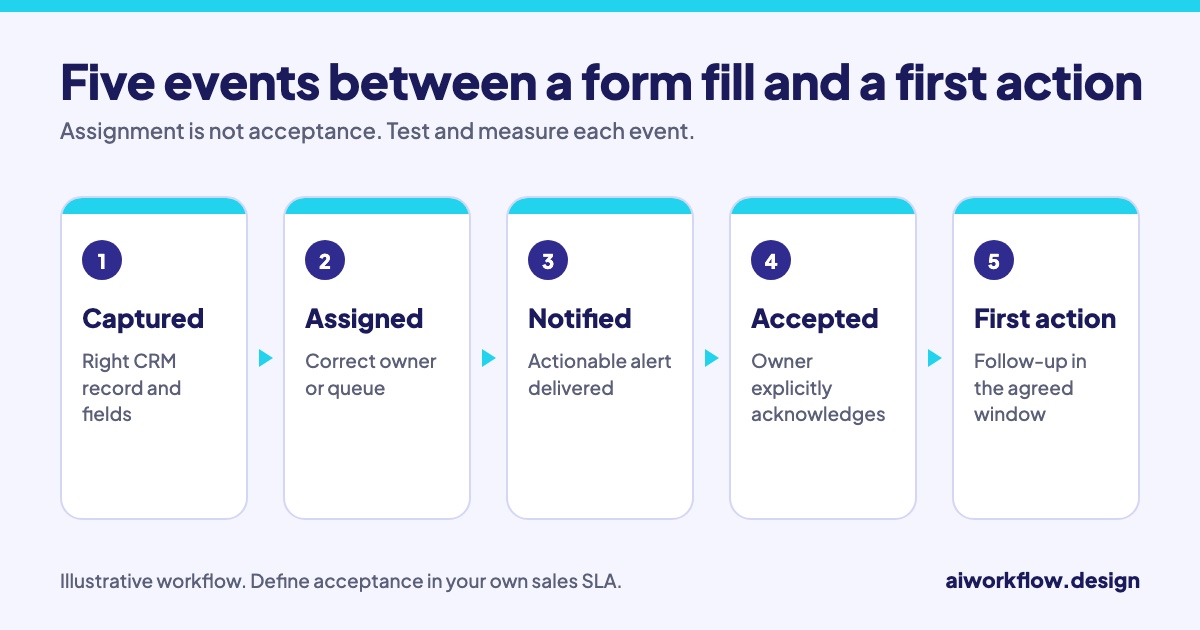
Good lead routing is therefore a series of events, not one integration toggle: submission, validation, creation, assignment, notification, acceptance, attempted contact and outcome. The distinction matters across companies with multiple offices, territories, sales queues, service lines or operating hours.
Platforms have native rules, but their configuration must be tested. For example, Salesforce documents lead assignment rules used to direct records to designated users or queues. That capability does not prove a specific client’s rules are correct. A successful CRM API call also does not prove the assigned person saw or accepted the lead.
Define “accepted” before creating reports
Agree a written service-level definition between the agency and sales team. An accepted lead might mean an authorised sales owner has explicitly acknowledged the record and agreed to follow it up within the agreed business window. This is different from the CRM’s technical owner field being populated automatically.
Use separate stages: Captured, Validated, Assigned, Acknowledged, Contact Attempted, Qualified / Disqualified, and Closed / Nurture. The actual CRM may use different labels; map them thoughtfully instead of adding duplicate status concepts. Decide who can change each stage and which timestamps need to be retained for audit and performance analysis.
Do not silently mark uncontacted leads as disqualified merely because the response SLA was missed. A late response is a process failure, not a judgment about prospect quality.
The routing QA checklist every agency needs
| Control | Test question | Expected proof |
|---|---|---|
| Form capture | Does the submission reach the intended destination? | CRM record ID and server-side event |
| Field mapping | Are contact, campaign, service and consent fields mapped correctly? | Validated field values |
| Duplicate handling | Is the lead merged or linked according to policy? | Duplicate-rule action / audit trail |
| Owner assignment | Is the correct queue or user selected? | Owner ID and assignment timestamp |
| Notification | Did the right recipient receive an actionable alert? | Delivery/log event where available |
| Acceptance | Did the owner explicitly take responsibility? | Acknowledgement time and actor |
| First action | Was a permitted follow-up attempted in the agreed window? | Activity log or disposition |
| Exception route | Who receives invalid, unrouted or unacknowledged leads? | Named escalation owner and record |
Test legitimate scenarios: working hours, after-hours submissions, missing optional fields, a lead from outside the target territory, a duplicate contact, an inactive salesperson, a temporarily unavailable queue and a submission rejected by validation. Use controlled test records without placing real prospects into unwanted calling sequences; label test records and remove them according to policy.
Follow-up cadence should reflect business hours and customer consent
A useful sales acceptance SLA is explicit about the triggering event, operating hours, ownership and exceptions. For example, if a business runs only weekday sales cover, a submission late at night should not be treated exactly like a daytime inquiry unless the company has staffed cover and permission to contact accordingly.
A “five-minute response” target can be a useful internal aspiration, but do not put a hard figure in a client-facing agreement without confirming staffing, calling regulations and actual workflows. The agency should measure median and tail response times against the agreed SLA, not against an invented universal benchmark.
Consent for marketing contact, text messages and calls varies by country and use case. The routing system should preserve relevant consent signals and suppression instructions; automated reminders to internal staff are not a justification for unsolicited prospect calls.
Who should receive the status call?
The right audience is often the internal owner, not the new prospect. If the assigned salesperson has not acknowledged the handoff, a short operational call can ask whether the lead record was received, whether the owner is available, and who should take it if not. The manager can then decide whether to reassign the lead under the approved policy.
For monday.com users, a marketing operations board might hold one summary task per unresolved routing exception rather than copy every personal CRM record into a second system. An agent could ask the responsible person for the exception status and mapped due date. AI Workflow Design’s AI agent products include scheduled check-in calls and integrations; specific CRM lead ownership controls, data field mappings and personal-data handling require configuration and confirmation.
Never read a full prospect profile, health detail or payment information aloud in a general status call. Use a reference ID, masked contact details where needed, and role-based access to the primary CRM.
Turn common lead-routing failures into named playbooks
No owner assigned: Marketing operations checks the assignment rule and captures the failed condition. Sales operations assigns an authorised owner. The agency verifies that the fix did not redirect unrelated inquiries.
Lead created but unacknowledged: The system records the missing acknowledgement, checks whether the recipient was notified and escalates after the agreed window. A manager resolves workload or availability rather than treating silence as acceptance.
Duplicate record: CRM operations checks whether deduplication merged the inquiry into an existing contact or removed its campaign attribution. The team preserves lawful source and consent information without inventing a second opportunity.
Wrong territory or service line: The owner provides the route issue and a proposed correct destination. Sales operations approves reassignment; reporting records both the initial routing and correction.
Form leads missing entirely: The technical team investigates form events, spam filters, API failures and CRM validation logs before claiming the marketing campaign produced no inquiries.
Measure what happens after capture
A useful weekly dashboard separates the number of submitted forms, valid leads, assigned leads, acknowledged leads, contact attempts and qualified outcomes. Show the count and percentage at each transition. Where the team cannot observe a stage reliably, describe it as unknown rather than estimating.
Keep conversion attribution separate from operational responsibility. Marketing can report the lead source; sales owns acceptance and disposition; CRM operations owns assignment and system health. This reduces arguments about “bad leads” when the underlying issue was a broken handoff.
The AI Workflow Design product overview distinguishes the monday.com-native Autoza option from the general check-in agent. The pricing page provides the current published commercial context, but a CRM-specific routing workflow still needs a scoped integration design.
Frequently asked questions
What is a CRM lead routing QA checklist?
It is a structured test of capture, validation, deduplication, assignment, notification, explicit sales acceptance, first follow-up and exception handling, supported by record-level evidence.
Is assigning a CRM owner the same as sales accepting a lead?
No. Assignment is a system or administrative event. Acceptance means the designated person or team explicitly acknowledges responsibility under an agreed process.
Can an AI caller follow up with salespeople about unaccepted leads?
A permitted internal status call can request acknowledgement or identify a blocker. The CRM and sales policy should control actual reassignment, customer contact and personal-data access.
How should an agency handle leads outside business hours?
Define who is on duty, when the SLA clock starts, whether there is after-hours cover, and what contact permission applies. Do not assume every prospect should receive an immediate automated call.
Which routing metrics belong in the client report?
At minimum track captured, validated, assigned, accepted, first-contact-attempted and qualified counts, with response times where available. Label missing tracking rather than making up conversion numbers.
Next step: audit one route from click to acknowledgement
Choose one live lead source and trace a consented test inquiry through every handoff. Document the first missing event and its owner. Explore AI Workflow Design’s products to assess whether scheduled internal calls could help resolve the exceptions your CRM dashboards already reveal.
Related reading
- Influencer Asset Rights: Document Usage Permission Before Campaigns Run
- Website Relaunch Content Freeze: Track Copy, Redirects and Sign-Off
- New Client Onboarding for Agencies: How to Chase Missing Assets and Access
- Daily Calls or Weekly Meetings? Choosing an Agency Follow-Up Cadence
- How to Structure Agency Tasks and Subitems for Reliable Follow-Up
- Explore workflows by industry
- Autoza AI for monday.com