

Answer in brief: A multi-market campaign approval workflow needs separate checkpoints for the master creative, translation quality, local legal and cultural review, production specifications, and final market-specific launch approval. Keep a named owner and evidence link for each checkpoint. A status call may establish that a reviewer has responded, but it must not be treated as approval to publish an asset or spend the client’s budget.
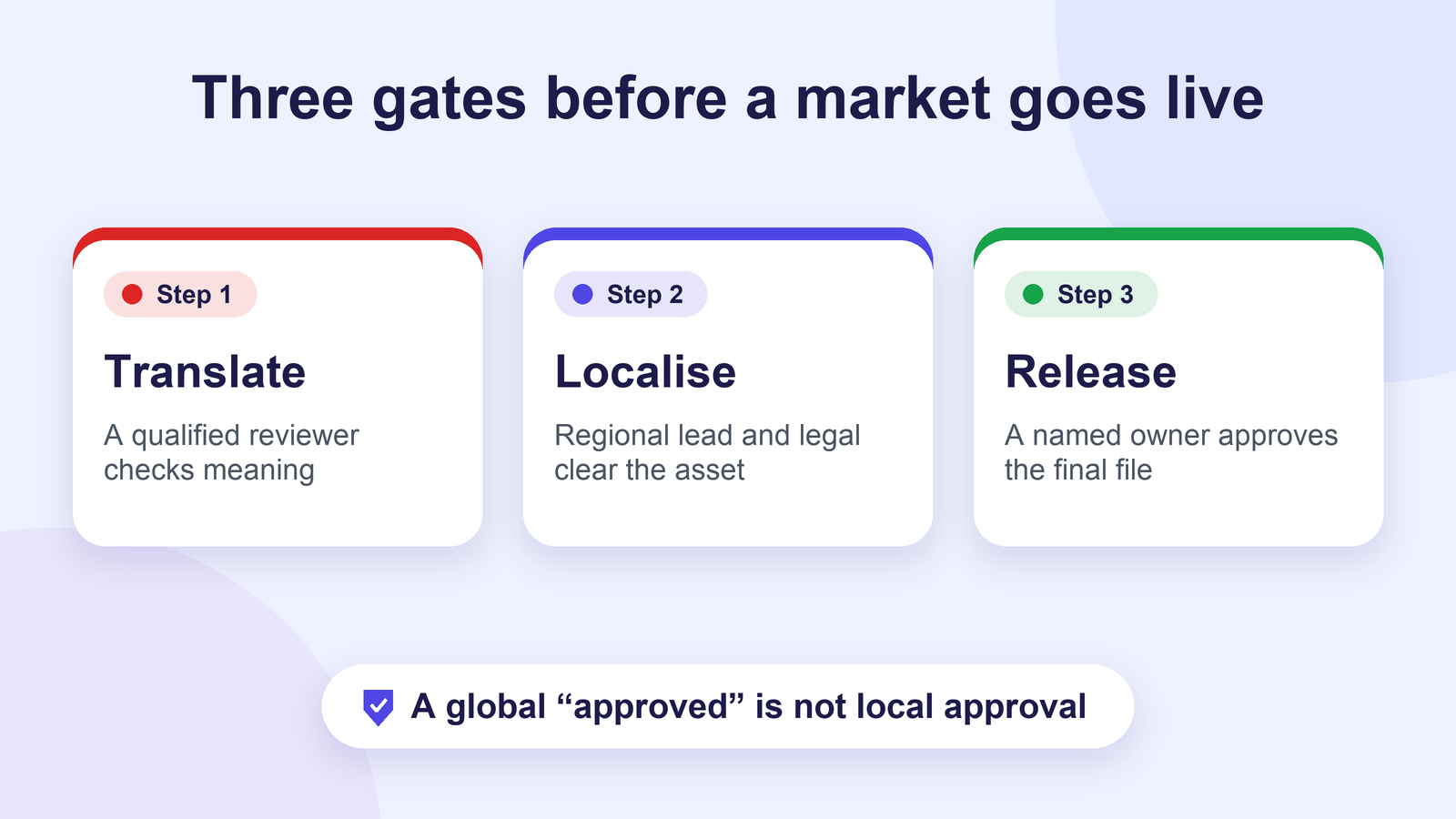
Why one global ‘approved’ status is not enough
An agency may create one campaign concept for several markets, yet each market needs different language, claims, dates, formats, disclaimers or commercial terms. If the central team says an asset is approved while the regional reviewer is still checking a regulated phrase, the global status hides a genuine launch risk. A single translated headline can become an expensive revision when it has already been applied to landing pages, social posts, emails and paid ads.
The solution is not an ever-growing email thread. It is a clear record of what was submitted, which version was reviewed, what changed and who can approve each market. Translation and local adaptation are distinct tasks: a sentence may be linguistically accurate while still sounding inappropriate to local audiences or conflicting with applicable advertising rules.
Separate five approval gates
| Gate | Key question | Owner and evidence |
|---|---|---|
| Master concept | Is the central brief and core message approved? | Global brand owner; approved creative version |
| Translation | Does the translation preserve meaning and required terminology? | Qualified language reviewer; tracked edits |
| Local adaptation | Are culture, offers, imagery, currency and dates appropriate? | Regional marketing lead; market review notes |
| Legal and policy review | Are claims, mandatory terms and platform requirements cleared? | Authorised local legal/compliance reviewer |
| Launch release | Does the final file match the approved version and market plan? | Named campaign owner; signed release evidence |
Not every campaign requires the same sequence, and the legal review requirements will vary. The key is to establish the gates before production. Make sure each approval refers to an identifiable version and market, not an ambiguous message such as ‘Looks fine’.
Design monday.com tasks around markets and asset versions
Use a master campaign item for the core concept, with separate market-specific items for the actual deliverables. Within each market, distinguish the headline, landing page, image or video and channel adaptation. Add fields for language, reviewer, version, review deadline, blocking issue, legal clearance, evidence link and release owner. If one translated landing-page claim is rejected, that task should remain open even if the master campaign is approved elsewhere.
A proposed sequence might be ‘Draft → Translation review → Local review → Compliance review → Final QA → Authorised to publish’. This sequence is an illustrative operating model, not a built-in Autoza or monday.com configuration. monday.com’s documentation on subitem automation can help teams evaluate what work structure is suitable; confirm the current platform behaviour before implementation.
Build a localisation checklist that a reviewer can answer
Before asking a reviewer for a decision, send a readable preview and specify what requires judgment. Check whether the headline is natural in the target language, addresses and telephone numbers are correct, prices and currencies are localised, offers and promotional dates are valid, and required disclaimers appear in the intended placement. Check whether the intended visual features culturally sensitive imagery, and whether the call to action leads to the correct local landing page.
When a reviewer asks for a change, log the exact version, market, asset component, decision and owner. The update ‘the German ad is done’ is too broad: does it mean translated, approved by legal, exported or actually published? Separate those milestones so an account director can identify what is truly ready.
Use follow-up calls for specific overdue decisions
An agency operations lead may need to contact a regional reviewer who has not opened the project system. A well-designed call asks, ‘Did you receive version 4 of the product landing page? Are you able to complete your local review by Thursday? Is there a specific claim or asset holding you up? Which person must decide?’ If the reviewer says that the legal team is examining an offer condition, record the blocker and next owner—not a final approval.
Apply a sensible calling schedule and respect local business hours, time zones, consent and applicable calling requirements. A brand team in Singapore should not receive an automated follow-up simply because the agency’s default timetable is set to London time. Escalate unresolved business-critical approvals through the actual campaign owner rather than increasing automated call frequency indefinitely.
Handle last-minute edits without losing the audit trail
Suppose the central team updates a discount figure after three regional versions have already completed language review. Reopening every asset blindly is wasteful, but leaving stale variants live is worse. Mark the revised claim, identify the affected markets and require targeted reapproval of the changed component. The final QA owner should compare the approved source version with each actual output file or destination URL.
The same applies to images and video: a changed product packshot, voiceover or local legal line may require a new render and another market-specific check. Keep the evidence of what was finally published, including the final asset link, version and release authority. Avoid storing confidential customer or agency credentials in call answers.
What should the campaign dashboard show?
Rather than a single green/red campaign status, show markets with all required approvals, markets awaiting a decision, affected launch dates, and the owner of each unresolved exception. The account director needs to know whether a launch is blocked by missing translated copy, local legal review, creative rework, tracking problems or budget approval. These risks need different people and different remedies.
For regional performance reporting, keep published creative versions aligned to your measurement naming scheme so that teams can explain which local treatment actually ran. Tracking data may help later optimisation, but it does not validate translation or legal claims by itself.
Where Autoza can support the follow-up layer
AI Workflow Design presents Autoza AI for monday.com as a solution for scheduled team check-ins and board updates. A proposed use case is to ask an authorised local reviewer whether a specific asset has been reviewed, capture a blocker and update a mapped task under approved rules. Do not assume the AI itself interprets legal clearance, approves translation quality or publishes campaigns.
For broader task design, see our article on structuring agency tasks and subitems. That foundation makes the local-review layer easier to organise without turning a campaign into hundreds of unowned messages.
Next step: If your agency uses monday.com for international work, explore an Autoza workflow review focused on overdue owner check-ins while keeping every market’s publication approval with the designated humans.
Frequently asked questions
Who signs off translated campaign copy?
The authorised role established by the brand and market—often a local marketing owner with qualified language and legal reviewers. A translator can confirm linguistic accuracy but should not automatically be treated as the commercial or regulatory approver.
What belongs in a local market checklist?
Language and terminology, claims and disclaimers, currency and price, dates, imagery, channel formats, destination URLs, accessibility and the identity of the final reviewer. Add jurisdiction- and platform-specific checks where needed.
When should unresolved changes escalate?
Escalate when they threaten an approved launch gate or require a decision the reviewer cannot make. State the affected market, exact version, decision requested, deadline and person with authority. Do not escalate merely because an automated call went unanswered once.
Can one approval cover all campaign markets?
Only when the organisation’s approval rules explicitly allow it and the assets truly share the necessary requirements. Localised claims, language and channel treatments typically need their own checks even when the core concept is approved globally.
Can an AI caller approve or publish translated content?
No. It may collect a review status and help chase an overdue response under the configured workflow. Only authorised people and systems should approve, release or publish an asset.
Related reading
- How to Structure Agency Tasks and Subitems for Reliable Follow-Up
- How to Follow Up on Creative Approvals in monday.com Without Endless Emails
- Campaign Launch Delays: 7 Status Questions to Ask Every Task Owner
- Content Production Handoffs: A Call Plan From Brief to Publish
- Paid Media Launch QA: Who Confirms Tracking, Creative and Budget Controls?
- Autoza AI for monday.com: scheduled status calls
- Workflow automation services
- Daily Check-in Agent