
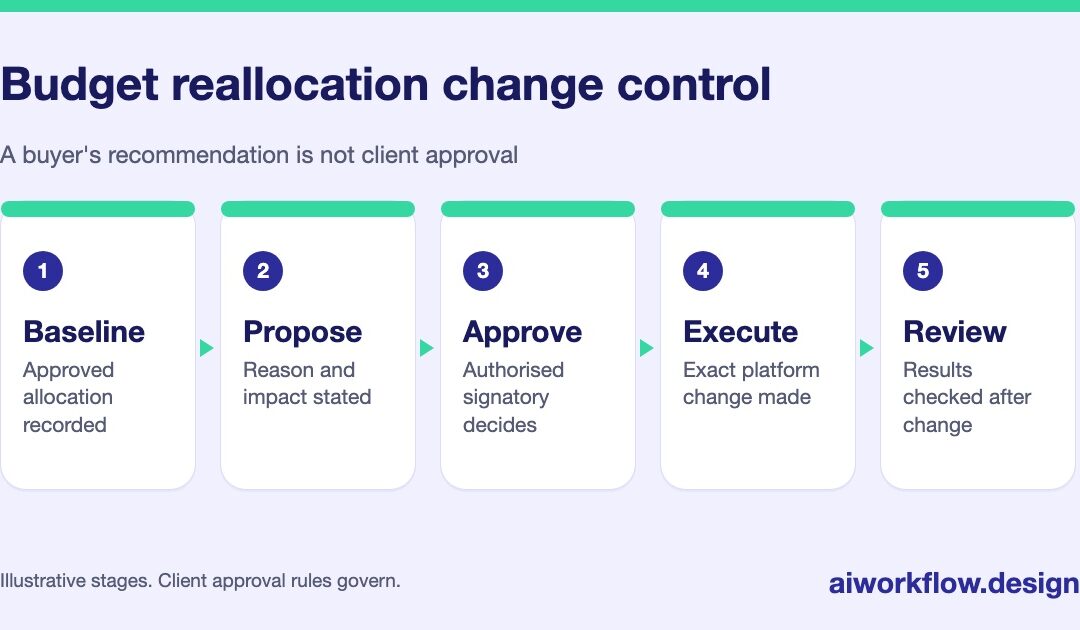
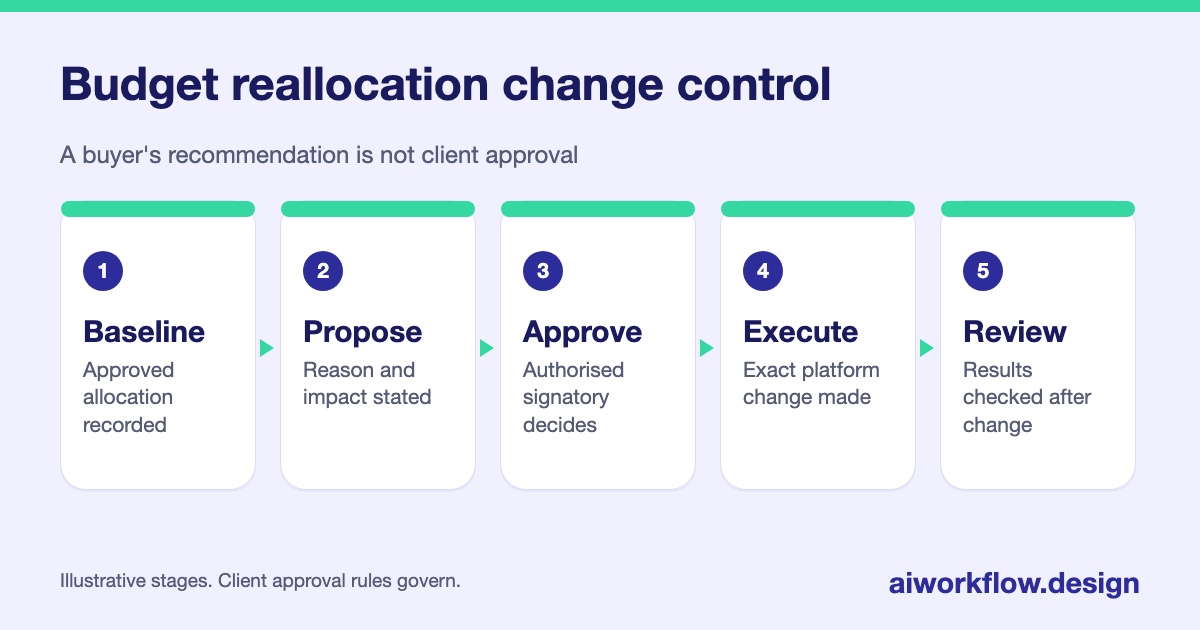
Quick answer: A campaign budget reallocation workflow records the current approved allocation, the proposed movement of spend, the reason for the change, its likely reporting and delivery implications, the person authorised to approve it, and the exact platform change made afterward. A media buyer’s recommendation or an AI-generated summary is not client approval. Keep proposal, decision, execution and verification as separate stages.
An agency notices that one campaign has weak lead quality while another is delivering qualified enquiries. A buyer wants to move budget immediately to protect the month’s results. The client contact is travelling, the account director has approved “optimisation” in general terms, and no one is certain whether the existing agreement allows reallocating spend between channels. The opportunity is real, but so is the risk: media costs, financial authority and accountability can move faster than the evidence trail.
The fix is not to demand a formal meeting for every bid adjustment. It is to define, before a problem occurs, which changes fall within the agency’s discretion, which require client authorisation, and what record proves the decision.
Define what the client actually approved
Begin with the agreement, insertion order, statement of work or current budget approval. Identify the approved spend period, currency, platform, account, business unit and any restrictions on campaign, geography or product category. Separate media spend from agency management fees, production costs and platform credits. A change that keeps the total media budget unchanged may still cross an approval boundary if it moves money into a different market, channel or regulated product campaign.
Do not equate the platform’s average daily budget with the client’s approved monthly cap. Google Ads supports average daily and shared budgets, while real spend can vary by day under its billing rules. The account owner should reconcile the commercial commitment to the actual pacing and platform settings, not compare one daily number with an invoice total and assume they match.
Record whether the proposed change is a tactical adjustment inside a documented authority threshold or a new approval request. Keep the threshold in the client’s agreement; don’t invent one for the blog or copy a different client’s rule.
Write a reallocation request that is understandable outside the media team
A good proposal states the problem in business terms, not just CTR or CPA jargon. Explain what has changed, which audience or campaign is underperforming, and why an alternative allocation could improve the client’s stated goal. Include enough evidence to evaluate the recommendation: relevant dates, data completeness, conversion definition, lead quality, attribution caveats, and any material seasonality or learning-phase effect.
List the affected campaigns with their existing and proposed budget settings, the effective date, expected duration, and whether the total planned spend will rise, fall or remain unchanged. Identify related changes to creative, landing pages, conversion tracking or bid strategy, because attribution can change independently of budget. Present confidence and uncertainty explicitly. A two-day conversion swing with incomplete offline lead data does not carry the same weight as a sustained quality trend.
For the related launch boundary, see paid media launch approval checks. A campaign that passed launch QA can still require fresh commercial authority before its spend mix is altered.
Keep the financial decision with the correct client signatory
Choose one accountable client approver, plus a named deputy if the agreement allows it. The buyer can recommend the change; the account lead can check the case and route the request; the client can accept, reject or request a revised proposal. If approvals require purchasing, finance or legal review, the record must show those gates separately.
An informal reply such as “looks good” may be sufficient only if the parties have already agreed that medium and signatory are valid. Otherwise ask for an unambiguous decision tied to the specific proposal version. Avoid a process where a general Slack thumbs-up is interpreted as permission for a larger monthly commitment or a cross-platform transfer.
Approval should identify the version, amounts or limits, period and authorised scope. A request that changes while the client is reviewing it needs a new version and, when material, a new decision. Keep rejections visible; deleting them hides why a different plan was adopted.
Execute only the approved change and verify it in-platform
Once authorised, have the media operator perform the modification within the agreed window. Log the platform, account, campaign IDs, original settings, new settings, change time, change author and client approval reference. If the budget is shared across campaigns, verify how the setting applies to the group rather than assuming a campaign-level edit affects only one item.
Use the native change history and finance reporting as evidence. A board item saying “updated” does not establish that the correct account was changed. Have a second reviewer check critical edits, especially when accounts have similar campaign names or currencies. Confirm that tracking, conversion actions and pacing reports still align after the change; otherwise the agency may celebrate an apparent efficiency gain caused by changed measurement.
Google Ads’ official budget guidance explains average daily and shared-budget concepts. Treat those mechanics as an execution reference, not a substitute for the client’s written authority.
Use monday.com to manage the decision trail
Create one item per change proposal. Suggested fields: client; platform and account ID; current approved budget reference; proposed allocation; financial impact; business rationale; evidence link; owner; approver; version; approval status; planned effective time; execution owner; platform change evidence; post-change review date; and exceptions. Keep sensitive financial information in permission-controlled systems and reference it rather than distributing unrestricted exports.
Design statuses such as draft → internal review → awaiting client decision → approved/rejected → execution queued → applied → independently verified → monitoring → closed. The awaiting decision stage must not automatically progress to approved because a reminder was sent or the contact failed to answer.
monday.com supports status and date-triggered notifications, useful for asking the account lead to chase a pending approval. AI Workflow Design’s workflow automation service may be relevant when an agency needs a purpose-built cross-system handoff. Any proposed integration with ad-platform writes should be scoped and tested; the website’s general product description is not proof of a prebuilt budget-editing integration.
Give AI status calls one narrow job
An AI check-in can ask the authorised account manager whether the request has been sent, whether the client has responded, and which evidence is outstanding. It can send a follow-up reminder through an approved channel or add a neutral status note to the board where configured. It should not negotiate a new spend amount, decide which campaign deserves funding, or click an approval control on behalf of the client.
A sensible script asks: “Is the budget change request for the named account still pending, approved in the agreed system or returned for revision?” It then records the stated answer with a source, not a conclusive authorisation. For sensitive clients, avoid speaking budget amounts in voicemail or collecting payment credentials in call transcripts.
See the AI Workflow Design products for scheduled administrative status checks that can complement, rather than replace, the client’s approval procedure.
Review the outcome without rewriting the original case
At the agreed checkpoint, compare pacing and business outcomes to the assumptions in the request. Note material creative changes, delayed conversion imports and seasonal factors. The review should show what happened, not force a success narrative. If reallocating spend failed to improve qualified lead volume, document that finding and the next decision separately.
Retain the proposal, approval, platform change evidence and follow-up analysis as one record. This is important when different specialists manage Google, Meta, CRM attribution and invoicing. It also helps distinguish overspend due to an unauthorised edit from a reporting or billing misunderstanding. For that adjacent problem, use the marketing reporting discrepancy workflow.
The result is a decision history that an account director, client finance lead and new media buyer can all understand. Routine check-ins become faster because nobody has to reconstruct what was agreed from fragments of emails and chat.
Next step
Want these follow-ups handled consistently? Explore Autoza AI for monday.com or talk to AI Workflow Design about scheduled, permissioned status follow-ups that leave approvals and decisions with the right people. For a companion workflow, read Agency Client Offboarding: Transfer Marketing Assets and Revoke Access Safely.
Frequently asked questions
Can an agency move budget between campaigns without asking the client?
Only within the authority granted by the client’s agreement and documented account controls. Cross-channel, market or total-spend changes may need separate approval even if the agency can technically edit the platform.
Is a Google Ads daily budget the same as the client’s monthly budget?
No. Platform budget mechanics and the client’s commercial spend commitment are different concepts. Reconcile both using the relevant Google Ads billing rules and the agreed reporting period.
What evidence should accompany a reallocation request?
The baseline approved allocation, proposed changes, reason, relevant performance and lead-quality evidence, measurement limitations, expected spend impact, implementation date and named approver.
Can a monday.com automation approve a budget change after a deadline?
A reminder can escalate an unanswered request. It should not interpret silence or elapsed time as approval unless a properly reviewed, legally valid agreement explicitly establishes that outcome and the organisation implements it safely.
How should the agency document the completed change?
Retain the approved proposal version, authorised decision, native platform change history, independent verification and a dated post-change outcome review.